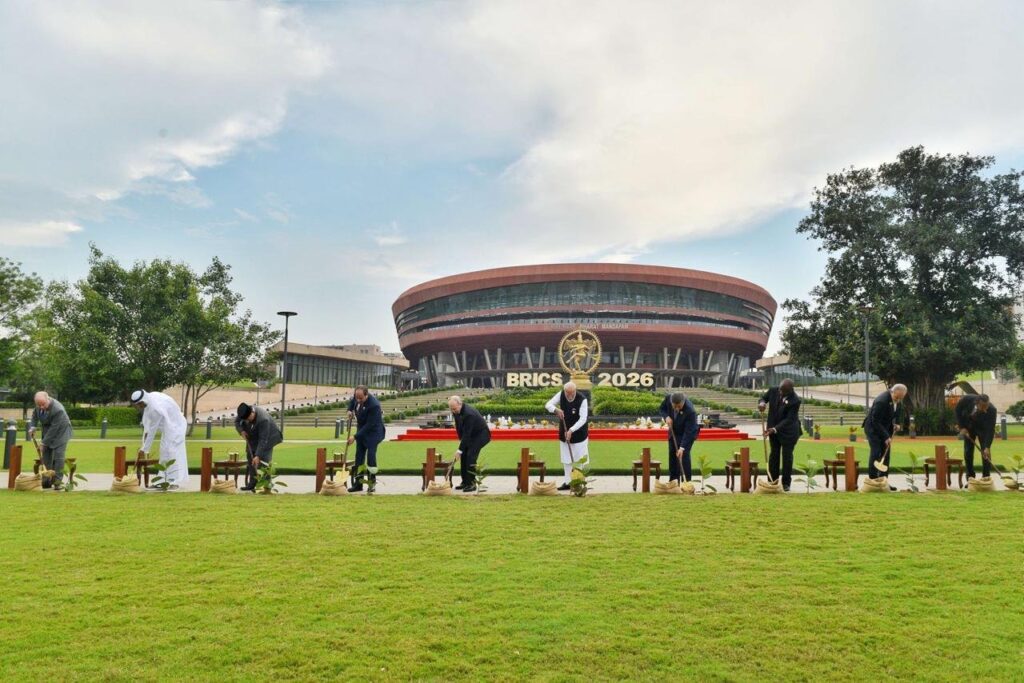
From Xi Jinping’s India visit to the US–China effort to “coexist in peace”, the past month offered no shortage of consequential developments in international politics. As these events unfolded, what were readers of world affairs turning to for perspective? Here are the five best-selling non-fiction books at Midland Books, New Delhi, in September 2026.
Iran’s Grand Strategy: A Political History
Vali Nasr | Princeton University Press, 2025
Iran’s strategic behaviour cannot be understood through ideology alone. In Iran’s Grand Strategy, Vali Nasr examines how war, pressure from the United States and other external powers, the nuclear question and regional competition have shaped Tehran’s pursuit of security and influence. Drawing on memoirs, oral histories and interviews with Iranian decision-makers, Nasr shows how external threats interact with domestic vulnerabilities to shape Iran’s statecraft. The book offers a more nuanced understanding of a country whose regional ambitions have long been central to the politics of the Middle East.
Chokepoints: How Economic Warfare Is Changing the World
Edward Fishman | Elliott & Thompson, 2025
Economic interdependence has increasingly become a source of strategic leverage. In Chokepoints, Edward Fishman examines how sanctions, tariffs and control over financial, technological and energy networks have transformed economic policy into an instrument of power. Drawing on his experience in US economic policy, Fishman traces the evolution of American economic statecraft towards Iran, Russia and China. The book explores how the networks connecting the global economy can become pressure points in an era of intensifying geopolitical competition.
Power and Progress: Our Thousand-Year Struggle Over Technology and Prosperity
Daron Acemoglu & Simon Johnson | Basic Books UK, 2023
Technological progress does not automatically translate into shared prosperity. In Power and Progress, Daron Acemoglu and Simon Johnson trace a thousand years of technological change to examine who benefits from innovation—and who does not. They argue that institutions and the distribution of political and economic power determine whether new technologies broaden prosperity or deepen inequality. The book has gained renewed relevance amid debates over artificial intelligence, automation and the future of work, particularly following the authors’ 2024 Nobel Prize in Economic Sciences.
India after Non-alignment: The Quest to Become a Pole in International Politics
Happymon Jacob | Penguin Viking, 2026
What comes after nonalignment? In India after Non-alignment, Happymon Jacob examines India’s foreign policy through its long-standing quest for strategic agency and greater international influence. Tracing India’s foreign-policy journey, Jacob argues that nonalignment and strategic autonomy are expressions of a deeper ambition: to shape, rather than simply respond to, the international order. The book offers a timely framework for understanding India’s aspirations to emerge as an independent pole in an increasingly multipolar world.
Data Empire: How Information Shaped Human History
Roopika Risam | Transworld Publishers Ltd, 2026
The politics of data did not begin with the digital age. In Data Empire, Roopika Risam traces an 11,000-year history of information and record-keeping, from early systems of recording to the modern algorithmic state. The book examines how information has been used to organise societies, administer populations and exercise power. By connecting historical practices with contemporary data brokers, surveillance and artificial intelligence, Risam places today’s digital transformation within a much longer history of governing through information.