India’s railway diplomacy has entered a new phase. For much of the past decade, New Delhi’s engagement with neighbours took the form of financing new infrastructure and extending rail links to countries that had never possessed them. That effort built a substantial portfolio of projects, but many carried little traffic because the rules governing their use were settled years after the tracks were finished. The change now underway is quieter than a new line. India is turning from building rail links to making the ones it has carry goods.
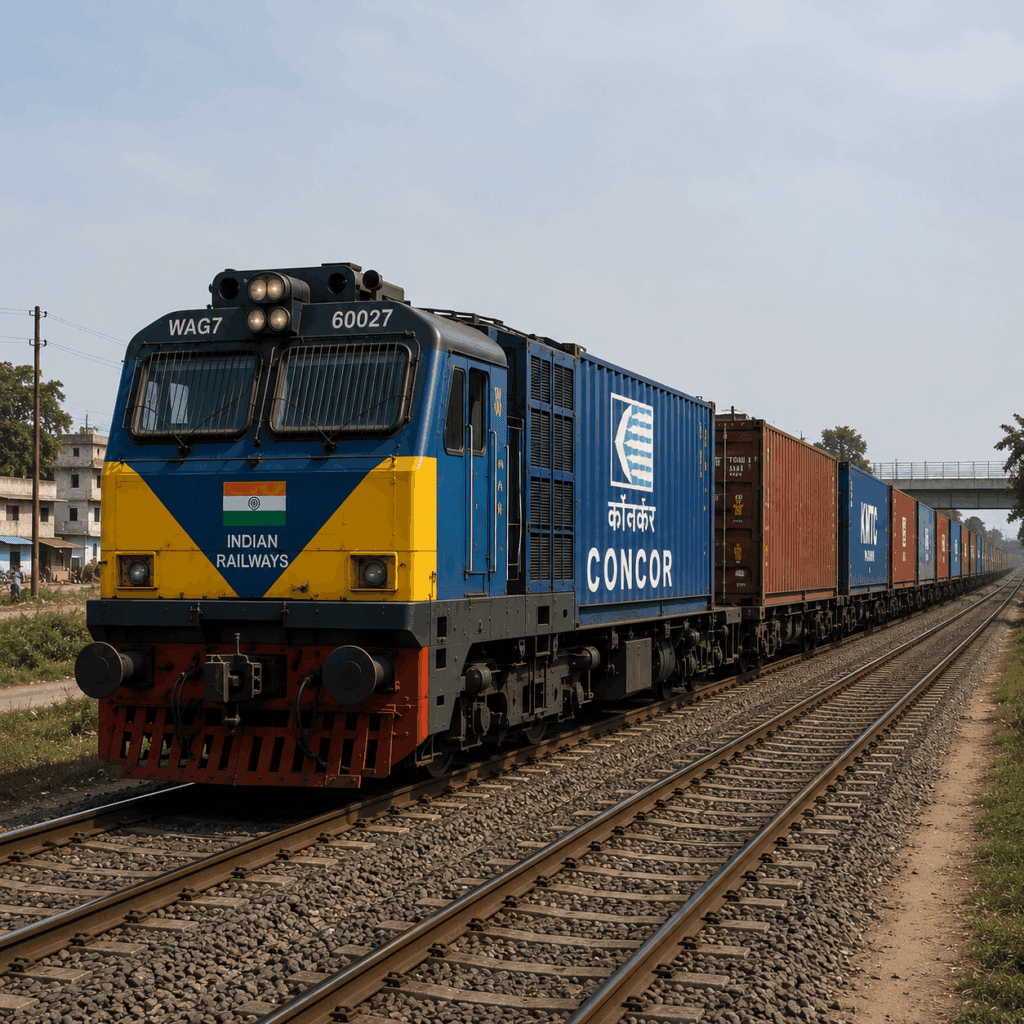
The clearest recent example is a single freight train. In mid-July 2026, the Container Corporation of India flagged off a container service carrying 40 wagons of canola from Kolkata Port, and it reached Nepal’s Biratnagar Customs Yard on 20 July. The Ministry of Railways described it as the first direct commercial container freight service between the two countries. At first glance the journey appeared routine. No new railway had been inaugurated, no bridge had been opened, and the cargo itself was unremarkable. What made it a first was the paperwork behind it.
Why the First Freight Train to Nepal Matters
For the first time, containerised freight travelled directly from an Indian port to an inland customs terminal in Nepal without being unloaded at the border. Earlier consignments had to be transferred to trucks at Jogbani before completing the final stretch. This shipment stayed on the same train throughout, with customs formalities completed inside Nepal.
No new engineering made this possible. The Jogbani-Biratnagar line had existed since June 2023, built with Indian grant assistance, and had carried almost no commercial freight for nearly two years. What was missing was not track but permission. Existing provisions under the India-Nepal Treaty of Transit allowed rail-borne container traffic to clear customs only at Birgunj, which kept Biratnagar from working as a commercial rail gateway.
That changed in November 2025, when India and Nepal amended the transit protocol through an exchange of letters. The revised arrangement expanded the list of authorised rail clearance points, widened the categories of freight that could move by rail, and extended transit rights across additional corridors linking Kolkata and Visakhapatnam with Nepal. Nothing changed physically on the ground. The railway simply became commercially viable once the regulatory bottleneck was removed.
The Three Pillars of India’s Railway Strategy
The Kolkata to Biratnagar service illustrates the emerging architecture of Indian railway diplomacy. Three elements now define it.
1. Finance. India typically funds cross-border railway infrastructure through grants, transfers the completed asset to the partner government, and negotiates the operational framework separately. This differs markedly from China’s model, which has relied far more heavily on loans. In countries such as Nepal, Sri Lanka and Bangladesh, where concerns over debt sustainability increasingly shape public debate, that distinction has become an important element of India’s regional diplomacy.
2. Operation. Infrastructure creates possibilities; the agreements governing its use determine whether those possibilities become economic or strategic gains. That is why administrative decisions often matter more than headline projects. The railway to Biratnagar had existed since 2023; an inconspicuous amendment to the transit protocol turned it into a working trade corridor. The contrast with larger schemes is instructive. Railway Minister Ashwini Vaishnaw told the Rajya Sabha in March 2026 that the Final Location Survey for the 136-kilometre Raxaul-Kathmandu railway had been completed and a Detailed Project Report prepared, yet no construction schedule or financing framework has followed. While the larger project remains in preparation, a minor procedural change has already produced commercial results.
3. Frontier logistics. Railway projects along and across the borders are no longer isolated bilateral schemes but parts of a wider strategic investment programme. Funding for cross-border links increasingly overlaps with efforts to strengthen railway infrastructure in eastern and northeastern India. Investments in Nepal, Bhutan, Sikkim and the Northeast reinforce one another, reflecting a view of frontier connectivity as a single integrated system rather than a collection of individual projects.
Three Neighbours, Three Trajectories
Nepal is the clearest case study of this shift. As a landlocked country, almost all of Nepal’s overseas trade moves through Indian ports before travelling overland, and India is its largest trading partner, accounting for the overwhelming share of its imports and exports. The Biratnagar service reduces pressure on Birgunj, Nepal’s only functioning rail freight gateway until now, and provides an alternative rail entry point into the country. That diversification carries strategic value in its own right, particularly given the disruptions experienced during the 2015 border blockade, when interruptions to cross-border movement quickly translated into shortages of fuel, medicines and essential commodities.
Bhutan represents the next stage. Unlike Nepal or Bangladesh, it has never possessed a railway network. That is now set to change. In September 2025, India approved two cross-border railway projects worth more than Rs 4,000 crore, the 69-kilometre Kokrajhar-Gelephu line and the shorter Banarhat-Samtse connection. A joint steering committee first met two months later, the rail link featured among the Kokrajhar works Prime Minister Narendra Modi launched in March 2026, and construction is expected to begin in early 2027. The strategic logic extends beyond transport. Gelephu is at the centre of Bhutan’s planned Special Administrative Region, the country’s most ambitious economic project, which requires efficient freight access to Indian ports and markets. India is aligning infrastructure investment with Bhutan’s long-term development priorities rather than treating transport as an isolated sector.
Bangladesh presents a strikingly different picture. Until recently it was India’s most advanced example of cross-border railway integration, with multiple links restored, passenger services resumed after decades, and further projects promising to reconnect India’s Northeast with the rest of the country through much shorter routes. That momentum stalled after the political upheaval of 2024. Cross-border passenger services were suspended in July that year. In April 2025, New Delhi suspended approximately Rs 5,000 crore of railway assistance, citing concerns over the safety of Indian personnel. Affected projects included the Akhaura-Agartala link, the Khulna-Mongla Port railway and the Dhaka-Tongi-Joydebpur expansion. The Akhaura-Agartala line, intended to cut the Agartala to Kolkata journey via Dhaka from around 31 hours to about 10, was inaugurated in November 2023 but has yet to enter commercial service. Deliveries of Indian-built coaches to Bangladesh, paused during the transition, are resuming in mid-2026 under a European Investment Bank facility now implemented by the Bangladesh Nationalist Party government, and talks on restoring the Kolkata-Dhaka passenger service are expected later in 2026. The cross-border links themselves remain inactive, and the practical consequence has been a reordering of India’s regional connectivity priorities.
The China Factor: Competing Models of Connectivity
China inevitably forms part of the story, though not always as commonly portrayed. Beijing has transformed railway infrastructure across the Tibetan plateau. The Lhasa-Xigaze railway, followed by the Lhasa-Nyingchi line that opened in 2021, has pushed China’s rail network closer to the Himalayan frontier. Although these lines remain entirely within Chinese territory, they have altered the strategic geography of the border by cutting the time needed to move personnel and supplies towards Tibet’s southern edge. As Chitresh Shrivastva, Stabak Roy and Dhruv Ashok argue in India Quarterly, railway infrastructure has become an instrument of geopolitical competition, shaping both military logistics and the psychological balance along contested frontiers.
Yet China’s cross-border railway ambitions have proved harder to realise. The most prominent proposal is the Kerung-Kathmandu railway. Chinese survey teams completed fieldwork during 2026, but financing remains unresolved, and successive governments in Kathmandu have held that the project should be financed through grants rather than loans. Engineering is a further obstacle, since much of the proposed route would run in tunnel or on viaduct. Further east, Beijing has proposed an economic corridor linking Yunnan with Bangladesh through Myanmar. Any overland route across Myanmar must pass through territory where authority is fragmented and large areas lie outside government control. Political instability, rather than engineering, is the principal constraint. Chinese ambition is often greatest where implementation is least certain.
What This Means for India’s Regional Strategy
India’s recent railway investments are about more than transport. Frontier railways are increasingly conceived as dual-use infrastructure, supporting civilian commerce in peacetime while providing strategic mobility in crises. Bloomberg reported in August 2026 that as much as Rs 45,000 crore could be directed towards railway projects across border states over the next two years, including Punjab, Rajasthan, Himachal Pradesh, West Bengal, Assam and the Northeast. Although the government has not formally confirmed those figures, the direction of policy is unmistakable.
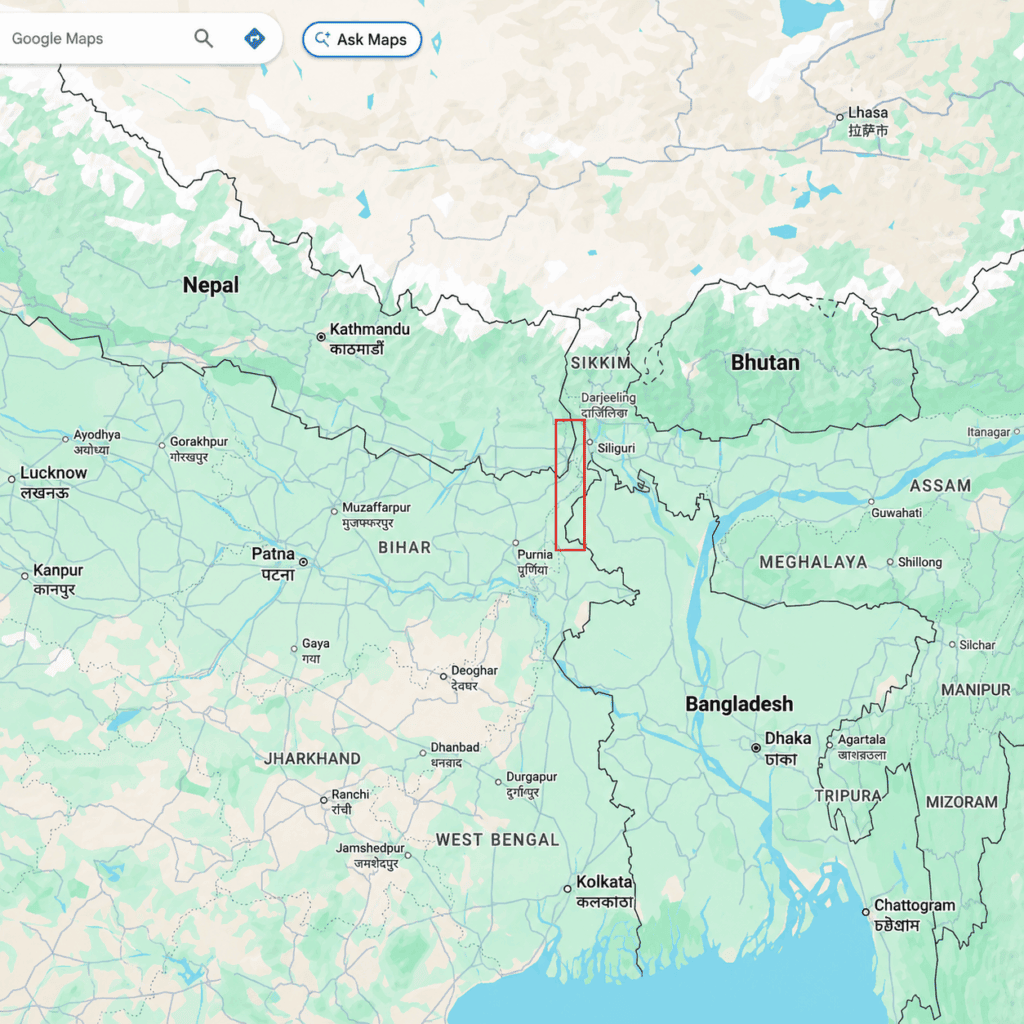
The eastern Himalayan region shows this most clearly. The Sivok-Rangpo railway, scheduled for completion in 2027, will give Sikkim its first railway connection to the national network, and planning has advanced beyond Rangpo, with surveys extending towards Gangtok and Nathu La. Indian Railways recently sanctioned a new line from Khunia More to Jaldhaka in northern West Bengal, close to the India-China-Bhutan tri-junction where Indian and Chinese troops confronted each other at Doklam for 73 days in 2017. Individually these projects appear modest; collectively they represent a sustained effort to strengthen connectivity across some of India’s most exposed terrain.
There is, however, an important limitation. Building railways within India is a domestic decision; extending them across international borders is not. Cross-border services require agreement between governments, coordination between customs authorities and, often, political negotiations. Engineering determines how quickly a railway can be built. Diplomacy determines whether trains are allowed to run. India’s regional railway programme therefore operates at two distinct speeds.
The Real Test Ahead
The Biratnagar freight train is unlikely to remain isolated. It offers a glimpse of where India’s regional railway strategy is heading. The next phase will be shaped less by construction than by revised transit agreements, customs procedures, operating protocols and regulatory coordination. These lack the visibility of new lines but are far more likely to determine whether existing infrastructure delivers results. That approach was visible in the June 2026 India-Nepal bilateral railway meetings, which focused on operating procedures for the Janakpur-Ayodhya passenger service and the implementation of projects already under way rather than the announcement of new ones.
Four indicators will show whether the shift is durable. The first is Biratnagar itself, whether container traffic becomes regular rather than exceptional. The second is Bhutan, where construction from 2027 will test India’s ability to deliver as well as to finance. The third is Bangladesh, where no alternative route can substitute for rail connectivity across its territory, and where progress will turn on bilateral politics rather than engineering. The fourth lies north of the Himalayas, in the financing terms offered on the Kerung-Kathmandu line. The balance between grants and loans there will show how smaller South Asian states intend to navigate competing offers from Asia’s two largest powers.
Sanctioned kilometres tell only part of the story. Whether trains run on them is the more revealing measure, and by that standard a modest freight train to Biratnagar may prove more consequential than several larger projects awaiting service.
Note: This explainer has been researched, edited, and fact-checked by India’s World staff and prepared with AI assistance.