India’s eighth Trade Policy Review presents a broadly positive assessment of its economic performance between 2021 and 2025, while arguing that the ambition of becoming a developed economy by 2047 will require deeper structural reforms and a careful balance between industrial policy and global integration.
What the Review Is, and Why It Matters
Every few years, the World Trade Organization (WTO) reviews the trade policies of each of its members through its Trade Policy Review (TPR) mechanism. Unlike the WTO’s dispute settlement process, a TPR is neither a legal judgement nor an assessment of compliance with trade rules. It is an independent evaluation prepared by the WTO Secretariat to improve transparency and encourage informed discussion among members. The country under review simultaneously submits its own policy statement outlining its trade priorities.
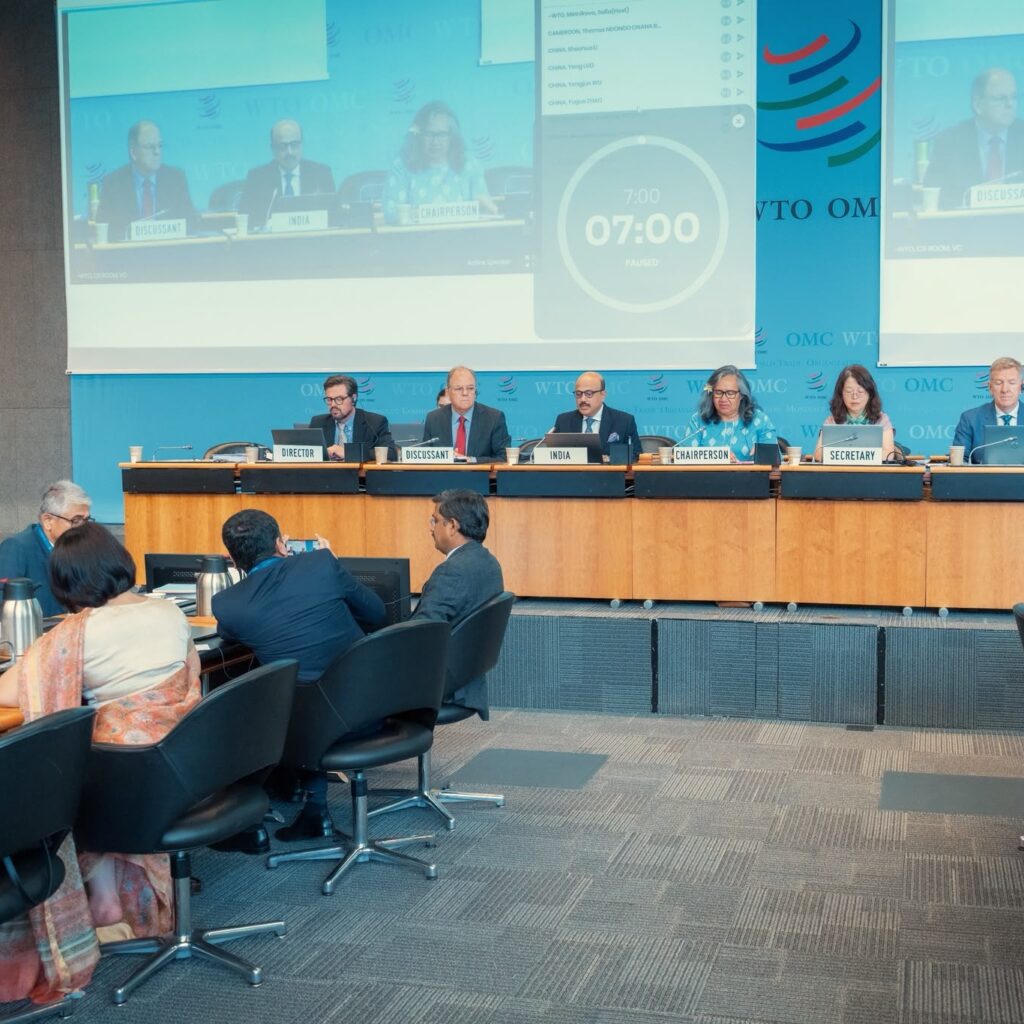
India’s eighth TPR, with the review meeting held in Geneva on 21 and 23 July 2026, examines developments between 2021 and 2025, a period defined by post-pandemic recovery, geopolitical uncertainty, supply-chain disruptions, and an increasingly fragmented global trading environment. It is also the first review undertaken during the Amrit Kaal, the 25-year period through which the government aims to transform India into a developed economy, or Viksit Bharat, by 2047.
A Strong Economy with Unfinished Reforms
The WTO’s overall assessment is broadly favourable. Between FY2022–23 and FY2025–26, India’s economy grew at an average annual rate of 7.3%, making it the fastest-growing G20 economy throughout the review period. The International Monetary Fund (IMF) projected in early 2026 that India would grow by 6.3% that year and contribute roughly 17% of global real GDP growth. Per capita GDP, however, remained at US$2,671 in FY2024–25, placing India in the lower-middle-income bracket. The WTO estimates that attaining high-income status by 2047 would require sustaining growth at approximately 8% annually over the next two decades.
Domestic demand drove the recovery. Public investment in physical infrastructure rose by 2.6 times from its FY2020–21 level, projected to reach 3.2% of GDP by FY2025–26. Extreme poverty declined by 22 percentage points over a decade, falling to 5.3% of the population by FY2022–23. India’s trade-to-GDP ratio peaked at 50% in FY2022–23 before dropping to 45% in FY2024–25, still above the pre-pandemic trend. The services sector remained the principal engine of growth, generating a trade surplus of 4.8% of GDP that partly offset a merchandise trade deficit of 7.3%. Manufacturing’s share of GDP held broadly stable at 17–18%, though the report notes a gradual shift towards more technology-intensive production and exports.
Digital Transformation as a Competitive Advantage
Among the report’s strongest endorsements is India’s digital public infrastructure. The rapid expansion of the JAM Trinity (Jan Dhan bank accounts, Aadhaar biometric identification, and mobile connectivity), the Unified Payments Interface (UPI), and the broader India Stack are described as defining features of the review period. Monthly UPI transactions rose from around four billion in 2021 to more than 18 billion by early 2025, while cross-border payment linkages expanded to eight countries. Wireless telephone subscribers exceeded 1.26 billion by December 2025, and India achieved near-universal 5G coverage across 99.9% of districts.
India’s leadership in digitally delivered services receives considerable attention. The WTO estimates that exports of digitally delivered services grew by an average of 17.3% annually between 2021 and 2025, producing a trade surplus exceeding US$200 billion in 2025. The IndiaAI Mission and the Open Network for Digital Commerce (ONDC) reflect the government’s ambition to position digital infrastructure as a source of long-term economic competitiveness. The digital economy is estimated to be growing at twice the pace of the overall economy.
Trade Reforms and a More Active External Strategy
The report credits India with reducing the cost of doing business across borders. Customs procedures have become almost entirely electronic, handling nearly 99% of trade through the Indian Customs Electronic Data Interchange System. Average import release times fell by approximately six hours at seaports, five hours at air cargo complexes, and 18 hours at integrated check posts between 2023 and 2025. India rose six places to rank 38th on the World Bank’s Logistics Performance Index in 2023. A new open-ended Foreign Trade Policy, launched in 2023, anchored trade facilitation as a central priority.
India also adopted a more outward-looking trade strategy during the review period. Free trade agreements (FTAs) entered into force with Australia, the United Arab Emirates, Mauritius, and the European Free Trade Association (EFTA). India signed further agreements with the United Kingdom and Oman, completed negotiations with New Zealand, and was close to concluding talks with the European Union, while negotiations with the United States and other partners remained ongoing. Foreign direct investment (FDI) rules were liberalised across several sectors, with insurance FDI limits raised from 49% to 74% in 2021 and then to 100% under the automatic route in 2025. According to the Press Information Bureau (PIB), India’s exports reached a record US$863.1 billion in 2025–26. Sixty-five WTO members participated in the review, and several commended India’s constructive engagement in the multilateral trading system. India also deposited its instrument of acceptance of the WTO Agreement on Fisheries Subsidies on the eve of the review, having completed the domestic ratification process after the review period ended.
Agriculture and Food Security
Agriculture contributes around 15% of gross value added (GVA) and employs roughly 46% of India’s workforce, with most agricultural employment remaining informal. The WTO report notes that India’s agricultural GVA expanded at an average annual rate of 4.4% since 2021, and that India remains a net agricultural exporter, led by rice (28% of total agricultural exports in FY2024–25). Food security, price stability, and raising productivity for small and marginal farmers remain central objectives of agricultural policy. The government maintains minimum support prices for 22 mandated crops and, since 2023, has provided free access to essential foodgrains for over 800 million people under the National Food Security Act, a measure the Secretariat describes as unparalleled in scale among India’s contemporary policy interventions. This provision accounted for almost the entire food subsidy allocation in the FY2025–26 budget.
The WTO observes that India regulates both imports and exports of agricultural products through tariffs, tariff-rate quotas, import licensing, minimum import prices, and state trading. Export controls on wheat, sugar, and selected other commodities remained in place at the end of the review period. The report frames these measures as reflecting legitimate food security objectives, while noting that they can affect predictability for trading partners.
Where India Still Falls Short
The report identifies a number of structural constraints. India’s average applied most-favoured-nation (MFN) tariff remains relatively high at 15.8%, with agricultural tariffs substantially higher at 38.6% compared to 12.4% for non-agricultural goods. Additional levies, including the Agriculture Infrastructure and Development Cess (AIDC), Social Welfare Surcharge, and Health Cess, raise the effective level of protection further. The WTO does not argue that tariffs are inherently undesirable. It suggests, instead, that high border protection can increase production costs for firms relying on imported intermediate goods, making it more difficult for Indian manufacturers to compete within globally integrated supply chains.
Beyond tariffs, the report highlights India’s continued use of import licensing, minimum import and export prices, export restrictions, and state trading enterprises. Some information technology hardware imports, including laptops and tablets, became subject to automatic import licensing in 2023. India also remains a significant user of trade remedies: between January 2021 and June 2025, it notified 226 anti-dumping investigations and maintained 170 anti-dumping measures in force. Frequent policy changes, the WTO argues, can create uncertainty for exporters, importers, and investors.
Perhaps the most consequential structural concern is India’s relatively modest participation in global value chains (GVCs). Despite improvements since the pandemic, India’s GVC integration remains below the ASEAN average. The government’s ambition of increasing India’s share of global merchandise exports from approximately 1.8% in 2024 to around 10% by 2047 will require more than domestic production incentives. Lower trade costs, predictable regulations, and easier sourcing of components across borders will all matter.
Self-Reliance versus Openness
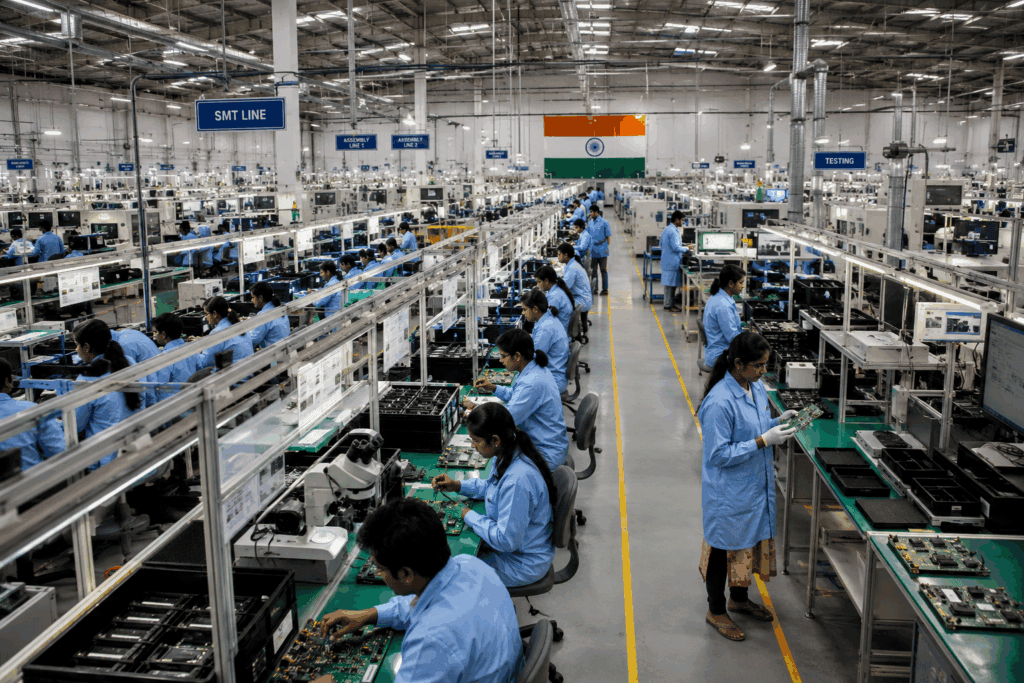
Running through the report is a question that extends beyond tariff schedules. India is simultaneously pursuing greater economic self-reliance and deeper integration with the global economy. Initiatives such as Aatmanirbhar Bharat, the Production Linked Incentive (PLI) schemes, Make in India, and the National Manufacturing Mission, launched in 2025, aim to strengthen domestic production capabilities and reduce dependence on imports in strategic sectors. India has emerged as the world’s second-largest mobile-phone producer and fourth-largest automobile manufacturer. Electronics production expanded six-fold and exports eight-fold since FY2014–15.
At the same time, the expansion of FTAs, FDI liberalisation, and export promotion reflect a parallel push for greater global engagement. The WTO does not treat these objectives as inherently contradictory. It suggests, rather, that India’s long-term success depends on whether industrial policy strengthens or constrains integration into international markets. Self-reliance and export competitiveness, the report implies, must reinforce each other rather than pull policy in opposite directions.
India’s Response
During the TPR meetings in Geneva, Commerce Secretary Rajesh Agarwal reiterated India’s commitment to a transparent, inclusive, and development-oriented multilateral trading system. He argued that reforms undertaken during the review period demonstrated their effectiveness despite a challenging international environment marked by geopolitical tensions, supply-chain disruptions, and rising protectionism. India maintains that initiatives under Aatmanirbhar Bharat are intended to strengthen domestic capabilities while enabling deeper integration into GVCs, not to promote economic isolation. It also emphasises that, as a large developing economy, preserving adequate policy space remains essential for industrialisation, employment generation, food security, and technological upgrading.
The discussant, Guilherme de Aguiar Patriota of Brazil, commended India’s structural reforms, particularly the Goods and Services Tax (GST) for unifying the national market, digital trade reforms, and India’s Duty-Free Tariff Preference Scheme for least-developed countries. The difference between the WTO Secretariat and the Indian government is, in many respects, one of emphasis rather than fundamental disagreement. Both recognise the importance of stronger manufacturing, export growth, and improved competitiveness. Where the Secretariat places greater weight on reducing trade costs and lowering barriers, India argues these objectives must be pursued without compromising the policy flexibility required to support its development priorities.
Why This Review Matters
Trade Policy Reviews do not compel governments to change their policies. Their significance lies in providing an internationally recognised, evidence-based assessment that serves as a reference point for governments, investors, and trading partners. For India, this review arrives at a moment when questions surrounding productivity, export competitiveness, industrial policy, and global economic integration have become central to the country’s development strategy.
The WTO’s assessment does not recommend a fundamental departure from India’s current economic strategy. It suggests, instead, that the next phase of development will require a shift in emphasis: from rapid growth driven primarily by domestic demand to growth reinforced by higher productivity, greater participation in GVCs, and continued regulatory reforms. Achieving Viksit Bharat by 2047, the report implies, will depend not simply on sustaining high growth rates, but on ensuring that self-reliance strengthens, rather than constrains, India’s competitiveness in international markets.
Note: This explainer has been researched, edited, and fact-checked by India’s World staff and prepared with AI assistance.