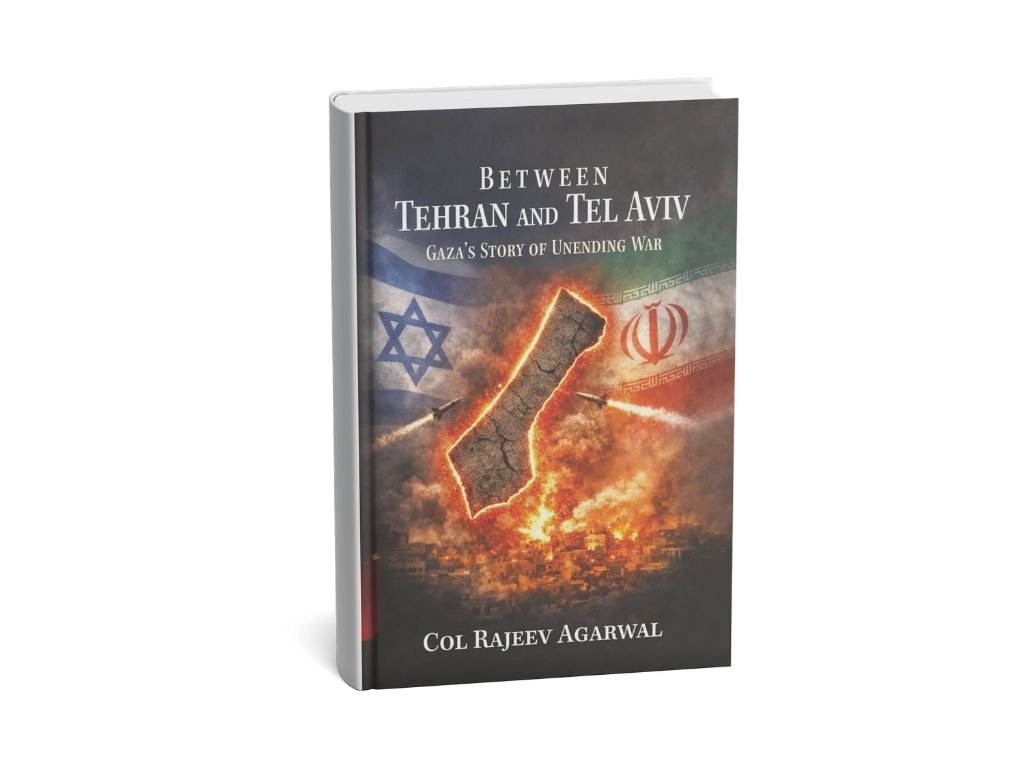
Col. Rajeev Agarwal, in Between Tehran and Tel Aviv: Gaza’s Story of Unending War, transforms a geopolitical conflict into a gripping political series that is layered, alarming, and unresolved. It shows that the story of Gaza is part of a much bigger and ongoing narrative involving many different actors across multiple settings.
The “cast” of this series involves Israel, one of the central characters, driven by military dominance and the need to protect itself from its neighbours. Hamas emerges as the immediate trigger for the unfolding events following October 7. Groups like Hezbollah and Houthis appear as pawns in Iran’s larger objectives, depicting Iran as the main strategist operating in the background. The United States gets more involved to steer outcomes in its favour.
The setting of the “series” is as dynamic as its characters. What began in Gaza quickly transcends geographical confines, and Col. Agarwal effectively shows that the conflicts in West Asia are not a single-stage conflict but a multi-theatre production.
Structurally, the book is written like a series of episodes. Resembling a dramatic pilot episode, Col. Agarwal illustrates the backdrop of each character and their actions, which led to the October 7 attack. The later chapters intensify as other groups get involved, and the conflict transitions from a localised war into a regional power struggle. Since the narration is written in the present tense, it reflects real-time developments, which adds urgency to the narrative.
The most compelling element of the book: the “plot twist” is the realisation that the Gaza war is not the main character, but it is an extension of the Iran-Israel confrontation. The military background of Col. Agarwal and his strategic insights often help the reader understand how and why the conflict was no longer localised. His comparison of —Abhimanyu’s Chakravyuh— offers an effective view of Israel’s strategic challenges. He also addressed the asymmetry of the war and the violations of sovereignty, often seen as a result of the absence of a strong international law.
However, the book is not without limitations. Although its real-time pace and style of writing engage the reader, it does not explore the conflicts through a theoretical perspective. Additionally, some repetition of the events may seem unnecessary.
Nevertheless, the book successfully grabs the main plot— the development of the anarchic conflict in West Asia. By presenting an ongoing series with no definitive finale, Col. Agarwal underscores the absence of a clear end, which shows that the conflict is far from over.
Ultimately, Between Tehran and Tel Aviv: Gaza’s Story of Unending War— is an excellent read for those who would like to understand the conflict in West Asia beyond the headlines.