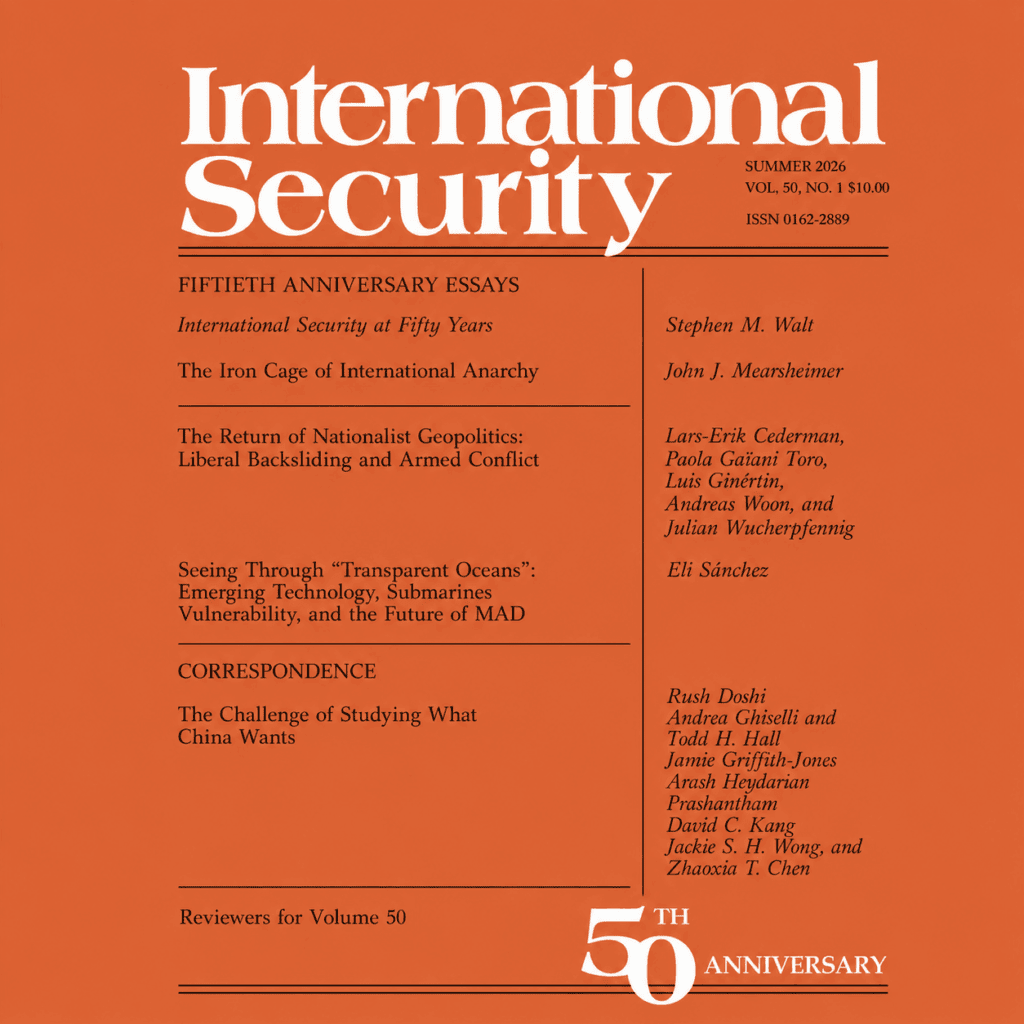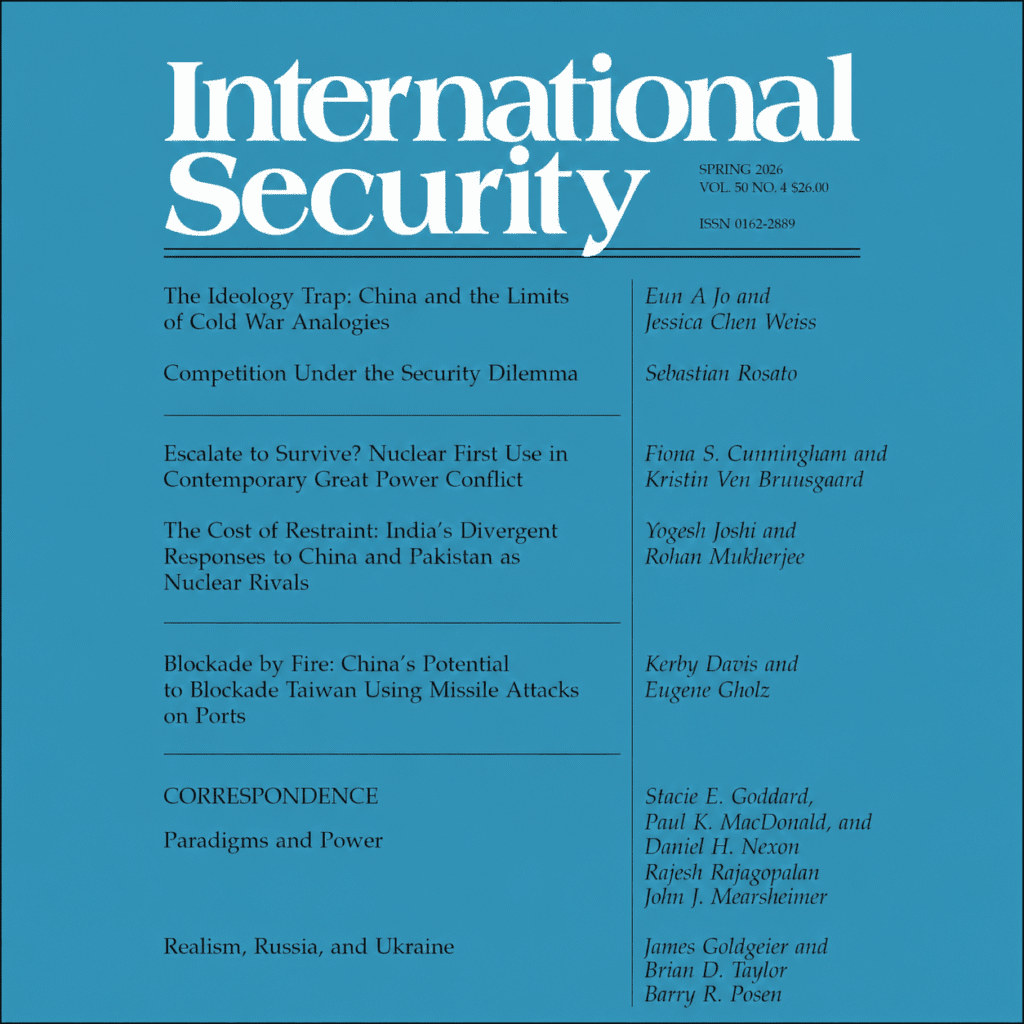
In their latest article “The Cost of Restraint: India’s Divergent Responses to China and Pakistan as Nuclear Rivals”, published in International Security (Vol. 50, No. 4, Spring 2026), Yogesh Joshi and Rohan Mukherjee seek to answer a puzzle at the heart of India’s nuclear history: why did India respond with relative restraint after China’s first nuclear test in 1964, yet move towards weaponisation in response to Pakistan’s nuclear programme in the 1980s?
The article makes both a theoretical and historical intervention. Existing explanations of nuclear proliferation, the authors argue, focus primarily on the costs of pursuing nuclear weapons, including technological constraints, financial burdens, and international pressure. While these factors matter, they do not explain why some states facing severe security threats decide not to pursue nuclear weapons in the first place. To address this gap, Joshi and Mukherjee introduce the concept of the “cost of restraint”: the price a state expects to pay if it chooses not to acquire nuclear weapons in response to a rival’s proliferation. Whether a state proliferates, they argue, depends not only on the costs of acquiring the bomb but also on how costly restraint appears to decision-makers.
The article is situated within a broader debate on the so-called nuclear domino theory. Since the beginning of the nuclear age, policymakers and scholars have repeatedly predicted that every new nuclear power would trigger a cascade of proliferation among its rivals. Yet these predictions have consistently failed to materialise. President John F. Kennedy famously warned that there could be as many as 25 nuclear powers by the 1970s. More than six decades later, there are only nine. The authors use this gap between expectation and reality to develop a new theory of “dyadic reactive proliferation”, arguing that proliferation pressures vary considerably across rivalries rather than operating uniformly.
According to their framework, a non-nuclear state facing a proliferating rival makes two key assessments. First, it evaluates the rival’s political aims. Rivals with limited objectives pose a different challenge from those seeking extensive revision of the status quo. Second, it assesses the balance of conventional military capabilities. A conventionally superior rival has less incentive to rely on nuclear coercion, whereas a conventionally weaker rival may view nuclear weapons as essential for compensating for conventional inferiority. Together, these factors determine the degree of nuclear threat posed by a proliferating rival and, consequently, the cost of restraint.
The article’s principal contribution lies in testing this argument through extensive archival research. Drawing on recently declassified documents from the National Archives of India, the Nehru Memorial Museum and Library, foreign archival collections, and interviews with former policymakers and officials, the authors reconstruct Indian threat perceptions from the 1960s through the late 1980s. This evidence allows them to challenge the conventional narrative that India’s nuclear trajectory followed a simple China-India-Pakistan chain reaction.
The first case study examines India’s response to China’s nuclear development between 1964 and 1974. The authors show that Indian civilian and military leaders consistently viewed China as a limited-aims rival whose nuclear weapons were largely “superfluous” to the Sino-Indian rivalry. Although the 1962 war remained fresh in policymakers’ minds, Indian assessments concluded that China had already achieved its primary territorial objectives and was unlikely to risk nuclear escalation against India. China’s conventional military superiority reinforced this judgement. Indian leaders believed that any future conflict would be fought primarily through conventional means and that India’s security would be better served by strengthening conventional capabilities rather than embarking on an expensive and vulnerable nuclear weapons programme. Even the failure of India’s efforts to obtain security guarantees from major powers did not fundamentally alter this assessment. The authors therefore argue that India’s 1974 nuclear test represented a political and technological demonstration rather than the acquisition of an operational nuclear deterrent.
The second case study focuses on India’s response to Pakistan’s nuclear programme between 1972 and 1987. Here, Indian assessments were markedly different. Pakistan was viewed as an extensive-aims rival with a long record of attempting to revise the regional status quo through military means. At the same time, Pakistan’s conventional military inferiority created strong incentives to rely on nuclear weapons as instruments of coercion. As evidence of Pakistan’s advancing programme accumulated throughout the late 1970s and 1980s, Indian concerns steadily intensified. The Brasstacks crisis of 1986–87 proved especially important because it appeared to confirm that Pakistan was prepared to invoke its emerging nuclear capability to offset India’s conventional advantage. According to the authors, this was the point at which the cost of restraint began to exceed the cost of pursuit. India’s eventual move towards weaponisation was therefore driven principally by Pakistan’s nuclearisation rather than by China’s earlier acquisition of nuclear weapons.
The article also evaluates alternative explanations rooted in external threat perceptions, domestic politics, leadership psychology, and normative constraints. Joshi and Mukherjee argue that none of these accounts can satisfactorily explain the sharp contrast between India’s restrained response to China and its eventual nuclear response to Pakistan. Their framework, by contrast, explains both outcomes within a single analytical model.
The broader implication of the article is that theories of nuclear proliferation must account for what the authors call the “cost of restraint” alongside the more familiar cost of pursuit. Nuclear dominoes do not fall automatically because a rival’s possession of nuclear weapons does not generate uniform proliferation pressures across all rivalries. As Joshi and Mukherjee demonstrate, India coexisted with China’s growing nuclear arsenal for more than two decades without pursuing an operational nuclear deterrent, yet moved decisively towards weaponisation as Pakistan’s nuclear programme matured. The authors contend that understanding nuclear proliferation requires more than counting warheads or identifying security threats. It requires assessing a rival’s political aims, conventional military capabilities, and the role nuclear weapons are likely to play in its strategy. India’s nuclear history, they conclude, was not the product of an automatic China-India-Pakistan cascade. Rather, it reflected two distinct strategic calculations that produced sharply different outcomes and continue to shape South Asia’s nuclear order today.