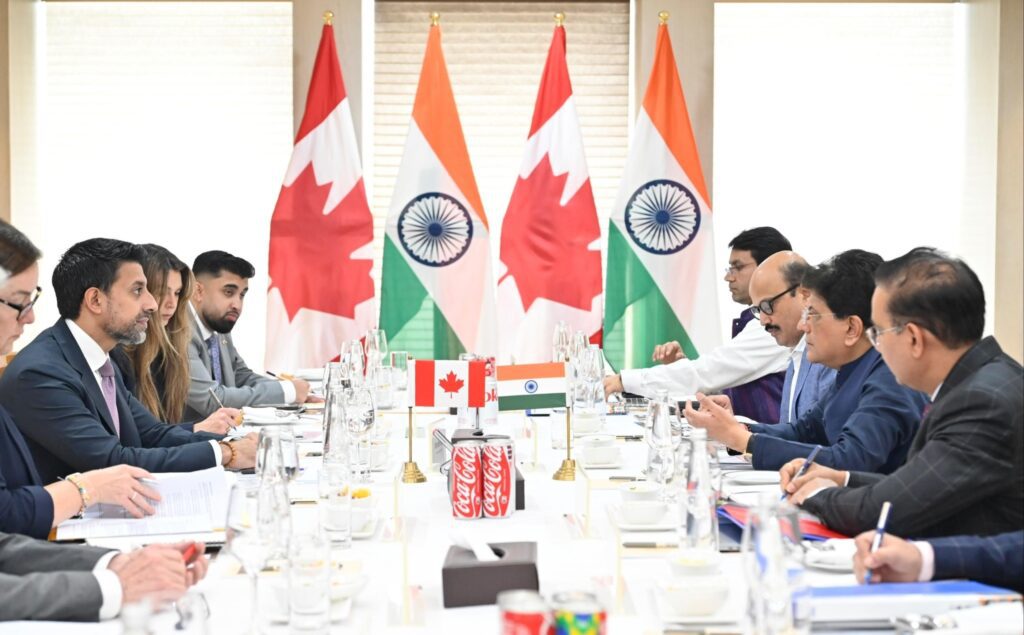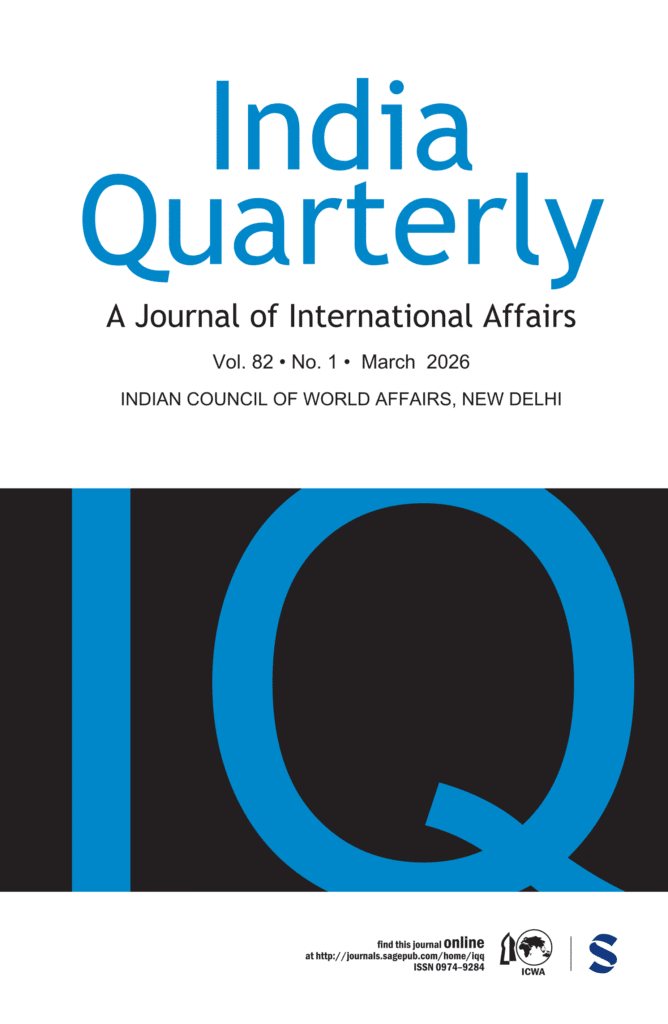
Zhang Jiadong and Wei Lijun, in China–US–India Triangular Relationship: Historical Evolution and Strategic Interactions (India Quarterly, 2026), challenge the common assumption that interactions among China, the United States, and India can be understood primarily through conflict, containment, or rigid alliance structures. Rather than viewing these ties as a set of independent bilateral relationships, the authors argue that the triangle operates as an interdependent system in which each country’s policies towards one actor are conditioned by its relations with the third. The complexities of the triangular relationship can further be understood through three dimensions: theoretical origin, historical evolution, and present-day strategic and economic interactions. Authors highlight that the contemporary triangle functions as a “weak triangle”, in which competition, cooperation, and strategic autonomy coexist, producing a dynamic but relatively stable interaction pattern that shapes the emerging global order.
The theory of triangular relationships therefore offers a lens to analyse international politics, whose origins can be traced to India’s Mandala Theory and China’s strategic thinking, highlighting four features: significance, independence, relevance, and stability. Scholars from realism and neorealism emphasise ideas of power balancing, systemic constraints, and strategic alliances, while Kissinger’s triangular diplomacy focused on a pivot country exploiting competition between the other two. Among these triangular models are also Dittmer’s models of “ménage-à-trois”, “romantic triangle”, and “stable marriage”, which show different patterns of cooperation and hostility.
The article then traces the historical evolution of this triangle. First, during the Cold War (1947–1991), China, the US, and India were embedded in different geopolitical camps, with limited trilateral engagement. The US–India relationship was constrained by India’s strategic autonomy, while China and India remained adversaries, leaving triangular interactions weak and fragmented. This was followed by the post-Cold War period (1991–2008), which saw the emergence of a unipolar international system, rapid economic growth in China and India, and the deepening force of globalisation. Economic interdependence between China and the US expanded, while US–India strategic ties strengthened partly to balance China. China–India relations also improved economically and diplomatically, although longstanding border disputes and emerging maritime competition persisted. Finally, with the Indo-Pacific Strategy (2017), trilateral interactions became more structured, with the US deepening engagement with India to counter China, China consolidating its regional influence, and India adopting a multi-alignment strategy, balancing ties with both powers.
The authors identify three core structural drivers shaping the triangle. First, economic strength has redefined global influence: the US maintains technological and financial dominance, China leads in manufacturing and infrastructure projects, and India excels in services and demographic potential. Second, divergent strategic trajectories—US contraction, China’s regional consolidation, and India’s assertive multi-alignment—produce both friction and opportunities for cooperation. Third, the geographic and sectoral distribution of power allows for non-overlapping coexistence: the US dominates globally in maritime and technological domains, China is central in East Asia, and India controls key routes and resources in South Asia and the northern Indian Ocean.
From this analysis, the article advances three key arguments. First, viewing the triangle purely as a zero-sum system misses the nuances of interdependence and the dynamics of flexible alignments. Second, strategic competition coexists with cooperation in trade, technology, and multilateral institutions. Third, long-term stability depends on each country managing its unique strengths, sustaining strategic autonomy, and balancing cooperation with competition.
The authors therefore conclude that the China–US–India triangle represents a distinct form of international interaction in the contemporary era of globalisation, different from the ‘strong triangle’ of the US–Soviet–China during the Cold War. It is a weak but inclusive and multi-hub system that allows the three powers to influence global governance, technological standards, and industrial networks without falling into the rigid confrontations characteristic of Cold War triangles. Its future trajectory will depend on how these countries navigate emerging domains such as AI, shaping a more interconnected and stable global order.