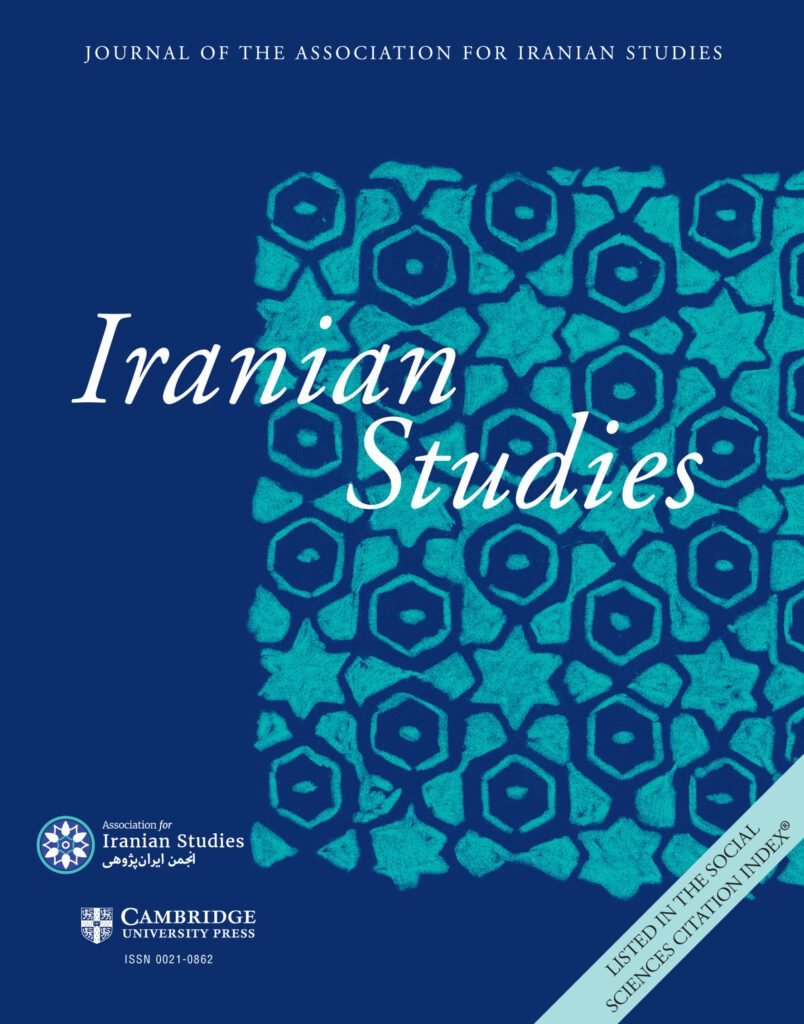
Dr Shabnam Holliday and Dr Edward Wastnidge, in The Islamic Republic of Iran and International and Regional Orders: A Roundtable Discussion (Iranian Studies, 2026), examine how the Islamic Republic has positioned itself within, and at times against, evolving international and regional orders. Rather than treating Iran as merely reactive to Western pressure, the authors frame it as an actor with agency operating across multiple, overlapping systems shaped by global power shifts, regional rivalries, and domestic politics.
The article situates Iran historically within changing global orders, from imperial competition in the early twentieth century to Cold War bipolarity and the subsequent movement toward multipolarity. The 1979 Revolution marked a decisive rupture. Ayatollah Khomeini’s “neither East nor West” doctrine rejected both Cold War blocs and embedded anti-hegemonic resistance, particularly toward the United States, at the centre of Iran’s foreign policy identity. Since then, Iran’s relationship with international order has been shaped by confrontation with US dominance, the end of the Cold War, and the rise of political Islam as a force in global politics.
Moving beyond the Iran–US dyad, the roundtable highlights Iran’s engagement with alternative power centres and institutions. Positioned partly “outside” the Western-led system, Tehran has leveraged ties with actors in the Global South and East. Its membership in organisations such as the Shanghai Cooperation Organization and BRICS reflects an effort to align with Russia and China in initiatives that may recalibrate Western-dominated global governance structures. China’s rise has offered economic and strategic avenues to mitigate US containment, while Iran’s Eurasian orientation seeks deeper integration with the Caucasus and Central Asia.
At the regional level, the article traces how isolation during the Iran–Iraq War pushed Tehran to cultivate a network of alliances that later evolved into the so-called Axis of Resistance. Support for Hezbollah in Lebanon, ties with Iraqi Shi‘i factions, alignment with Syria under Assad, and backing of the Houthis in Yemen expanded Iran’s strategic depth. At the same time, Tehran has framed the Palestinian cause as a cross-sectarian issue, incorporating Sunni groups such as Hamas and Palestinian Islamic Jihad to counter accusations of sectarianism.
The authors also underscore how US military presence in the Middle East, especially after the Global War on Terror, intensified Iran’s perception of encirclement, even as the removal of Saddam Hussein and the Taliban eliminated two hostile neighbours. Post-2011 regional upheavals deepened rivalry with Saudi Arabia and heightened tensions with Israel, culminating in direct Iran–Israel confrontation in the wake of the October 7, 2023 Gaza crisis and subsequent strikes on Iranian-linked targets. The status of Iran’s nuclear programme and the broader regional order remain unsettled.
From this analysis, the article advances three core arguments. First, Iran’s relationship with international order cannot be reduced to opposition to the United States; it involves multidimensional engagement with global, regional, and domestic systems. Second, the Islamic Republic has combined resistance with adaptation, exploiting openings in an increasingly multipolar environment to diversify partnerships. Third, regional order in the Middle East is shaped not only by interstate rivalry but also by transnational networks, sectarian narratives, and Iran’s internal political dynamics.
The article concludes that Iran’s position in both international and regional orders is neither fixed nor marginal. It is actively negotiated through shifting alliances, ideological commitments, and responses to systemic change. This perspective is directly relevant to current developments in Iran, where escalating confrontation involving the United States and Israel, leadership uncertainty, and visible positioning by Russia and China reflect precisely the kind of fluid, contested international and regional environment the article describes.