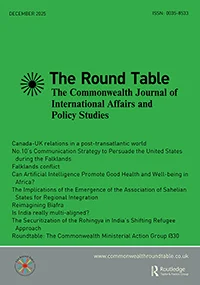
In the journal article India–EU Cooperation in Critical and Emerging Technologies, published in The Round Table: The Commonwealth Journal of International Affairs and Policy Studies (January 2026), authors Dr Amrita Jash and V. Anand examine how technology cooperation has moved to the centre of India–EU strategic relations.
In the article, the authors argue that critical and emerging technologies are no longer neutral economic assets but drivers of geopolitical power, security, and autonomy. As they note, critical and emerging technologies are instrumental in shaping contemporary geopolitics. Against this backdrop, the authors emphasise shared concerns in India and the European Union over technological dependence and supply-chain exposure, particularly in relation to China’s growing dominance.
The authors highlight complementary strengths rather than symmetry. For instance, EU’s advantages lie in regulation, standards-setting, research capacity, and green technologies, while India brings scale, skilled human capital, digital capability, and an expanding innovation base. Cooperation, therefore, is framed as a way to offset mutual weaknesses rather than pursue technological leadership in isolation.
Institutionally, the article treats the India–EU Trade and Technology Council as a practical mechanism to translate convergence into action, especially in areas such as semiconductors, trustworthy AI, quantum research, clean energy, and resilient value chains. At the same time, the authors are clear that differences in threat perception and foreign policy priorities, particularly toward China and Russia, place limits on strategic alignment.
The article concludes that India–EU cooperation in critical technologies is driven by necessity rather than ideology. Its value lies in reducing vulnerability, diversifying partnerships, and safeguarding strategic autonomy in an international system increasingly shaped by technological competition.