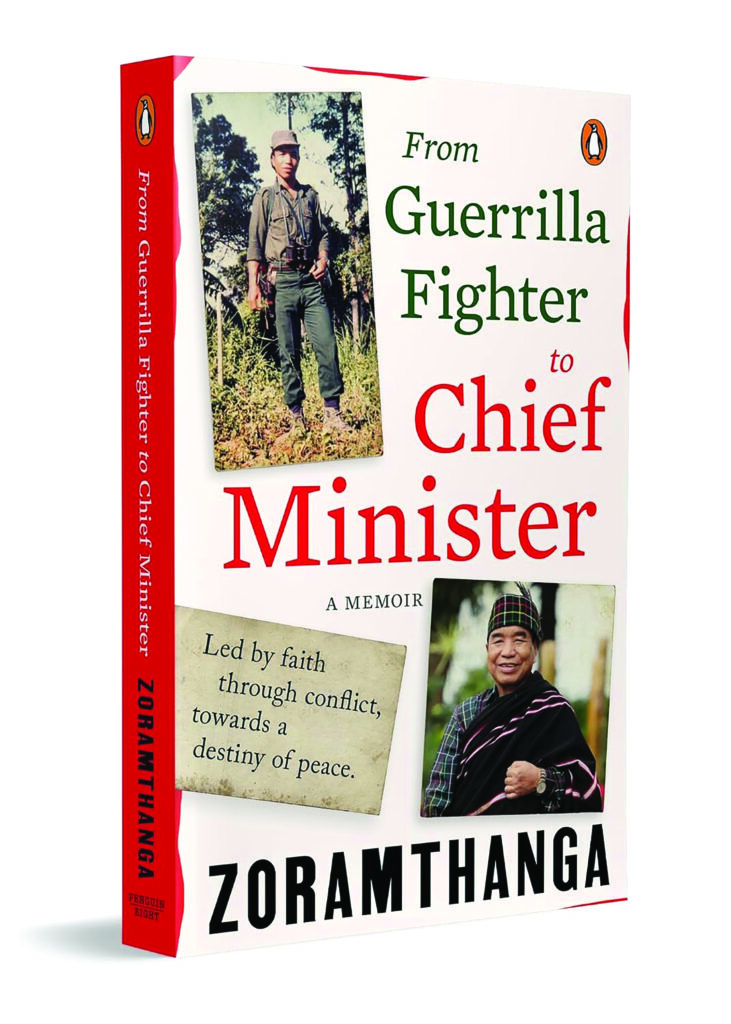
From Guerrilla Fighter to Chief Minister, written by Zoramthanga, was published by Penguin in 2026. The book is a memoir, placing readers inside the Mizo insurgency in Mizoram through the eyes of a former insurgent who entered constitutional politics and became chief minister for three terms. It is a first-person narrative of Zoramthanga’s journey into the armed rebellion of the Mizo National Front (MNF), which started in 1966 and ended with negotiated peace in 1986 with the Mizoram Peace Accord.
The book is divided into ten parts, with the first half laying the insurgency’s background, the emergence of Laldenga as the leader of the MNF and operations carried out by the organisation. The author relies on memory to reconstruct jungle camps and the cross-border activities of MNF fighters in China, Burma (now Myanmar), and East Pakistan to procure arms, funds and training to achieve self-determination. The transnational character of this insurgency underscores the fact that insurgent movements often exploit porous borders and inter-state rivalries to compensate for their military asymmetry vis-à-vis the state. According to Zoramthanga’s account, external contacts appear not as part of any grand strategy but out of the necessity of seeking political recognition and sanctuary. He also laments the use of aerial bombings in Mizoram and the uprooting of villages to form grouping centres as counter-insurgency tactics, which were so devastating and unpopular that the Indian state has not used them in any other counter-insurgency operation.
The second half explores the transformation of armed rebellion into constitutional politics, whereby the story travels to West Pakistan, Kabul, Bangkok, Rome, Cologne, and Geneva. This section is an intriguing portrayal of efforts to contact the Indian government secretly while the MNF had sanctuary in West Pakistan. The drawn-out negotiation process between the MNF and the Indian government is an important read as it details multiple occasions when peace talks broke down due to mistrust, ceasefire violations, and frustration with the obstinacy of senior officials involved in negotiations, particularly during the Janata Party government. It also traces the resumption of dialogue by Indira Gandhi in the 1980s, which was brought to fruition by Rajiv Gandhi in 1986. The lacuna of the book lies here, as it does not delve deeply into the mechanisms of political transition and governance, compressing these issues. Additionally, the memoir is an insider account based on selective memory, thus privileging its own perspective, giving scant attention to internal disagreements, civilian costs, and political rivalries within the insurgent movement. Nonetheless, the book is a valuable addition to insider accounts of insurgencies in India and is a must-read due to the author’s trajectory from insurgent to constitutional head.