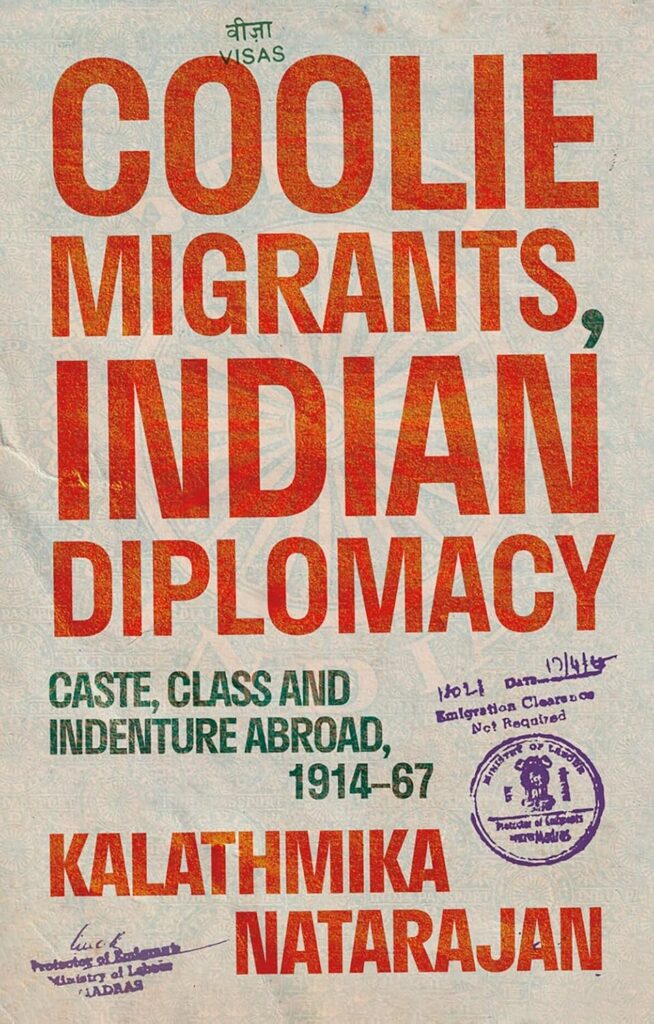
The book under review introduces us to a whole new world of Indian diplomacy. It brings into focus a range of new diplomatic actors, sites, and negotiating dynamics that have been either silenced or marginalised in the history of Indian diplomacy. For instance, the conventional scholarship on Indian International Relations (IR) hardly accounts for the role of caste in international affairs. It has ignored caste as an analytical lens to understand political processes transcending the national space. Caste is often framed as a “local” or “domestic” affair. Similarly, the diplomatic nitty-gritty of managing the earliest migration of Indian labourers under the British Indian state remains an unexplored field. Others have uncritically argued that the postcolonial Indian state has “distanced” itself from its post-indentured labourer societies and migrant diaspora.
Kalathmika Natarajan’s Coolie Migrants, Indian Diplomacy: Caste, Class and Indenture Abroad,1914-67 shakes the foundations of existing scholarship on Indian diplomacy in multiple ways. It establishes the transhistorical centrality of caste in India’s diplomatic engagement with the external world. Natarajan argues that caste fashioned and functioned in a very subtle way to constitute the “international” and shape the Indian diplomatic apparatus and agenda. With diverse archival sources and critical reasoning, she illustrates how caste elites have dominated the Indian diplomatic discourse while restricting and patronising mobility of coolie migrants at multiple international levels and sites.
In these archival retrievals, Natarajan brings to us painful stories of “lower” caste/class Indian migrants and the paradoxical standing of “official” diplomats on their identity, ability, and mobility. Herein, she explores the British/postcolonial Indian state’s continued interest in migrating/diasporic communities and their strategic leveraging by raising them as indentured labourers/“spiritual lever” and abandoning them when they asked for rights, repatriation, and respect. Their demands were considered a burden on the state.
Moreover, the desires of oppressed caste/class/gender categories to move from domestic space to the international, and their return, were both considered “undesirable” and disrespectful, yet they were patronised as their own by the self-proclaimed superior races, castes, and genders.
However, the oppressed individuals and collectives asserted their agency to resist and reclaim their rights to mobility, opportunities, and dignity by charting out alternative diplomatic issues, strategies, skills, and sites. The horizons of these alternative engagements ranged from issues pertaining to quarantine certification to reclaiming the right to hold an Indian passport, where casteist and anti-caste actors were perpetually struggling over their civilisational status, mobility, public health, birth control, and citizenship.
For instance, Mandapam forced intimacy and close contact between inhabitants from different social strata, leading to a reorganisation of respectability and status. These anxieties over the breakdown of existing caste hierarchies “strengthened calls for an Indian diplomacy led by Indians themselves”. Since then, the parameters of “appropriate” “Indianness” in the international realm were contested in alternative sites of everyday diplomacy, away from metropolitan centres such as London and New Delhi to Ceylon, Trinidad, Birmingham, Madras and Punjab. In these sites, enablers of mobility such as Rettainalai Srinivasan, Iyothee Thass, M.C. Rajah, and Ishwar Das Pawar emerged as diplomatic actors.
This is a must-read that not only explores how caste intersects with IR but also provides a critical foundation for understanding the roots of contemporary India’s aspirations for leadership through civilisational assertiveness and reconnecting with the diaspora.