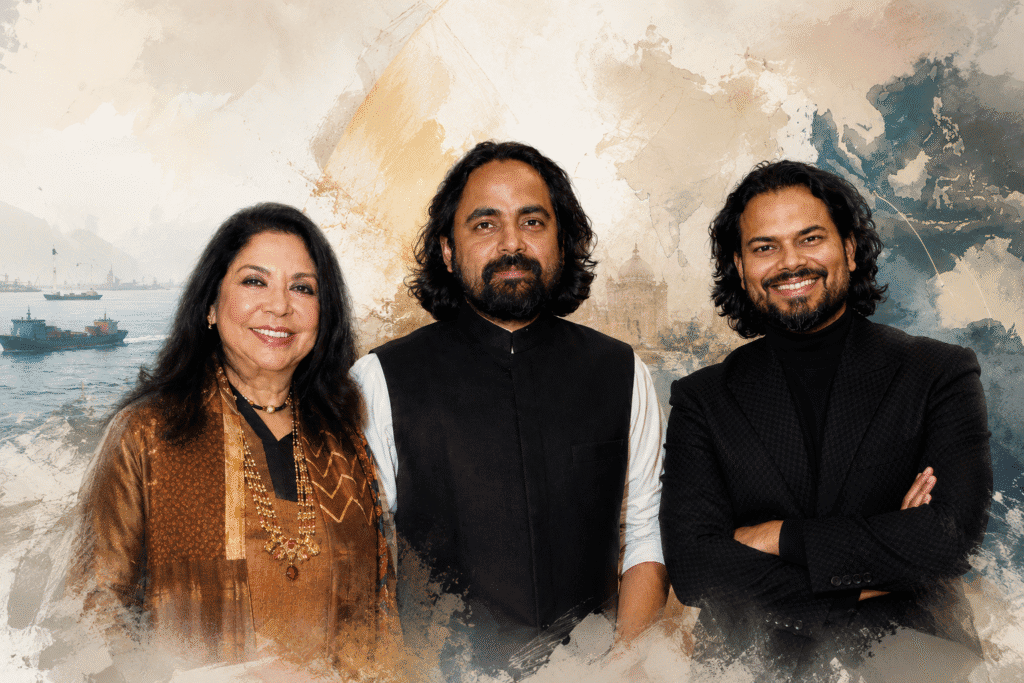
Ritu Kumar
The Pioneer Who Made Indian Craft Fashionable Again
Few individuals have done more to revive India’s textile heritage for the modern fashion industry than Ritu Kumar. Long before Indian fashion became a global conversation, she was demonstrating that India’s centuries-old crafts could compete with the world’s finest luxury traditions. At a time when handloom textiles and traditional embroidery were often dismissed as relics of the past, she recognised them as India’s greatest creative asset. Beginning her career in Kolkata in the late 1960s with a handful of hand-block printers, Kumar built a design philosophy rooted not in imitation of Western fashion but in the revival of India’s own textile heritage.
Her work arrived at a critical historical moment. Industrialisation had pushed many traditional crafts to the margins, and younger generations increasingly viewed handmade textiles as old-fashioned. Kumar travelled extensively across India, working directly with block printers, embroiderers, and weavers, documenting forgotten techniques and adapting them for contemporary fashion. The result was neither costume nor nostalgia, but modern clothing infused with centuries-old craftsmanship.
When artisans create a timeless artefact with numerous hours of passionate labour, its exclusiveness, cultural beauty, and ability to sustain craft communities make it true sustainable luxury
Over the following decades, Ritu Kumar transformed Indian fashion into a globally recognised luxury proposition. Her boutiques expanded beyond India, her garments appeared in international exhibitions, and her label became synonymous with refined Indian elegance. Unlike many designers who merely borrowed motifs from traditional crafts, Kumar built her brand around the artisans themselves, creating sustained demand for techniques that might otherwise have disappeared.
Her influence extends well beyond the garments she created. She demonstrated that Indian textiles possessed the sophistication to compete with the world’s finest fashion traditions without abandoning their cultural identity. In doing so, she inspired an entire generation of designers to see heritage not as a limitation but as a source of innovation.
Today, as sustainability, slow fashion, and artisan-made luxury dominate global conversations, many of the principles Ritu Kumar championed decades ago have become industry ideals. Her legacy lies not only in the clothes she designed but in restoring confidence that Indian craftsmanship deserved a place on the world’s most prestigious fashion stages. She proved that India’s future in fashion lay not in abandoning tradition but in reinventing it.
Sabyasachi Mukherjee
Building India’s Most Recognisable Global Luxury Brand
If Ritu Kumar revived Indian craft, Sabyasachi Mukherjee transformed it into one of India’s most successful luxury exports. Today, his label has become synonymous with Indian luxury around the world. Few contemporary designers have reshaped international perceptions of Indian fashion as profoundly as he has. His richly embroidered bridal couture, vintage-inspired aesthetics and meticulous craftsmanship have become instantly recognisable, making “Sabyasachi” one of the few Indian fashion names with worldwide brand recognition.
Founded in Kolkata in 1999, the label grew steadily by refusing to follow fast-changing fashion trends. Instead, Sabyasachi embraced timeless craftsmanship, drawing inspiration from Bengal’s artistic traditions, royal Indian textiles, and handcrafted embellishments. Every collection celebrates Indian artisanal excellence while meeting the expectations of the international luxury market.
India needs to play the luxury game from a place of confidence, not subjugation. Confidence is magnetic. And when that confidence comes from heritage and roots, it becomes a powerful cultural statement
His global breakthrough came through visibility as much as design. International celebrities, Hollywood actors, and members of royal families have worn his creations, while collaborations with global brands such as H&M and Christian Louboutin introduced his aesthetic to entirely new audiences. Flagship stores in cities including New York further established Indian luxury as an international commercial force.
Yet the true significance of Sabyasachi lies beyond celebrity endorsements. His success demonstrated that Indian fashion could compete not merely as ethnic wear or occasion dressing but as a luxury lifestyle brand capable of standing alongside Europe’s most established fashion houses. His business has expanded into jewellery, accessories, home décor, and beauty, reflecting the evolution of Indian fashion from a niche cultural expression into a comprehensive luxury ecosystem.
At the heart of the brand remains an enduring commitment to craftsmanship. Thousands of artisans contribute to Sabyasachi’s creations, ensuring traditional embroidery, weaving, and hand-finishing techniques continue to thrive in a rapidly mechanising industry.
In many ways, Sabyasachi has become a cultural ambassador. Through every collection, he presents India not as an emerging fashion destination but as one of the world’s oldest and most sophisticated centres of craftsmanship. He showed that an Indian fashion house could become a global luxury brand without compromising its cultural identity.
Rahul Mishra
Taking Indian Craft to Paris Haute Couture
Rahul Mishra has taken Indian craftsmanship to fashion’s highest international stage. As a regular participant at Paris Haute Couture Week, he has demonstrated that Indian artisans are not merely suppliers to global luxury; they are creators of it. While many designers export Indian aesthetics, Mishra exports Indian craftsmanship itself, placing the country’s artisans at the very centre of haute couture.
Raised in Uttar Pradesh and trained at the National Institute of Design before studying at Istituto Marangoni in Milan, Mishra has consistently combined international design education with an unwavering commitment to Indian handicraft traditions. His international breakthrough came in 2014 when he became the first Indian designer to win the prestigious International Woolmark Prize, placing him firmly on the global fashion map.
I really feel that the most sophisticated tool in the world is human hands.
Since then, Mishra has achieved what few Indian designers had imagined possible: a regular presence at Paris Haute Couture Week. His collections feature extraordinary hand embroidery inspired by Indian miniature paintings, forests, flowers, and biodiversity, executed by thousands of artisans across India. Rather than concealing the human labour behind luxury, Mishra celebrates it, often speaking of his work as creating livelihoods alongside beautiful garments.
This philosophy has earned him recognition beyond fashion. At a time when sustainability has become one of the industry’s defining concerns, Mishra argues that India’s centuries-old craft traditions already embody many of the principles now being rediscovered worldwide: slow production, handmade excellence and close relationships between designer and artisan.
His garments have appeared on international red carpets, worn by actors and public figures, but celebrity visibility has never overshadowed the people who create them. Every collection acknowledges the embroidery traditions, weaving techniques, and communities that make the work possible.
Rahul Mishra’s greatest achievement may be changing the global conversation about Indian fashion itself. Rather than presenting India simply as a source of inspiration, he positions it as a creator of the world’s highest level of craftsmanship. In doing so, he has transformed Indian artisans from anonymous contributors into recognised participants in the global luxury industry. He has made Indian artisans visible not as suppliers to luxury, but as its creators.