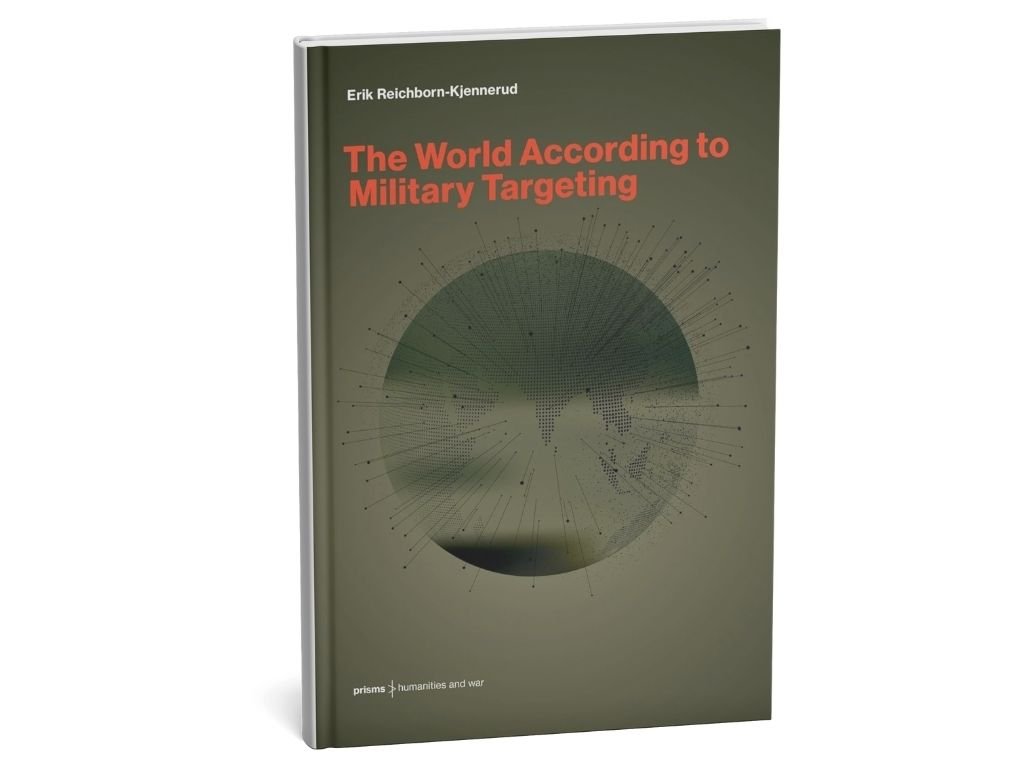
Erik Reichborn-Kjennerud’s The World According to Military Targeting is one of those exceptional works that expands the very lexicon of war. Reichborn-Kjennerud works against the grain of studying targeting as merely the last step in combat—detect, lock, and destroy—and instead constructs it as a philosophical apparatus: a way of knowing and ordering the World. He situates himself within a small but consequential lineage of scholars and thinkers, from Michel Foucault to Antoine Bousquet, who have indicated that the grammar of security is also the grammar of knowledge.
Across seven rigorously argued chapters, Reichborn-Kjennerud develops what he calls a “martial epistemology”: a mixture of the technological, cognitive, and violent dimensions that condition how militaries see and act. Beginning with the interwar Air Corps’ “enemy-as-a-system” doctrine and concluding with today’s algorithmic wars, he reconstructs a century’s worth of targeting as both method and mechanism. The early chapters describe how, during World War II, the aerial mapping of industrial networks yielded an illusion that societies could be scientifically disassembled, node-by-node. Subsequent chapters turn to Vietnam’s Computerised Hamlet Evaluation System and to Geocell operations in the War on Terror, where satellites and signals intelligence combine to create what Reichborn-Kjennerud calls the “Map of the World”—a living digital twin in which all action becomes intelligible and thus actionable.
Reichborn-Kjennerud’s most unique intervention is his contention that targeting is not only destructive but generative: it generates enemies, territories, and truths. “Making up the enemy,” he writes, is less about locating opponents than it is about stabilising uncertainty via data. War, then, is no longer episodic but continuous; waged via sensors, algorithms, and prediction models that pre-empt rather than respond. His writing, dense yet fluid, moves deftly between military doctrine, the histories of computation, and feminist science studies to show how the desire for total vision erodes the division between peace and war, or perhaps denatures them both.
The World According to Military Targeting is less a historical account of war than a reflection on the modern condition. Reichborn-Kjennerud captures how the pursuit of precision and technological mastery, hailed as human progress, engenders civilian-encountered war, which often confuses surveillance with security and data with knowledge. He concludes with a warning: as artificial intelligence reshapes the battlespace, the future may not lead us to peace at all, but to a new permanence of war, where only the indicators of conflict are permissible: every life, movement, and signal kept perpetually in range.