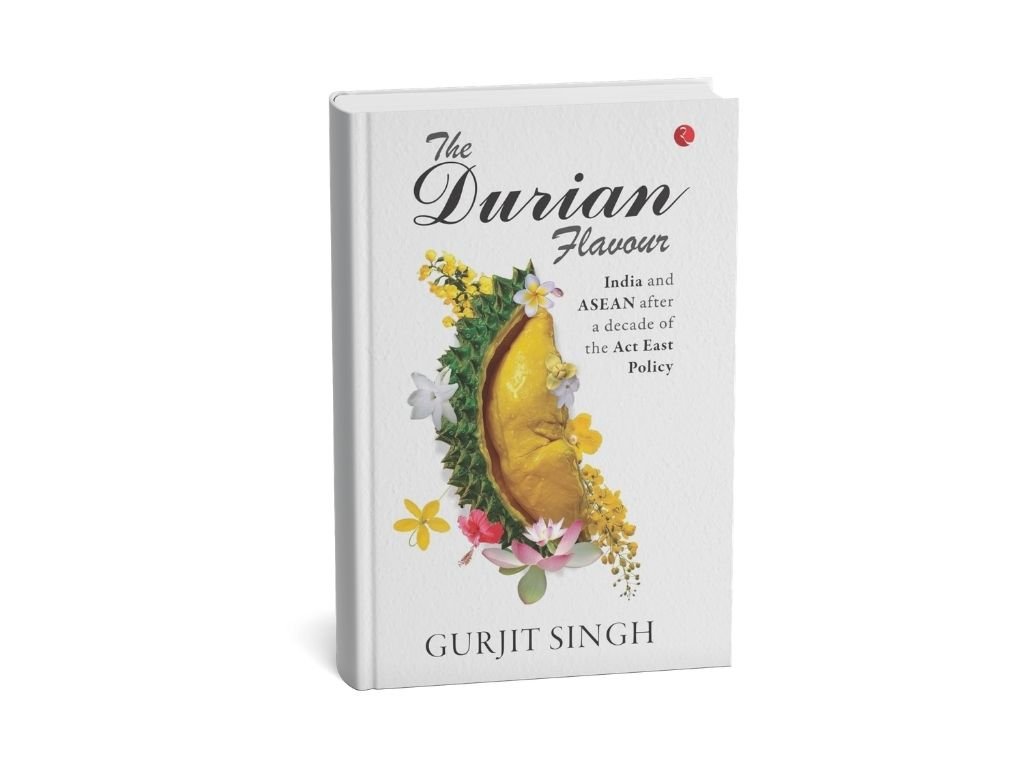
Southeast Asia is close to India not only geographically but historically and culturally as well, while also having strategic significance. Amidst geopolitical churn, The Durian Flavour: India, ASEAN and the Act East Policy by Amb. Gurjit Singh gives an account of India’s historical and contemporary engagement with Southeast Asia. Despite civilisational linkages through the Ramayana and Mahabharata over millennia, and both blocs belonging to the Global South, the India-ASEAN relationship has not lived up to its potential, which the author attributes to a persistent perception gap on both sides.
The book offers insight into the evolution of India’s Act East Policy, whose objective differs from the Look East Policy, driven largely by economic interests, while Act East marks a strategic shift with political and security underpinnings. It places ASEAN centrality at the heart of the relationship in a geopolitical era where uncertainty is becoming the new certainty. Singh examines India-ASEAN ties across political, security and defence pillars. He argues that Chinese coercion in the South China Sea, great power rivalry between the USA and China in the Indo-Pacific, and weaponised globalisation pose a threat not only to ASEAN centrality but also expose vulnerabilities in Indian economic growth. It is therefore in the strategic and economic interest of both blocs to deepen cooperation across political, economic and defence domains.
Although the book provides a detailed account of India-ASEAN relations, it primarily offers an India-centric view. From an ASEAN perspective, it overlooks ASEAN’s hesitancy to deepen the relationship. Singh does not press sufficiently on the trust deficit created by India’s withdrawal from RCEP. This translated into a structural setback and pushed ASEAN closer to China. Further, there is much emphasis on civilisational connection, but a civilisational continuum alone does not guarantee robust political and economic relations.
Singh points out that despite a shared Global South identity, India-ASEAN ties are hindered by bureaucratic attitudes and a tendency on both sides to seek alternative partnerships. Despite these constraints, he makes a case for deepening relations in the wake of supply chain disruptions following COVID-19 and an emerging multipolar order. Cumulatively, these circumstances offer an opportunity to strengthen ties in areas such as reliable supply chains, a common Indo-Pacific narrative and tourism. To realise the full potential of engagement, Singh advocates cooperation with corporates, academia, and private actors, going beyond formal diplomacy. Particularly valuable is the book’s practitioner perspective, drawing on diplomatic experience to connect policy debates with implementation challenges. Its discussion of connectivity, maritime cooperation and institutional mechanisms strengthens the argument that India’s engagement with ASEAN requires sustained strategic attention. As he metaphorically puts it, just as the durian is hard to grow, India-ASEAN relations require adjustment, accommodation, and acceptance to enjoy their fruits.