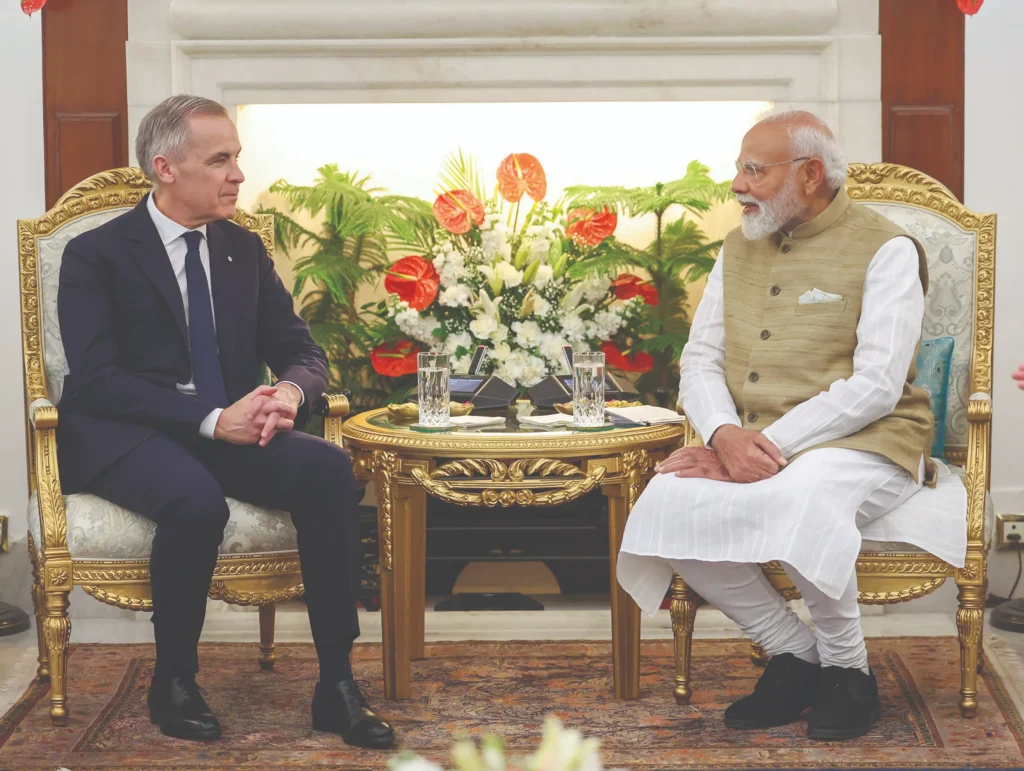
On 17 November 2026, the leaders of India, the United States, Australia, and Japan met in Manila for the seventh Quad Leaders’ Summit. Prime Minister Narendra Modi, US President Donald Trump, Australian Prime Minister Anthony Albanese, and Japanese Prime Minister Sanae Takaichi met on the sidelines of the Association of Southeast Asian Nations (ASEAN)-related summits hosted by the Philippines. Their joint statement set out cooperation on maritime surveillance, business ties, cable connectivity, and cybersecurity, while reaffirming the grouping’s wider Indo-Pacific agenda.
The meeting was the first in-person Quad leaders’ summit since September 2024. It also came nearly a decade after the grouping was revived in Manila in 2017 and ten years after former Japanese Prime Minister Shinzo Abe articulated the vision of a Free and Open Indo-Pacific. The Japanese government’s account of the meeting records the leaders’ discussion of maritime and economic security, energy, critical technologies, and regional developments.
Five outcomes stand out: the Quad Business Leaders’ Forum, counterterrorism cooperation, the Indo-Pacific Maritime Surveillance Collaboration, an expanded cable partnership, and enhanced cybersecurity cooperation. The leaders also reaffirmed the Super Intelligence Accelerator and discussed critical minerals. Those two issues matter to the summit’s wider economic-security agenda, but they should be distinguished from the five outcomes.
What Is the Quad, and Why Meet in Manila?
The Quad brings together four countries: India, Australia, Japan, and the United States. Its origins lie in the cooperation that followed the 2004 Indian Ocean tsunami. Officials from the four countries first met in 2007, but the dialogue did not develop into a sustained arrangement at the time. It was revived in Manila in 2017, with discussions on maritime security, counterterrorism, and connectivity. The Ministry of External Affairs’ background note sets out this history and traces the expansion of the grouping’s agenda.
The Quad is not a treaty-based military alliance. Its members have instead built a network of cooperation through leaders’ meetings, foreign ministers’ consultations, and practical initiatives. That distinction matters: the partnership can coordinate on regional challenges without requiring members to adopt identical positions on every foreign-policy issue. In Manila, the leaders reaffirmed support for ASEAN centrality and unity, a reminder that the Quad’s stated Indo-Pacific vision is meant to work alongside regional institutions rather than replace them.
Five Key Outcomes
1. A Quad Business Leaders’ Forum in Mumbai
The most prominent economic announcement was the decision to hold the inaugural Quad Business Leaders’ Forum in early 2027, with Mumbai as the host city. The India-proposed forum will bring together business leaders, government officials, and policy experts from the four countries to encourage commercial deals and private-sector partnerships. Modi announced Mumbai as the venue.
The proposal addresses a practical gap: government-to-government cooperation does not automatically produce investment or supply-chain links between companies. Modi pointed to the potential to combine Australia’s mining experience, Japan’s recycling technology, US expertise, and India’s manufacturing base. Albanese also presented the forum as a way for private enterprise to turn government decisions into commercial activity; his opening remarks in Manila emphasised business participation.
For India, the choice of Mumbai gives the initiative a visible commercial setting. Its worth will be judged by the partnerships and projects that follow, particularly in minerals processing, manufacturing, clean energy, and advanced technology. The announcement itself does not amount to a new trade agreement or a pooled investment fund.
2. Maritime Surveillance and a Joint Patrol-Aircraft Exercise
The Indo-Pacific Maritime Surveillance Collaboration (IPMSC) is designed to improve information-sharing and maritime domain awareness. The four countries plan to bring their maritime patrol aircraft together for an exercise in 2027. The joint statement specifies P-8 and P-3C aircraft and describes the planned activity as the first maritime exercise of this kind in a Quad context.
Maritime domain awareness means developing a clearer picture of activity at sea: which vessels are operating, where they are moving, and whether their behaviour raises concern. Better information can help authorities respond to illegal fishing, trafficking, and other illicit activity. The initiative builds on the earlier Indo-Pacific Partnership for Maritime Domain Awareness (IPMDA), which supports information-sharing with regional partners.
The planned exercise adds an operational element to this cooperation. India’s Foreign Secretary Vikram Misri said the first activity was expected to take place alongside Exercise Sea Dragon in Guam in March 2027, with illegal fishing and trafficking among the challenges to be addressed. The initiative is about surveillance and coordination; it does not create a collective-defence commitment.
3. Cable Cooperation Extends to Electricity Links
The leaders agreed to expand the Quad Partnership for Cable Connectivity and Resilience. Until now, the partnership has concentrated on secure communications infrastructure. At Manila, the partners welcomed an expanded Australian contribution focused on electricity cables and noted upcoming undersea cable projects in the Indian Ocean.
Telecommunications cables carry data for banking, government services, digital commerce, and international communications. Damage can disrupt services across several countries. Electricity cables raise a related issue: reliable infrastructure is central to energy security. The expansion takes the Quad’s connectivity agenda beyond digital communications.
For India, the Indian Ocean projects are directly relevant to the resilience of its external digital links. The Japanese Foreign Ministry’s summit summary also records the leaders’ emphasis on energy security. The statement, however, does not identify the routes, costs, or completion dates of the projects. Those details will determine how quickly the announcement translates into infrastructure.
4. Enhanced Cybersecurity Cooperation
The fourth area is cybersecurity. The leaders acknowledged the increase in the number and scale of cyber incidents across the region and announced Enhanced Quad Cybersecurity Cooperation, with the stated aim of promoting an open and secure cyberspace. The commitment recognises that cyber threats can affect far more than government networks. Banks, telecommunications providers, businesses, power systems, and public services all rely on digital infrastructure.
The announcement remains broad. The joint statement does not specify a shared cyber-response unit, a common threat database, or a new mechanism for responding to attacks. The next stage will have to establish how information is exchanged and what technical assistance can be offered. For India, the issue touches the security of its digital economy and public-service networks.
5. A Renewed Commitment on Counterterrorism
The fifth outcome was a reaffirmation of counterterrorism cooperation. The four leaders condemned terrorism and violent extremism in all their forms, explicitly including cross-border terrorism, and committed to strengthening the Quad’s existing work in this area. The wording is consistent with India’s longstanding effort to focus international attention on terrorist networks operating across borders.
This is a political commitment, not the announcement of a new counterterrorism organisation or a detailed operational framework. Similar language appeared in the Quad leaders’ statement in 2024. Manila therefore keeps counterterrorism on the agenda as the grouping devotes more attention to economic, technological, and infrastructure security.
AI and Critical Minerals: The Wider Agenda
Artificial intelligence (AI) and critical minerals were prominent in the leaders’ remarks, although neither should be confused with the five outcomes listed above. The leaders reaffirmed the Quad Super Intelligence Accelerator, announced earlier by their foreign ministers in Atlanta. It is intended to coordinate and fund support for access to trusted AI, deployment, and technical assistance across the Indo-Pacific. The joint statement clarifies that Australia, India, and Japan use “Super Intelligence” to refer to artificial intelligence.
Trump said more than US$85 million would be spent to expand trusted AI ecosystems across the region. Questions remain over how the money will be allocated, who will receive assistance, and what standards will guide deployment.
Critical minerals were discussed in the context of supply-chain resilience. These materials are used in batteries, semiconductors, electric vehicles, renewable-energy equipment, and defence systems. Their extraction and processing are concentrated in a relatively small number of countries, leaving manufacturers vulnerable to export restrictions and supply disruptions. Trump said the Quad partners had reached agreements intended to prevent coercion by any single foreign supplier. The joint statement expressed concern about economic coercion without naming a country.
The issue is also about what each country can contribute. Australia has mineral resources, Japan has processing and recycling capabilities, the United States has technological and industrial strengths, and India wants to expand manufacturing. Whether these strengths can be combined will depend on investment, commercial viability, and the development of processing capacity, not simply on political declarations.
What Does the Summit Mean for India?
For New Delhi, the Manila outcomes align with three priorities. The maritime surveillance initiative gives India another channel for working with partners on activity across the Indo-Pacific. The cable and cybersecurity initiatives address vulnerabilities in infrastructure that supports its digital economy. The Mumbai business forum, meanwhile, offers a route to turn strategic cooperation into commercial links.
Modi also raised the safety of seafarers and proposed a Quad Sea Lanes Safety Initiative, as reported after the summit. India had signalled the issue ahead of the meeting; Modi was expected to raise seafarer safety. This proposal should be treated separately from the five outcomes. The Indian government’s record of the Manila visit also lists a Seafarers’ Safety Initiative at the East Asia Summit, focused on joint training and emergency response.
The arrangement suits New Delhi’s preference for issue-based partnerships. India can work with the United States, Japan, and Australia on maritime and economic security without joining a formal military alliance. It also retains room to manage its relationships with countries outside the grouping.
From Announcements to Delivery
The joint statement sets out broad commitments, but leaves many operational details open. The business forum needs companies willing to invest; the surveillance plan needs regular coordination and usable information; cable and cyber projects require funding, technical standards, and clear responsibilities. The AI and critical-minerals commitments will face the same test.
The planned patrol-aircraft exercise and the first Business Leaders’ Forum in Mumbai are due in 2027. Their preparation will show whether the four governments are putting staff, money, and institutional support behind the Manila announcements.
Note: This explainer has been researched, edited, and fact-checked by India’s World staff and prepared with AI assistance.