In his recent issue brief, “Nepal-Tibet Floods: Need for Regional Cooperation”, published on 31 August 2026, Dr Amit Ranjan, a Research Fellow at the Institute of South Asian Studies (ISAS), examines the devastating floods along the Nepal-Tibet border and argues that the disaster should serve as a “wake-up call” for stronger regional cooperation on environmental and disaster-related issues.
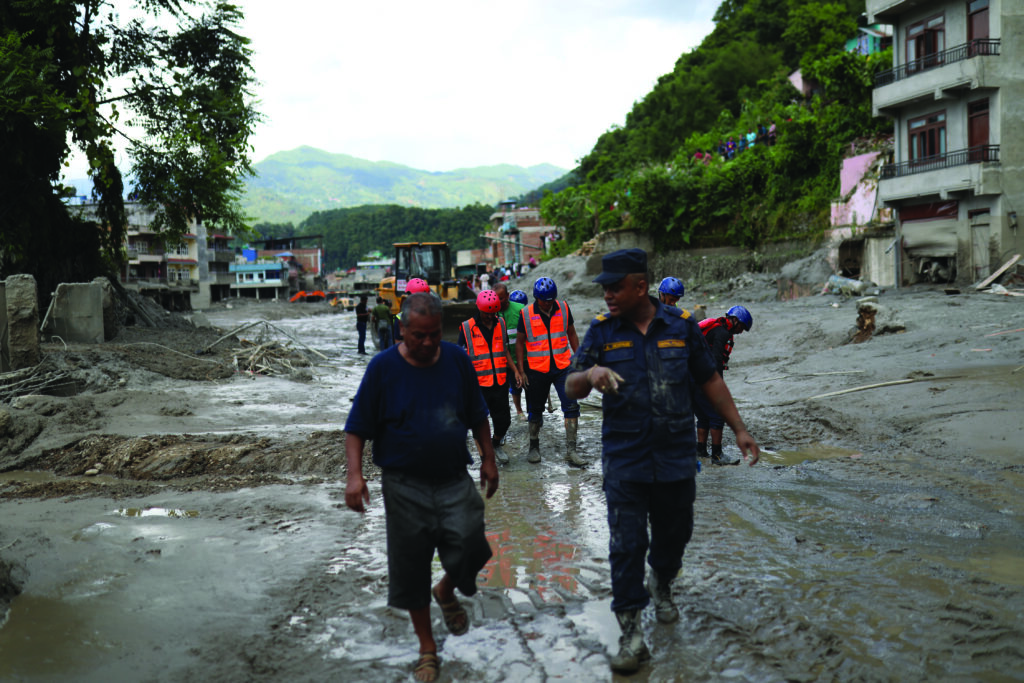
Ranjan begins by outlining the scale of the 26 August floods, which caused extensive loss of life and severe damage to infrastructure on both sides of the border. In Tibet, the Gyirong Port crossing was badly damaged by mudslides, while in Nepal roads, bridges, hydropower facilities and other infrastructure were destroyed or affected. Initial reports attributed the disaster to an earthquake, but the United States Geological Survey subsequently identified a “glacial collapse” as the cause. Citing cryosphere specialist Mohammad Farooq Azam, Ranjan notes that the collapse involved an estimated 100 to 200 million cubic metres of ice. The impact of the collapsed ice hitting the bottom of the valley was so forceful that it registered as a 5.2-magnitude earthquake. According to Nepalese officials, a “large volume of ice and rock debris” entered the Lende Khola River, producing a sudden downstream surge of water, mud and rocks.
The disaster also raised questions about cross-border early-warning mechanisms. Ranjan notes debate over whether China could have issued an earlier warning after facilities at the Rasuwagadhi-Gyirong crossing and Gyirong Port were affected. The Chinese Embassy rejected allegations that a warning had been withheld and instead called for “cooperation” rather than “accusations”. Ranjan places this controversy within the broader framework of Nepal-China agreements. Under the 2019 Agreement on the Boundary Management System, the two countries agreed not to alter the course of shared rivers and to cooperate on cross-border facilities. After a major flood in Nepal in 2025, they also agreed to share real-time information on floods and landslides and to flag potential glacial lake outburst flood risks, although no formal agreement was signed.
Ranjan then examines efforts to improve information sharing. Nepal raised the matter again during Foreign Minister Shisir Khanal’s visit to Beijing in May 2026. Following the August floods, Nepal’s Department of Hydrology and Meteorology and the China Meteorological Administration agreed in a virtual meeting to cooperate on weather monitoring, forecasting and the exchange of meteorological information. For Ranjan, these developments point to the need for more effective institutional mechanisms for disaster preparedness and early warning.
On climate change, Ranjan is careful not to establish a direct causal relationship with the August floods. He notes that rising temperatures are weakening glaciers globally, but stresses that “the link between disaster and climate change has not yet been established” in this case. He cites research showing that glacier loss accelerated in the Langtang catchment between 1964 and 2023, while also noting that the number of glaciers increased due to fragmentation, separation and disconnection. Ranjan also argues that the environmental consequences of construction activity deserve attention, particularly the rapid expansion of hydropower projects across the Himalayan region. Drawing on the concept of “hydrocapitalist” development, he notes that hydropower projects can function as a “wealth extraction mechanism”.
The brief also considers concerns over construction activities near rivers. Some Nepalis alleged that Chinese construction near the Trishuli River contributed to the disaster, while Nepal’s government had earlier asked China to stop construction of a safety wall along the Bhote Koshi River because of concerns about its impact on the river’s course. At the same time, Ranjan points to Nepal’s own extensive hydropower plans, noting that hundreds of projects are at different stages of development. The issue, therefore, is presented as a wider question of how infrastructure development interacts with fragile Himalayan ecosystems rather than simply a dispute over responsibility between Nepal and China.
Ranjan concludes by widening the discussion to the Hindu Kush Himalayan (HKH) region, comprising Afghanistan, China, Nepal, Bangladesh, Bhutan, Pakistan, India and Myanmar. Because rivers, glaciers and ecological systems cross national boundaries, disasters in one country can directly affect others. He notes, for example, that Nepal’s hydrological conditions can raise flood alarms in parts of Bihar and Uttar Pradesh. Ranjan therefore argues that environmental cooperation is necessary “regardless of the nature of bilateral political ties”. He points to ICIMOD, described as an “intergovernmental knowledge and learning centre”, as one institution capable of supporting regional cooperation. He ultimately calls for stronger institutional cooperation on environmental matters across the Himalayas, alongside more democratic and decentralised decision-making within individual countries.