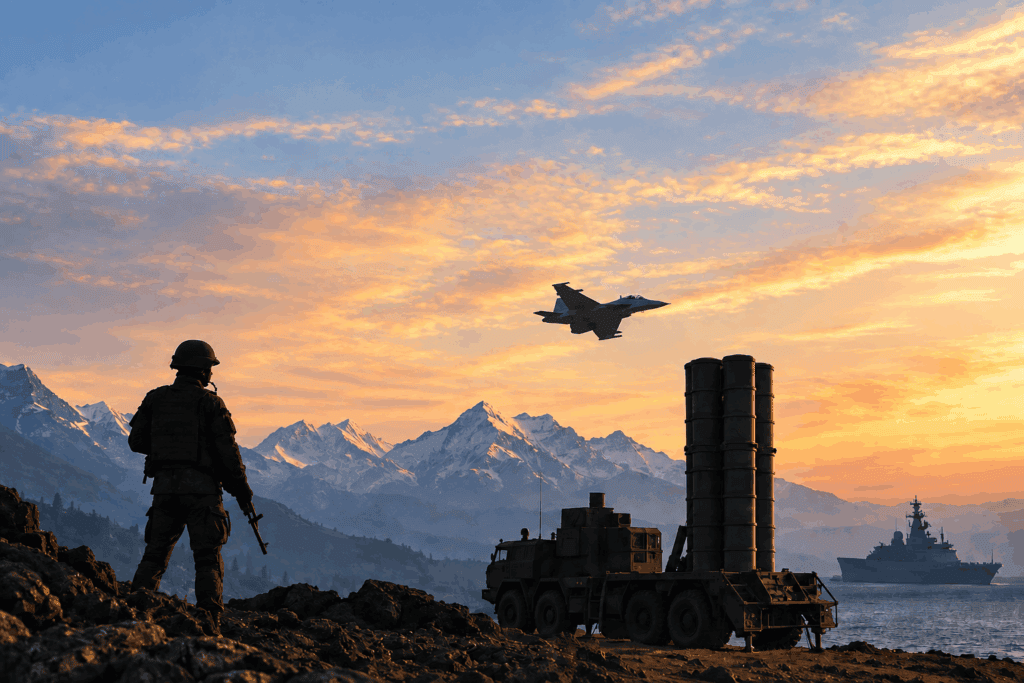
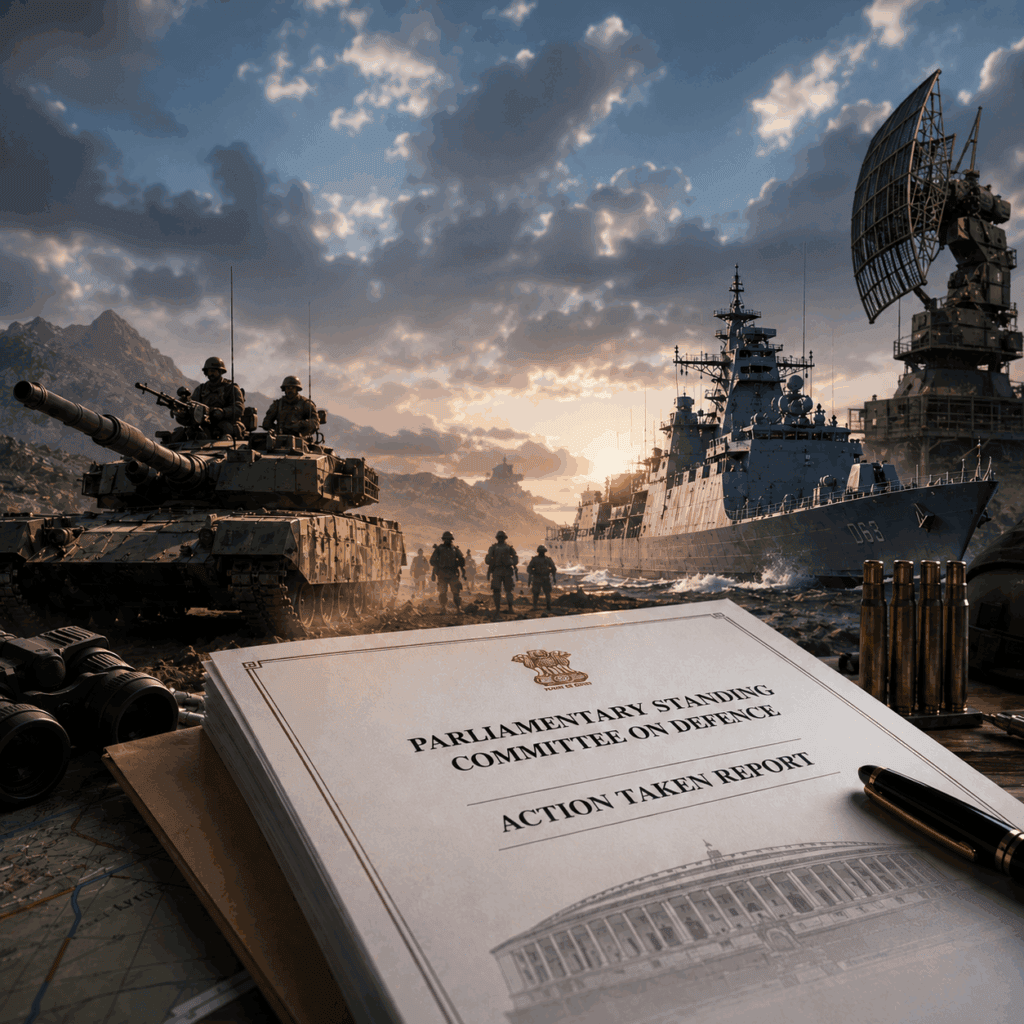
The latest Action Taken Report of the Parliamentary Standing Committee on Defence has drawn attention for one finding above the rest: the Ministry of Defence has begun efforts to “co-join” the Future Combat Air System (FCAS), a sixth-generation combat-aircraft programme, and the Committee has asked the government for a status report, roadmap and tentative timeline for the development and acquisition of sixth-generation aircraft.
That finding sits inside a wider document. The report responds to the Committee’s Twentieth Report on the Defence Demands for Grants for 2026-27, which examined the Army, Air Force, Navy, Joint Staff, Ex-Servicemen Contributory Health Scheme and Directorate General of Armed Forces Medical Services. It was presented to Parliament on 7 August 2026. Read as a whole, it is less a single announcement than a progress check across the services.
What Is an Action Taken Report?
An Action Taken Report does not assess the armed forces afresh. It follows the Committee’s earlier recommendations and records how the government has responded to each one.
The distinction matters for how the report should be read. It does not establish that India has joined FCAS, ordered a sixth-generation fighter or completed any modernisation programme. It records what the government says it has done and what the Committee now wants to see next. The value lies there: the report shows where the Committee believes the forces need more resources, faster planning or clearer timelines, and which programmes are already under way across the three services and Joint Staff.
Why Is Sixth-Generation Air Power Already on India’s Agenda?
The Committee treats the technical upgrading of the Air Force’s fleet as a “top priority” for combat capability, and has recommended that the government set a trajectory and accelerate planning for sixth-generation aircraft so that India does not lag in advanced air power.
The government told the Committee it has “initiated efforts in a concerted manner to co-join” FCAS, which the report describes as spearheaded by the French government. The Committee has asked for a detailed status report, a roadmap and a tentative acquisition timeline. None of this means India has joined FCAS or decided to buy a sixth-generation aircraft. The government reports that it has begun efforts to participate; the Committee is pressing for clarity on where those efforts stand.
FCAS is more than a fighter. It is conceived as a system of systems, pairing a next-generation fighter with crewed and uncrewed platforms across a combat network. The European picture behind it has also changed sharply. France and Germany abandoned their joint next-generation fighter on 8 June 2026, after years of disputes between Dassault and Airbus over industrial leadership, though cooperation on the combat-cloud component was expected to continue. France is now pursuing a France-led path under the FCAS label, which is why the ministry describes the programme as spearheaded by the French government. The Committee’s own Twentieth Report, written in March 2026 before the split, had described two consortia: the UK-Italy-Japan grouping and the France-Germany one.
The report therefore raises a larger question: why begin planning for sixth-generation capability while India’s own next-generation fighter is still in development?
Where Does AMCA Fit Into This?
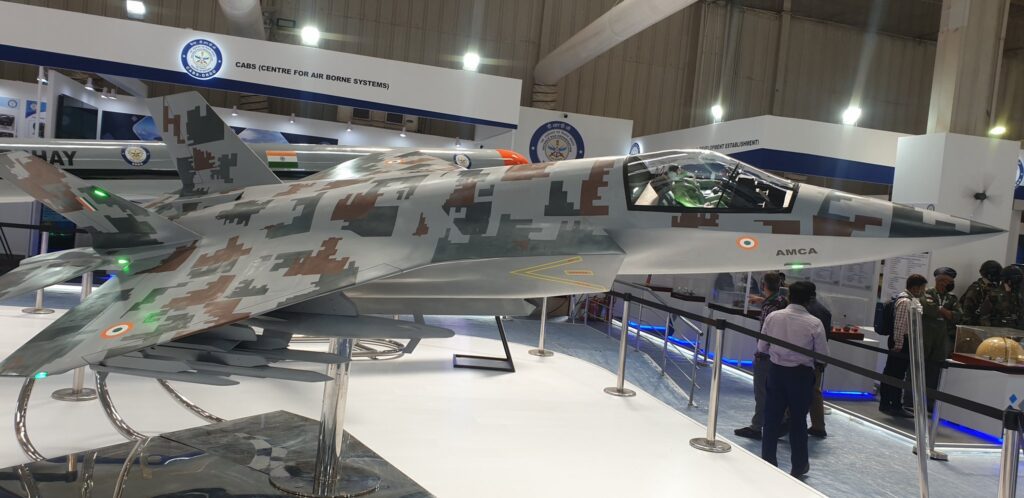
India’s sixth-generation ambitions run alongside the indigenous Advanced Medium Combat Aircraft (AMCA). The Committee records that the AMCA design has been developed and that production discussions are under way, and has asked for an update when the government files its next action-taken statement.
The report places LCA Mk-II and AMCA within India’s wider aircraft-development effort, while the Multi Role Fighter Aircraft (MRFA) programme is pursued to bridge the existing capability gap. India’s combat-aircraft planning now runs on several overlapping timelines: the LCA line expands indigenous production, LCA Mk-II offers a more capable indigenous platform, AMCA is India’s planned indigenous fifth-generation fighter, and FCAS concerns a further generation beyond that. For the IAF, the task is not choosing one aircraft but managing different requirements across different horizons without losing combat capability during the transition.
Why Does the Committee Want More Resources for the Air Force?
The Committee also flags the Air Force’s share of the Defence Services Estimates, which rose from 8.83 per cent in 2021-22 to 10.80 per cent in 2026-27. It argues the share should rise further, citing the current geopolitical environment and what it calls highly air-centric warfare.
Its argument is that air power needs more than fighters. The Committee has called for adequate resources for the IAF’s near-space operations, saying India must stay on par with other space powers, and links this to a “paradigm shift” in the technology of warfare. The question it poses is not only how many fighters India needs, but whether the Air Force has the resources and supporting capabilities to operate in an increasingly demanding technological environment.
What Does the Report Say About the Army?
The Committee commended the Army’s role in Operation Sindoor and pressed for sustained investment in preparedness, urging future budgets to prioritise state-of-the-art weapon systems and the infrastructure to support them.
It makes a direct argument on the Army’s capital budget: expenditure should stay proportionate to defence spending by neighbouring countries, and the budget should be sufficient to maintain a deterrent capacity in the event of hostility. The emphasis is on translation. A weapon system requires infrastructure, maintenance, ammunition and training before it becomes usable military power, so modernisation spending has to produce actual operational capability rather than equipment alone.
What Does the Report Reveal About the Navy?
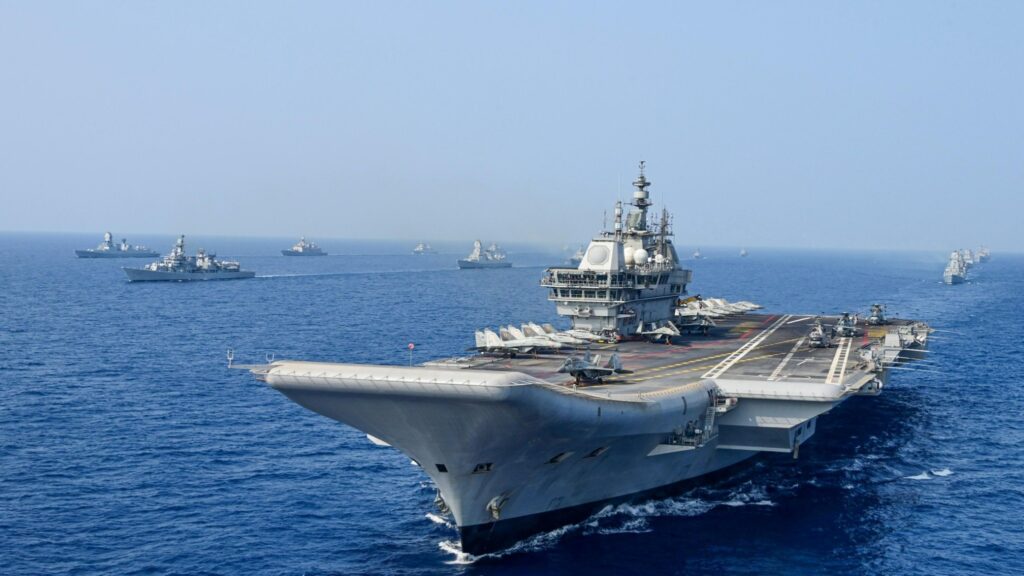
The Navy section shows the financial constraint most clearly. The government listed major projects, including a contract for 26 Rafale-M aircraft, follow-on support for MH-60R helicopters, and heavyweight torpedoes for Scorpene-class submarines.
Much of the Navy’s modernisation budget is already spoken for. Of the modernisation allocation, ₹47,748.31 crore, or 73.57 per cent, is earmarked for committed liabilities, while ₹17,146.28 crore, or 26.43 per cent, is available for new schemes. Committed liabilities are payments due under contracts signed in earlier years; only the smaller share can fund additional projects. A large capital allocation, in other words, is not the same as money available to spend now.
The broader budget data shows the same structural pressure. PRS Legislative Research notes that capital outlay is budgeted at 29 per cent of total defence expenditure in 2026-27, against the 40:60 capital-to-revenue ratio the Standing Committee has previously regarded as desirable, and that defence spending is estimated at around 2 per cent of GDP, below the 3 per cent the Committee has recommended.
Is This Only a Problem of Money?
No. The report also points to timing. India’s modernisation programmes can take years to move from design to production and induction. The FCAS discussion illustrates this: the Committee is asking for a roadmap and acquisition timeline even as India’s immediate requirements are met through other programmes, with AMCA still in development and LCA Mk-II part of the same effort.
Naval modernisation shows the mirror image, with large sums tied up in existing commitments. A capability approved today may take years to become operational, and delay can open gaps between the retirement of older systems and the arrival of replacements. The Committee’s insistence on status reports, roadmaps and timelines reflects those lead times rather than mere procedure.
What Does the Report Say About Self-Reliance?
The report ties modernisation to self-reliance in defence production. On the Air Force, the Committee notes efforts to progressively achieve self-reliance through the MRFA programme, expanded domestic manufacturing and the LCA line, with LCA Mk-II and AMCA remaining part of the indigenous effort.
The balance is difficult. Indigenous development takes time, while foreign purchase or co-development can supply technologies not yet available at home. The real question is not imports versus self-reliance, but how India combines foreign partnerships and domestic programmes without letting urgent procurement undermine long-term technological development. PRS notes, citing SIPRI data, that India was the world’s second-largest arms importer between 2020 and 2024 even as domestic production rose, and identifies limited high-tech manufacturing capacity and low R&D spending as continuing constraints.
What Does the Report Ultimately Reveal?
The report announces no single transformation, and it does not establish that India has joined a sixth-generation programme. What it reveals is a modernisation agenda running on several timelines at once. The Air Force is pushed to strengthen current capability while developing LCA Mk-II and AMCA and beginning to explore sixth-generation aircraft. The Army is asked to sustain investment in advanced weapons and infrastructure. The Navy pursues new platforms while most of its modernisation budget stays committed to existing contracts. And the IAF is asked to build near-space capabilities as the technology of warfare shifts.
The sharper distinction is between announcing a programme and creating a capability. India can hold a roadmap for AMCA, talks on FCAS, contracts for naval aircraft and helicopters, and plans for new technologies. The harder question is how quickly these translate into equipment that can be produced at scale, inducted, supported through service life and integrated into operational planning.
That is the most useful way to read the Committee’s report. It is not chiefly about the sixth-generation fighter. It is about the many demands competing for India’s defence resources and planning attention at the same time, with FCAS as the most visible illustration. The central question it leaves is straightforward: can India modernise across several technological generations quickly enough while sustaining the force it already has?
Note: This explainer has been researched, edited, and fact-checked by India’s World staff and prepared with AI assistance.