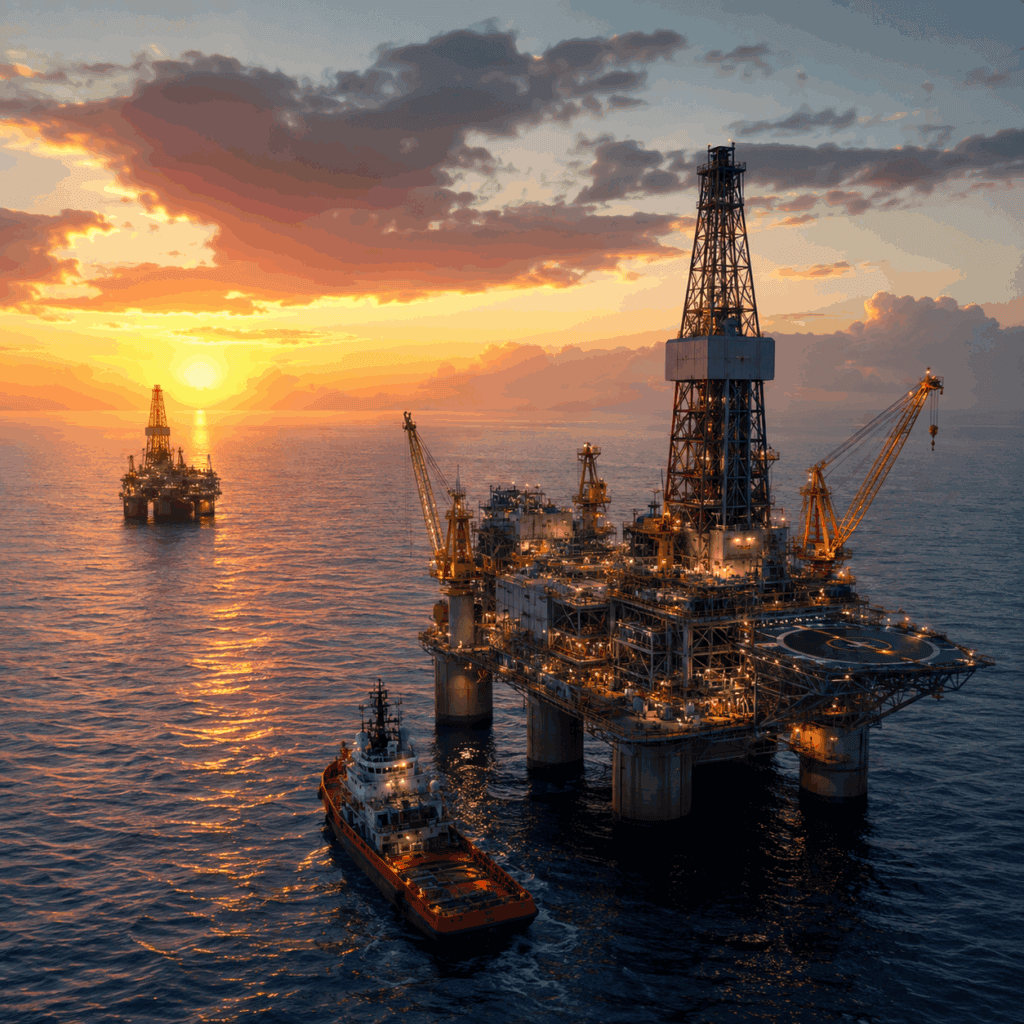
Samudra Manthan is the Indian government’s new ₹84,084 crore offshore exploration scheme, approved by the Union Cabinet on 31 July 2026, to search for oil and gas beneath India’s seas. It is an ambitious attempt to reduce the country’s dependence on imported energy, despite the harsh realities of deepwater exploration, where three out of every four wells fail to make a discovery.
India’s crude oil production has been declining for a decade, falling from 36.9 million tonnes in 2015-16 to 28.7 million tonnes in 2024-25, while its dependence on imported crude has climbed to a record 88.7%. The country also imports about half of the natural gas it consumes. In effect, nearly nine out of every ten barrels of oil India uses come from abroad, leaving its economy exposed to global prices and shipping routes beyond its control. To reduce that dependence, the Union Cabinet approved Samudra Manthan, the National Offshore Exploration Scheme, on 31 July 2026. Backed by ₹84,084 crore and administered by the Ministry of Petroleum and Natural Gas until 2030-31, the programme aims to search for oil and gas in the deep waters off India’s coasts. The scheme builds on an idea first announced by Prime Minister Narendra Modi during his Independence Day address in 2025. Its name draws from the mythological Samudra Manthan, the churning of the ocean by the gods in search of hidden treasures.
The Price of Exploration
The scheme covers far more than drilling alone. The first step is understanding what lies beneath the seabed. Around ₹28,500 crore has been allocated for large-scale 2D and 3D seismic surveys, which use sound waves to map underground rock formations, along with reprocessing older survey data to improve the National Data Repository. The largest allocation, ₹43,200 crore, will fund about 60 deepwater and ultra-deepwater exploration wells. Another ₹10,000 crore is earmarked for shared infrastructure such as pipelines and offshore platforms, allowing discoveries in basins like Mahanadi and Kutch to be brought ashore economically instead of remaining undeveloped. The remaining ₹2,000 crore will establish a manufacturing zone to produce drilling rigs and related equipment in India. The potential prize is substantial. According to ONGC, India’s eastern and western offshore basins could contain more than 5,600 million metric tonnes of oil equivalent (MMTOE), although most of these resources are yet to be proven.
The State Takes the Gamble
What makes Samudra Manthan different is not just its scale but who bears the financial risk. India has an exclusive economic zone covering more than two million square kilometres, yet much of it remains largely unexplored. The obstacle has been less about geology than about the cost and uncertainty of drilling. Under the scheme, the government will cover up to 50% of the eligible cost of a deepwater exploration well, capped at ₹675 crore per well. Instead of leaving companies to shoulder the full risk, the state will share the upfront cost. The logic is straightforward. A single deepwater well costs hundreds of crores, and three out of every four fail to make a discovery. In basins that even major international oil companies have largely avoided, few private firms are willing to invest on their own. By absorbing part of the early losses, the government shifts its role from simply auctioning exploration blocks to becoming a partner that shares the downside. This marks a significant change in industrial policy as well as energy policy.
Four Wells, Three Failures
The high failure rate becomes easier to understand once we see how oil accumulates underground. Oil does not collect in vast underground lakes. Instead, it seeps into the tiny pores of certain rocks. For a commercially viable deposit to form, five conditions must come together in what geologists Leslie Magoon and Wallace Dow described in 1994 as a working petroleum system. There must be a source rock that generates hydrocarbons from buried organic matter, a porous reservoir rock to store them, an impermeable seal to trap them, a geological structure that concentrates them, and the right timing so the trap forms before the oil escapes. If any one of these elements is missing, no oil field develops.
The odds reflect this complexity. According to Rystad Energy, offshore wildcat wells, those drilled in unexplored areas, had a success rate of just under 25% in 2020. In other words, three out of every four found no hydrocarbons. Even a successful discovery does not guarantee commercial production, since the quantities recovered may not be profitable to develop. Drilling a single deepwater well through more than a kilometre of water and several kilometres of rock costs between $80 million and $150 million. Even after a discovery, it typically takes another five to ten years of appraisal and infrastructure development before the field produces its first oil.
Chasing Guyana
The discoveries that supporters point to are exceptions rather than the norm. The benchmark is Guyana, where ExxonMobil’s Stabroek Block has achieved a success rate of nearly 80% since 2015. More than 30 discoveries there have uncovered close to 11 billion barrels of oil, with production from the first field beginning within five years. Namibia offers another, though smaller, example. Since 2022, major oil companies have made a series of discoveries in the Orange Basin. Both regions benefited from a rare geological combination: ancient source rocks that had filled deep reservoirs which had never been drilled before.
Examples of disappointment, however, are far more common. Near the Falkland Islands, Rockhopper’s Sea Lion discovery waited 14 years before reaching a final investment decision, the point at which a company commits to developing the field. Off Ireland, roughly 200 exploration wells drilled over five decades produced only four commercially viable discoveries. Off South Africa, TotalEnergies spent more than $400 million evaluating two discoveries before abandoning them in 2024 because they were too expensive to develop. The lesson for India is clear. Discovering oil is an essential first step, but it is no guarantee that production will ever follow.
What the Success Stories Have in Common
The countries that succeeded followed a similar path to the one India is now pursuing. Norway built its North Sea oil industry through decades of strong state involvement and investment in domestic engineering capabilities. Brazil also spent years developing deepwater technology before its vast pre-salt reserves began producing. In both cases, governments, rather than private companies, absorbed much of the early financial risk. India is adopting a similar approach, but with a different objective. Unlike Norway and Brazil, which developed their offshore resources to become major exporters, India’s goal is more modest: reducing its dependence on imported oil. That may sound like a smaller ambition, but achieving it at the scale India requires is no less challenging.
The Limits of Liberalisation
India already produces oil offshore, but output has continued to decline. Its largest offshore field, Mumbai High, has been in production since 1976. After peaking at 471,000 barrels a day in 1989, production has fallen to about 131,000 barrels a day, prompting ONGC to bring in BP to slow the decline. New discoveries have helped, but not enough. Oil production began at the Krishna-Godavari block KG-DWN-98/2 in January 2024, while a natural gas discovery in the Andaman Sea, reported in September 2025, tested at 87% methane. Even so, Rystad Energy notes that exploration in the region remains constrained by poor seismic data. Reflecting the urgency, ONGC began drilling its first Samudra Manthan well in the Mahanadi Basin on 25 July 2026, six days before the Union Cabinet formally approved the scheme.
The broader challenge is that opening more areas for exploration has not translated into higher production. Since the Open Acreage Licensing Policy (OALP) was introduced in 2017, the government has awarded 172 exploration blocks covering 378,652 square kilometres, allowing companies to choose the areas they wish to explore. Yet oil output has continued to fall. More acreage does not necessarily mean more promising geology. The clearest signal is who stayed away. Most major international oil companies did not participate, leaving the April 2025 OALP-IX round to ONGC, Oil India, Vedanta, and the Reliance-BP joint venture. When companies with the deepest financial and technical resources decide not to bid, it reflects their assessment of India’s geological prospects. ONGC has said it may drill as many as 150 deepwater wells under Samudra Manthan, more than double the 60 wells currently funded under the scheme, highlighting a gap between ambition and available resources.
Why Imports Will Persist
Even by the government’s own estimates, Samudra Manthan will reduce import dependence rather than eliminate it. The target is to raise India’s combined oil and gas production from about 62 MMTOE to 80 MMTOE a year by 2031, while adding more than 600 MMTOE to the country’s reserves over time. This would increase annual production by 10 to 15 MMTOE. Although these numbers appear significant, their impact is limited when measured against India’s growing energy demand. Ratings agency ICRA estimates that the scheme would reduce import dependence by only 3% to 5%. Based on the global average success rate of 25%, 60 exploration wells could produce roughly 15 discoveries. For the programme to meet its production targets, however, several of those discoveries would have to be exceptionally large, something that most frontier exploration campaigns fail to achieve.
Demand, meanwhile, continues to grow. The International Energy Agency (IEA) projects that India’s oil consumption will increase from 5.48 million barrels a day in 2023 to 6.6 million barrels a day by 2030. The Organization of the Petroleum Exporting Countries (OPEC) expects India to contribute more additional oil demand by 2050, about 8.2 million barrels a day, than any other country. Since deepwater projects typically take close to a decade to move from drilling to production, wells drilled in the late 2020s are unlikely to contribute much before 2031. In effect, the scheme is trying to catch up with a demand curve that continues to move ahead.
Building More Than Wells
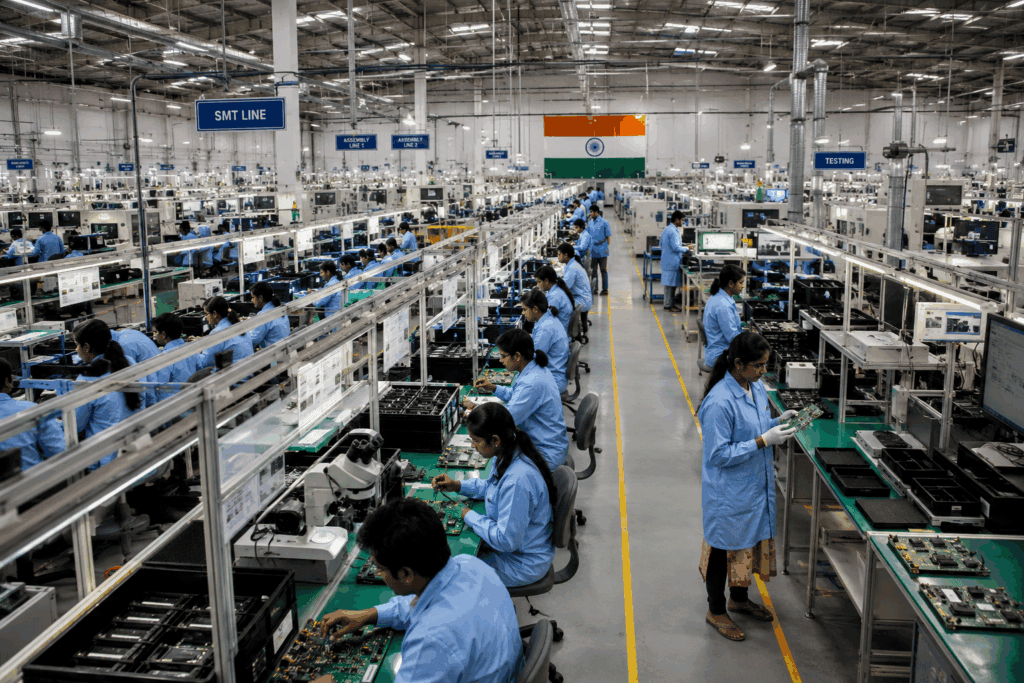
Samudra Manthan is not only about finding more oil and gas. It also aims to build India’s offshore energy capabilities. The scheme includes funding for a manufacturing zone, technology development, and specialised training to reduce dependence on imported drilling rigs, support vessels, and foreign expertise. In that sense, it complements the government’s broader Make in India and Atmanirbhar Bharat initiatives. The expectation is that a sustained offshore exploration programme will help develop a domestic ecosystem of engineers, geophysicists, equipment manufacturers, and subsea specialists whose value extends beyond any single discovery. But that outcome depends on maintaining a steady pace of exploration. Without enough drilling activity, the industrial base the scheme seeks to create may struggle to survive.
Betting on Time
If Samudra Manthan cannot free India from its reliance on imported oil, it could still make that dependence less risky. Disruptions in West Asia, the Strait of Hormuz, through which nearly half of India’s crude imports pass, and the Red Sea have already forced Indian refiners to reroute shipments and absorb higher freight and insurance costs. Every additional barrel produced at home avoids those vulnerabilities, giving even a modest increase in domestic production strategic value. That benefit, however, comes with environmental costs. Seismic surveys and offshore drilling can disturb marine ecosystems, a challenge that is likely to grow as exploration expands into new frontier waters.
The scheme also faces a longer-term uncertainty. India is rapidly expanding renewable energy, ethanol blending, electric vehicles, and green hydrogen, while the International Energy Agency’s central scenario projects that global oil demand will plateau around 2030. Seen in this context, Samudra Manthan is less a long-term destination than a bridge, providing the oil and gas India will continue to need as cleaner alternatives scale up. It also builds on a decade of reforms that opened almost all offshore acreage, including 99% of previously restricted areas, while modernising exploration licensing and geological data. What sets this programme apart is the government’s willingness to invest public money in exploration instead of waiting for private companies to take the risk. Whether India’s offshore basins ultimately deliver commercially viable discoveries will take years to determine. For now, the ₹84,084 crore investment guarantees something more immediate: the geological knowledge needed to find out.
Note: This explainer has been researched, edited, and fact-checked by India’s World staff and prepared with AI assistance.