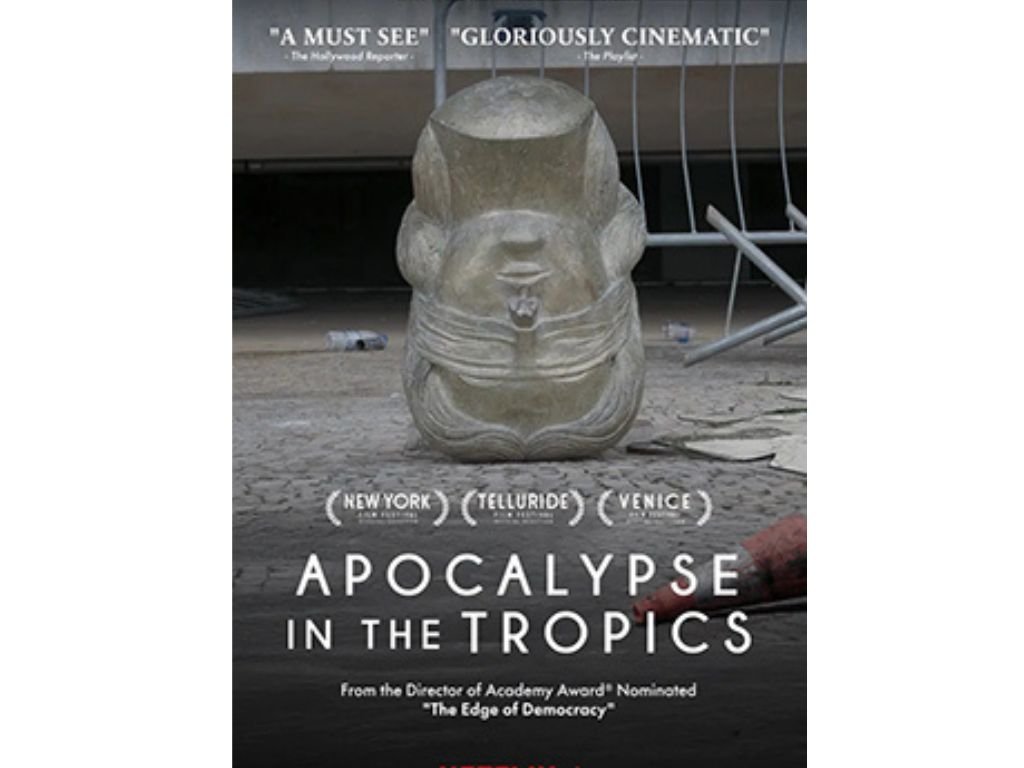
Over the past few decades, evangelical Christianity has emerged as a powerful political force in Brazil, reshaping public discourse and influencing electoral outcomes. What was once primarily a religious movement has increasingly become intertwined with questions of governance, nationalism, and political identity. This fusion of faith and politics has transformed Brazil’s democratic landscape, contributing to deep social polarisation and raising concerns about the role of religious institutions in public life.
Directed by Petra Costa, Apocalypse in the Tropics examines this transformation through a documentary that adopts a distinctly biblical framework. Structured around chapter titles such as “Genesis” and “Dominion,” the film traces the rise of evangelical political influence from the construction of Brasília in the 1960s to the turbulent years surrounding former President Jair Bolsonaro. Through interviews, archival footage, political rallies, protests, and moments of national crisis, Costa constructs a narrative that feels simultaneously historical and prophetic. The documentary’s biblical language gives familiar political events an unsettling quality, inviting viewers to see them as part of a larger struggle over power, belief, and national identity. Rather than relying on dramatic embellishment, the film draws its intensity from real events and the testimonies of those directly involved in them.
While occasionally slow-paced, Apocalypse in the Tropics succeeds in illuminating a complex political phenomenon with clarity and urgency. Its greatest achievement lies in showing how religion can be mobilised as a political tool, shaping public attitudes and influencing democratic institutions. The documentary does not offer easy conclusions or a reassuring ending; instead emphasising that the tensions it explores remain unresolved. For viewers seeking to understand contemporary Brazil and the growing intersection of religion and politics worldwide, it is an essential and deeply unsettling watch. As Karl Marx once described religion as an opiate, Costa’s film asks what happens when that opiate becomes a political weapon.