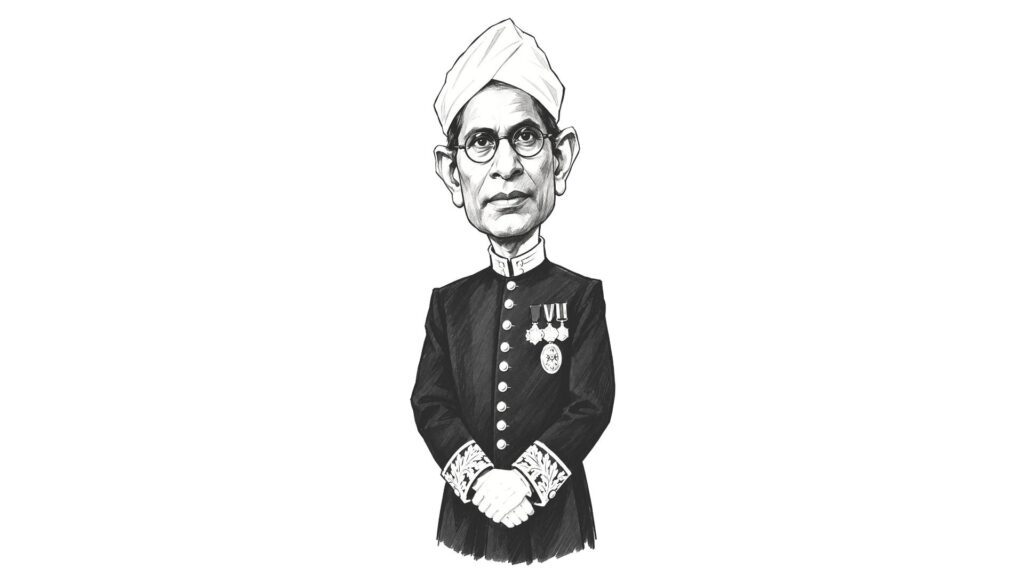
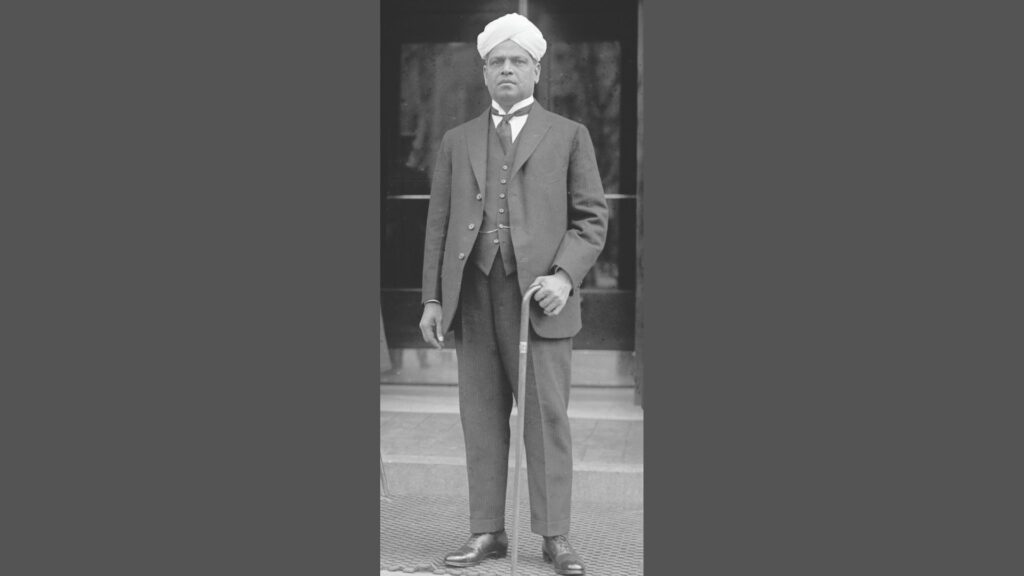
On 12 August 1922, a photograph of an Indian visitor appeared on the front page of The Victoria Daily Times, a Canadian newspaper. Dressed formally, with a receding crop of white hair and earnest eyes, V. S. Srinivasa Sastri had arrived in Canada to speak for the rights of Indians facing racial discrimination. The newspaper described him as “one of the most interesting and important visitors” to reach the country. Canada’s Under-Secretary of State for External Affairs, Joseph Pope, had travelled four days from Ottawa to Victoria to receive him. Sastri was not an ambassador in the modern sense. But he was helping establish what Indian diplomacy could look like before independence.
Born on 22 September 1869 in Valangaiman, near Kumbakonam, Sastri was the fourth child and eldest son of Vaidik Sankaranarayana Iyer Sastri and Balambal Sastri. His father belonged to a traditional Brahmin family of Sanskrit scholars and taught and recited Sanskrit scriptures. But learning did not bring prosperity. Sankaranarayana travelled in search of patrons and earned little, leaving the family in severe poverty.
Despite his circumstances, Sastri excelled in school. He studied at the Native High School in Kumbakonam and later at Government College, where he distinguished himself in English and Sanskrit. His mastery of English would later become one of his greatest diplomatic assets.
His first career was in education. He became a schoolteacher and eventually headmaster of the Hindu High School in Triplicane, Madras. In 1907, his life took a decisive turn when he joined the Servants of India Society founded by Gopal Krishna Gokhale. Sastri became one of Gokhale’s closest political associates and eventually succeeded him as president of the Society in 1915.
He served on the Madras Legislative Council from 1913 to 1916 and subsequently on the Imperial Legislative Council. In 1921, he represented India at the Imperial Conference and the League of Nations, and participated in the Washington Conference on the Reduction of Naval Armaments. That year, he was appointed to the Privy Council and received the Freedom of the City of London. In 1922, the Government of India sent him to Australia, New Zealand and Canada to press for the implementation of commitments concerning the rights of Indians in the Dominions.
Canada presented a difficult diplomatic challenge. Indians faced discriminatory immigration and citizenship policies, and Sastri sought to make the case for their equal treatment. His visit became an early example of an Indian representative using international diplomacy to challenge racial discrimination.
His most consequential diplomatic assignment came in 1927, when he was appointed India’s first Agent to the Union of South Africa. He served until January 1929, negotiating between the South African government, which sought to restrict the Indian population, and Indian communities fighting to protect their rights.
Sastri’s diplomacy was inseparable from his political philosophy. A committed liberal and constitutionalist, he believed India could advance through negotiation, persuasion and international opinion. This made him respected abroad but controversial among some Indian nationalists. Jawaharlal Nehru, in particular, regarded Sastri as excessively sympathetic to British rule.
After his diplomatic career, Sastri returned to academic life. In 1935, he became Vice-Chancellor of Annamalai University, a position he held for more than five years. He later returned to Madras, where he spent his final years and died in Mylapore on 17 April 1946, aged 76.
Sastri’s career offers an important glimpse of Indian diplomacy before independence: institutional, argumentative, and deeply concerned with equality.