
In a recent policy brief titled India as a Democratic Tech Power in the Liberal International Order, published by the Council on Foreign Relations (CFR), Constantino Xavier, Senior Fellow at the Centre for Social and Economic Progress (CSEP), examines India’s growing role in shaping global technology governance. Xavier argues that India is uniquely positioned to anchor a democratic alternative to China’s state-centric technology model, but its success will depend on the strength of its democratic institutions and its ability to build coalitions with like-minded partners.
The brief argues that India has become increasingly active in technology diplomacy through international partnerships, digital public infrastructure initiatives, and capacity-building programmes. Unlike its traditionally defensive positions on trade and climate negotiations, New Delhi has adopted a more ambitious approach to technology governance, seeking to shape international norms on artificial intelligence (AI), data governance, and digital infrastructure.
A central theme of the brief is the relationship between India’s domestic governance experience and its international ambitions. Xavier argues that despite concerns about democratic backsliding, India’s technology governance framework remains closer to democratic models than to authoritarian systems such as China or Russia. The brief highlights the Supreme Court’s recognition of privacy as a fundamental right in 2017 and the passage of the Digital Personal Data Protection Act in 2023 as examples of democratic institutions shaping digital governance.
The brief identifies three major challenges affecting India’s technology diplomacy. The first is the fragmentation of the global economy and the growing use of tariffs, export controls, and supply-chain restrictions as geopolitical tools. The second is the weakening of democratic institutions and public trust in many countries, creating greater space for authoritarian approaches to technology governance. The third is uncertainty created by the United States’ reduced commitment to multilateral leadership and democratic norm promotion.
According to Xavier, these developments have created a vacuum in global technology governance that China is increasingly seeking to fill. Beijing is expanding its influence through digital infrastructure projects, international institutions, and governance models that prioritise state sovereignty, surveillance, and centralised control. The brief warns that democratic countries risk losing both normative influence and economic opportunities if they fail to compete in shaping future technological standards.
To explain India’s potential role, Xavier highlights four key strengths. These include its democratic institutions, demographic scale, expanding pool of technology talent, and growing international influence. He argues that India’s leadership in the G20, engagement with the Global South, and participation in emerging technology coalitions reflect a broader ambition to shape the future international order.
The policy brief outlines three possible trajectories for India’s future role in global technology governance. In a democratic scenario, India works with other democracies to promote transparent and privacy-protective technology systems. In an agnostic scenario, it maintains strategic flexibility between competing blocs. In an authoritarian scenario, it moves closer to state-led governance models associated with China and Russia. Xavier argues that India currently remains closest to the democratic path.
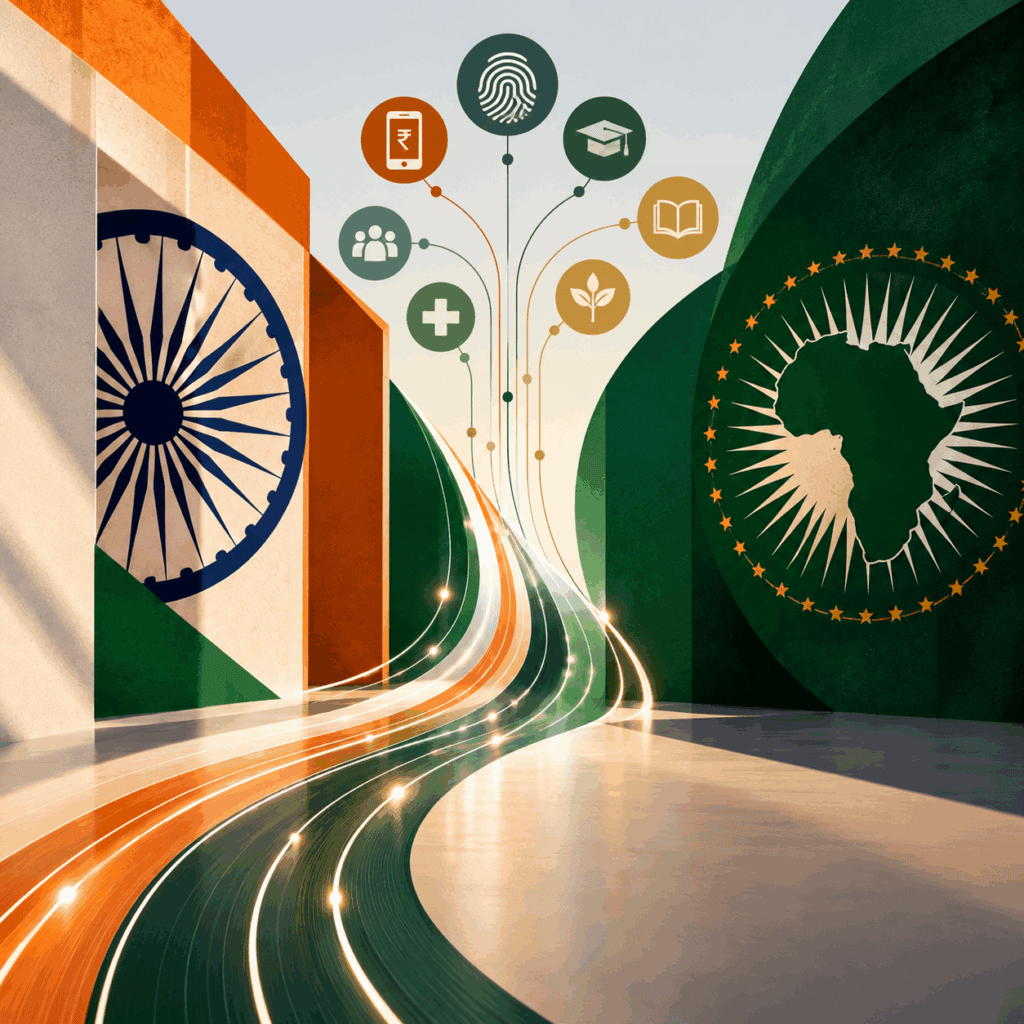
The brief also examines India’s emerging model of technology diplomacy. Xavier identifies several areas where New Delhi has sought to project influence, including convening global technology forums, promoting digital public infrastructure through India Stack, participating in minilateral initiatives such as the Quad, supporting development partnerships across the Global South, and expanding research cooperation with democratic partners.
At the same time, the brief highlights several contradictions that could undermine India’s credibility. These include frequent internet shutdowns, concerns about government access to data, scepticism towards some multilateral technology initiatives, and India’s continued commitment to strategic autonomy, which can create ambiguity regarding its international alignments.
The brief concludes that India possesses a rare combination of democratic legitimacy, technological capacity, market power, and geopolitical influence. However, Xavier argues that these advantages alone will not guarantee leadership. He recommends strengthening partnerships with democratic countries, expanding digital public infrastructure initiatives across the Global South, investing in technology capacity-building, and preserving domestic safeguards on privacy and accountability. According to the author, India’s choices in the coming years will play an important role in determining whether future technology governance is shaped by democratic or authoritarian principles.