Kusha enters long-range air-defence club
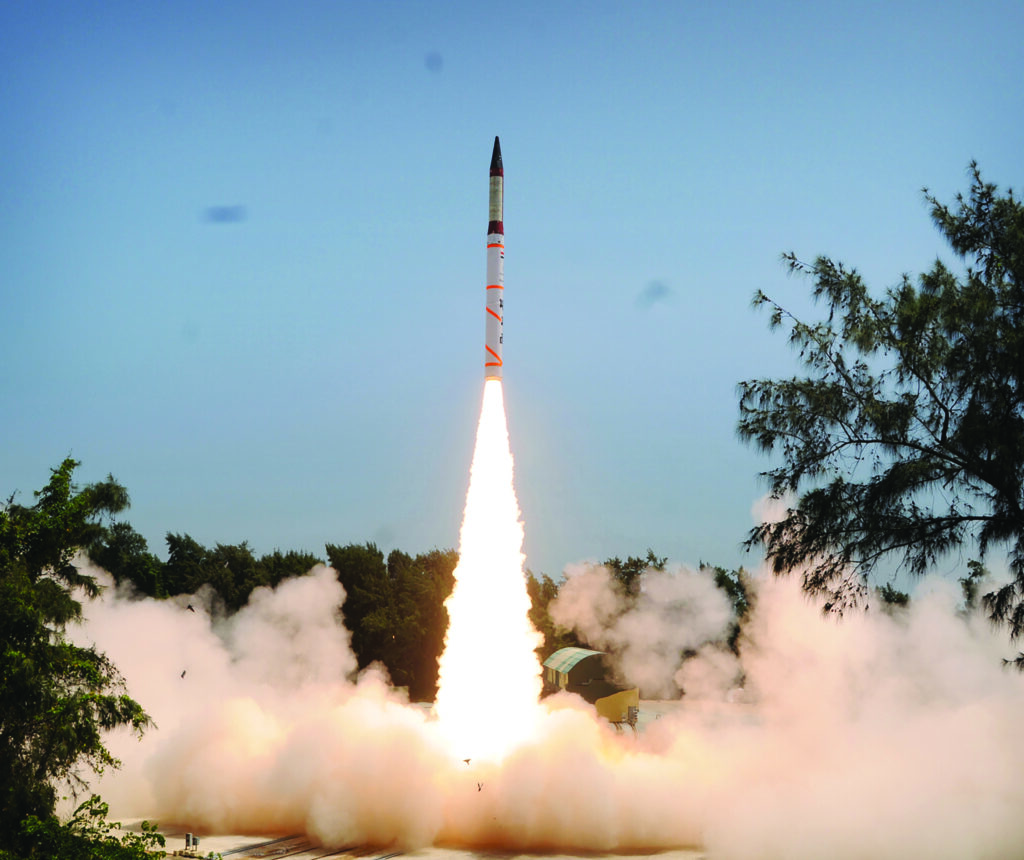
India conducted the maiden flight test of Kusha, its indigenous long-range surface-to-air missile system, on 23 July from the Integrated Test Range at APJ Abdul Kalam Island, Odisha. The missile successfully intercepted an electronic target simulating a high-speed, high-altitude aerial threat. Developed by the Defence Research and Development Organisation and industry partners, Kusha is intended to counter fighter aircraft, missiles, unmanned aerial vehicles and large enemy aircraft. The programme is planned around three missile variants, with the longest-range version expected to reach about 400 km. The test marks another step towards an indigenous layered air-defence architecture and reduces reliance on imported long-range systems.
China border trade resumes after six years
India and China resumed border trade through the Nathu La, Shipki La and Lipulekh passes on 1 August, restoring a channel that had remained suspended for six years. The reopening followed the broader stabilisation of India–China relations after years of military tensions along the Line of Actual Control. Trade through the three passes is scheduled on designated days until November, with specified traders and commodities. The move is economically modest but strategically significant. Border trade creates a practical mechanism for interaction in frontier regions while testing whether the recent political thaw between New Delhi and Beijing can translate into sustained local-level engagement. It also coincided with the resumption of the Kailash Manasarovar Yatra and other cross-border exchanges.
Agni-4 validates strategic missile readiness
India successfully test-fired the Agni-4 intermediate-range ballistic missile on 6 August from Chandipur, Odisha, in a user trial conducted under the Strategic Forces Command. The road-mobile, nuclear-capable missile has a range of about 4,000 km and forms part of India’s strategic deterrent. Unlike a developmental trial, a user trial is intended to validate the system under operational conditions. The launch therefore demonstrated not simply technological capability but the armed forces’ ability to maintain and periodically validate an established strategic system. Coming alongside continued development of longer-range missiles and new surveillance capabilities, the test reinforces India’s emphasis on maintaining a credible and survivable deterrent.
India formally maps 27 Arunachal locations
The government formally identified 27 places and geographical features in Arunachal Pradesh by their standard names on official Survey of India maps on 7 August. The list includes Longju, Dzo La, Riza La, Pukur La and Thag La, among other locations, as well as the Sher-e-Thapa Memorial. The move comes against China’s repeated attempts to assign alternative names to places in Arunachal Pradesh, which Beijing claims as “Zangnan”. By putting the names on official national maps, India is reinforcing its own cartographic and administrative position without altering the status of the disputed territory. The decision is therefore part of a broader contest over sovereignty and territorial narratives in the eastern Himalayas.
India moves towards sixth-generation fighter programme
India has initiated efforts to co-join the French-led Future Combat Air System, according to the Standing Committee on Defence report tabled in Parliament in August. The disclosure comes after Germany’s withdrawal from the programme, leaving France with fewer partners for its next-generation combat-aircraft project. The committee has asked the government to provide a roadmap and timeline for India’s possible participation while also seeking an update on the indigenous Advanced Medium Combat Aircraft programme. Participation in FCAS could give India access to technologies associated with sixth-generation combat aviation, including advanced sensors, networking and unmanned systems. At the same time, it raises questions about how a foreign collaborative programme would coexist with India’s own AMCA effort.
Modi outlines broader security architecture
Prime Minister Narendra Modi used his Independence Day address on 15 August to call for a major expansion of India’s civil-defence capabilities and a stronger push towards indigenous next-generation military technology. He argued that modern conflicts extend beyond conventional battlefields to data centres, financial systems and critical infrastructure. The government plans a large voluntary civil-defence force to respond to these emerging threats. Modi also called for India to become a global supplier of defence equipment, with particular emphasis on hypersonic technology, drones and counter-drone systems, while saying work on Mission Sudarshan Chakra, the planned indigenous air-defence shield, was progressing rapidly. The message signals a broader conception of national security spanning military, technological and civilian resilience.
Defence indigenisation expands to 405 items
The Department of Defence Production notified the sixth Positive Indigenisation List on 18 August, covering 405 strategically important items with an estimated business potential of ₹3,070 crore. The list includes 16 items used by the Indian Coast Guard and 389 associated with defence public-sector undertakings. The items span aircraft and engines, armoured vehicles, warships and missile systems, including components for the Su-30MKI, T-72, T-90 and MRSAM. The latest list extends a policy designed to progressively replace imported components with domestic production. Beyond reducing import dependence, the approach is intended to deepen India’s defence industrial base by creating demand for Indian manufacturers across the supply chain.
India and Japan deepen maritime security cooperation
India and Japan signed a Memorandum of Arrangement on Maritime Security Cooperation on 20 August, creating a framework for closer operational cooperation between the Indian Navy and Japan Maritime Self-Defense Force. The arrangement covers maritime-domain-awareness information sharing, search and rescue, humanitarian assistance and disaster relief, naval visits, exercises and logistical support, including access to ports and maintenance facilities. The two sides also agreed to explore cooperation in mine countermeasures, naval shipbuilding and design, and reciprocal ship-repair arrangements. A new working group will coordinate cooperation across operational, intelligence, equipment, technology and industrial domains. The agreement moves the relationship beyond broad strategic convergence towards more practical maritime integration in the Indo-Pacific.
Jaishankar reinforces Russia economic partnership
External Affairs Minister S. Jaishankar visited Moscow on 23–24 August to co-chair the 27th India-Russia Inter-Governmental Commission on Trade, Economic, Scientific, Technological and Cultural Cooperation. He also met Russian Foreign Minister Sergey Lavrov and President Vladimir Putin, to whom he delivered a personal message from Prime Minister Narendra Modi. Discussions covered trade, energy, fertilisers, nuclear cooperation and other economic sectors. Jaishankar also highlighted India’s concern over the widening trade imbalance and the need for greater Russian market access and removal of trade barriers. The visit demonstrates that India’s Russia relationship continues to operate across multiple tracks even as New Delhi manages increasingly complex ties with Western partners.
India–China boundary talks produce eight-point consensus
National Security Adviser Ajit Doval and Chinese Foreign Minister Wang Yi held the 25th round of Special Representatives’ talks on the India–China boundary question in Beijing on 25 August. Doval also met Chinese Vice President Han Zheng. The discussions covered the boundary question as well as bilateral, regional and international issues, with both sides stressing the importance of maintaining peace and tranquillity along the border. The talks produced an eight-point consensus that included continuing efforts towards a political settlement of the boundary question and maintaining stability along the frontier. The development marks another step in the cautious stabilisation of India–China relations, but does not amount to a settlement of the boundary dispute.