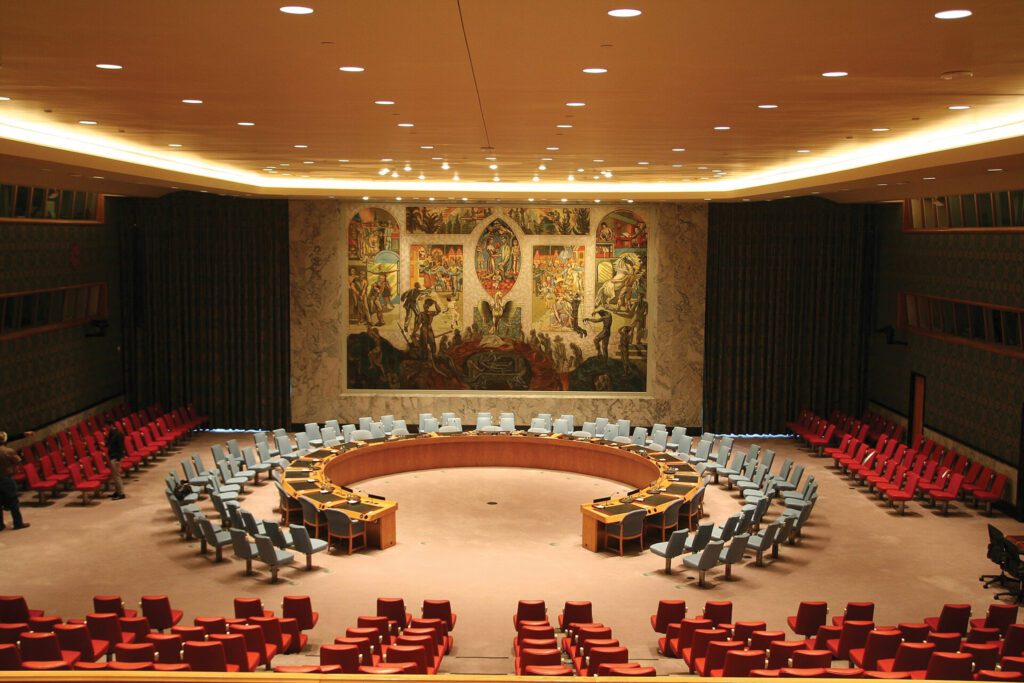
Every year, the United Nations General Assembly elects five countries to serve as non-permanent members of the United Nations Security Council (UNSC), which comprises fifteen members: five permanent members with veto power and ten elected members serving staggered two-year terms. Candidates must secure a two-thirds majority of the General Assembly members present and voting in a secret ballot. To ensure equitable geographical representation, the ten elected seats are allocated among the UN’s regional groups: three for the African Group, two for the Asia-Pacific Group, one for the Eastern European Group, two for the Latin American and Caribbean Group, and two for the Western European and Others Group. Election to the Security Council is widely regarded as a measure of a country’s diplomatic standing, international credibility, and ability to mobilise support across the UN membership.
India has been among the most successful candidates for election to the Security Council. Since its first successful bid in 1950, New Delhi has viewed the Council not merely as a forum to advance its national interests but also as a platform to represent the concerns of the developing world and strengthen multilateralism. Its credentials—ranging from one of the largest contributors to UN peacekeeping operations to leadership on decolonisation, South-South cooperation, counterterrorism, and maritime security—have earned it broad international support. As of 2026, India has completed eight terms as a non-permanent member of the Security Council, having contested ten elections. Building on this record, India has now launched its campaign for election to the Council for the 2028–29 term under the SHANTI (Securing Holistic Advancement through Norms, Trust and Integrity) vision, which sets out New Delhi’s vision for a secure, equitable and reformed multilateral order.
1950 Election (Term: 1950–51)
Prime Minister: Jawaharlal Nehru
Result: Elected
India secured its first election to the Security Council barely three years after independence. Its victory reflected the country’s growing international stature under Prime Minister Jawaharlal Nehru and its leadership in promoting decolonisation, peaceful coexistence, and the principles of the UN Charter. During its first term, India actively participated in discussions on the Korean War and emerging Cold War crises.
1966 Election (Term: 1967–68)
Prime Minister: Indira Gandhi
Result: Elected
After a gap of fifteen years, India returned to the Council during a period marked by Cold War rivalry and the rapid decolonisation of Asia and Africa. India advocated negotiated settlements to international disputes and consistently supported newly independent states in their efforts to strengthen sovereignty and development.
1971 Election (Term: 1972–73)
Prime Minister: Indira Gandhi
Result: Elected
India’s third term came immediately after the Bangladesh Liberation War. Having witnessed intense Security Council debates during the 1971 crisis, New Delhi used its tenure to emphasise humanitarian concerns, sovereign equality, and post-conflict stability while continuing to champion the interests of developing countries.
1975 Election (Term 1976–77)
Prime Minister: Indira Gandhi
Result: Defeated
India suffered its first setback in a fiercely contested election against Pakistan. The election required eight rounds of voting before Pakistan secured the necessary two-thirds majority. The outcome reflected Cold War alignments and the diplomatic after-effects of the 1971 South Asian conflict rather than any decline in India’s broader standing within the United Nations.
1976 Election (Term: 1977–78)
Prime Minister: Indira Gandhi
Result: Elected
India returned to the Security Council in the very next electoral cycle through the regional rotation process, demonstrating that its defeat the previous year had not diminished its widespread diplomatic support. During this tenure, India continued to advocate decolonisation, racial equality, and peaceful conflict resolution.
1983 Election (Term: 1984–85)
Prime Minister: Indira Gandhi
Result: Elected
India was elected without significant opposition during a period of heightened East-West tensions. Its diplomacy focused on strengthening the Non-Aligned Movement’s influence within the UN and promoting dialogue over military confrontation. India also supported peacekeeping efforts and called for greater attention to conflicts affecting the developing world.
1990 Election (Term: 1991–92)
Prime Ministers: V. P. Singh / Chandra Shekhar
Result: Elected
India entered the Council as the Cold War was coming to an end and the international order was undergoing profound transformation. During this term, the Security Council dealt with the Gulf War, the breakup of Yugoslavia, and a growing number of complex peacekeeping operations. India advocated respect for sovereignty while recognising the Council’s expanding responsibilities.
1996 Election (Term 1997–98)
Prime Minister: H. D. Deve Gowda
Result: Defeated
India’s second electoral defeat came against Japan, which eventually secured the required majority after several rounds of voting. Japan’s strong financial contributions to the United Nations, extensive diplomatic outreach, and broad support from developed countries gave it a decisive advantage. The setback also prompted India to intensify its campaign for comprehensive reform of the Security Council and permanent membership.
2010 Election (Term: 2011–12)
Prime Minister: Manmohan Singh
Result: Elected
India returned to the Council with overwhelming international support, securing 187 of 190 votes in the General Assembly. During this term, India played an active role in debates on Libya, Afghanistan, counterterrorism, peacekeeping, and maritime security. It also reiterated the need to reform the Security Council to better reflect contemporary geopolitical realities.
2020 Election (Term: 2021–22)
Prime Minister: Narendra Modi
Result: Elected
India was elected unopposed, receiving 184 of 192 valid votes. Its eighth term coincided with the COVID-19 pandemic and increasing geopolitical competition. During its presidency in August 2021, Prime Minister Narendra Modi chaired the Security Council’s first-ever high-level debate on maritime security. India also championed peacekeeping reforms, responsible use of technology in peace operations, counterterrorism, and stronger representation for developing countries in global governance.
India’s Record at a Glance
UN member since: 1945
Completed UNSC election contests: 10
Victories: 8
Defeats: 2
Completed terms served: 8
Opponents in defeats: Pakistan (1975) and Japan (1996)
Most recent term: 2021–22
Current campaign: Election for the 2028–29 term
UN peacekeepers contributed: More than 250,000 personnel to over 50 peacekeeping missions since 1948.
India’s electoral journey mirrors its evolution from a newly independent nation to one of the world’s leading diplomatic powers. Its repeated election to the Security Council underscores the confidence that the international community has placed in India’s commitment to multilateralism, peacekeeping, and the principles of the United Nations. As New Delhi campaigns for another term while continuing to advocate comprehensive reform of the Security Council, its strong electoral record reinforces its credentials as a leading voice of the Global South and a prominent contender for permanent membership of a reformed Council.