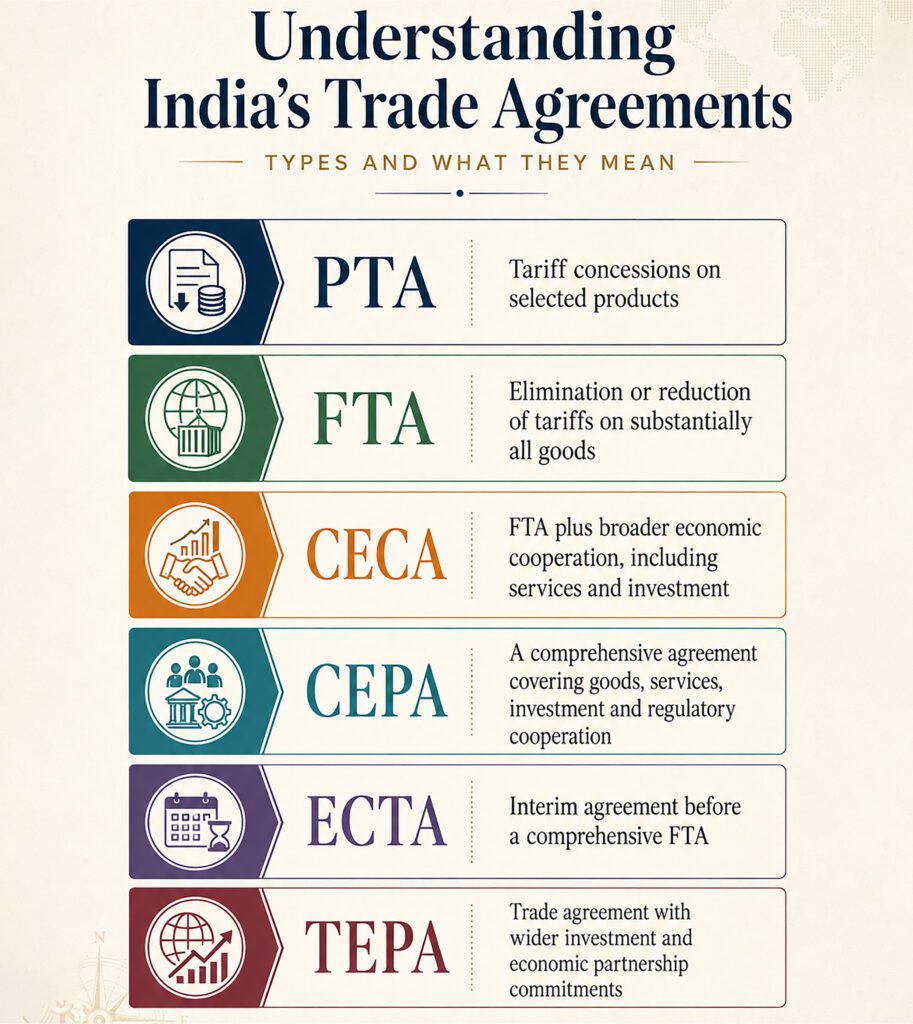
India’s Free Trade Agreement (FTA) programme is a relatively recent phenomenon. Although the economic reforms of 1991 fundamentally transformed India’s trade policy and integrated the country more closely with the global economy, New Delhi remained cautious about bilateral trade liberalisation for much of the decade. Instead, its regional trade engagement was largely confined to preferential trade agreements (PTAs), including the Asia-Pacific Trade Agreement (APTA), then known as the Bangkok Agreement, which India joined in 1975, the Global System of Trade Preferences (GSTP) in 1988, and the SAARC Preferential Trading Arrangement (SAPTA) in 1993. Unlike FTAs, which seek to eliminate or substantially reduce tariffs on most goods and often cover services and investment, PTAs provide tariff concessions on only a limited range of products.
A decisive shift came under Prime Minister Atal Bihari Vajpayee, whose government launched India’s first bilateral FTA negotiations with Sri Lanka in 1998. The negotiations culminated in the India–Sri Lanka Free Trade Agreement (ISLFTA), signed in December 1998 and entering into force on 1 March 2000, making it India’s first operational FTA. This marked the beginning of India’s FTA programme.
Between 1998 and 2011, India adopted a cautious but steadily expanding approach, concluding a handful of agreements with Sri Lanka, Singapore, ASEAN, South Korea, Malaysia, and Japan, while also signing PTAs with partners such as MERCOSUR and Chile. Several of these were negotiated as Comprehensive Economic Cooperation Agreements (CECAs) or Comprehensive Economic Partnership Agreements (CEPAs) rather than conventional FTAs, reflecting their broader scope. In addition to trade in goods, these agreements included commitments on services, investment, customs cooperation, intellectual property, and economic cooperation.
After 2011, however, India’s FTA momentum slowed amid concerns over widening trade deficits, limited export gains, and the impact of imports on domestic industry. These concerns culminated in India’s decision to withdraw from the Regional Comprehensive Economic Partnership (RCEP) negotiations in 2019.
Since 2021, India has embarked on what many describe as “FTA 2.0”, the most active phase of its trade diplomacy. Driven by the need to diversify supply chains, attract investment, boost exports, reduce dependence on China, and respond to an increasingly fragmented geopolitical landscape, India has concluded a series of high-standard agreements with Mauritius, the United Arab Emirates, Australia, the European Free Trade Association (EFTA), the United Kingdom, and Oman. As of 2026, India has 16 trade agreements in force, including FTAs, CEPAs, CECAs and Economic Trade Agreements, and is negotiating comprehensive trade deals with several major partners, including the European Union, the United States, Peru, Chile, and others. This factsheet traces the evolution of India’s FTA programme and provides a concise overview of each agreement, its key provisions, and its strategic significance.
I. Preferential Trade Agreements (PTAs)
Asia-Pacific Trade Agreement (APTA)
- Type: Preferential Trade Agreement (PTA)
- Partners: Bangladesh, China, India, Lao PDR, Mongolia, Republic of Korea and Sri Lanka
- India joined: 1975 (then known as the Bangkok Agreement)
- Indian Prime Minister: Indira Gandhi
- Commerce Minister: D. P. Chattopadhyaya
- Partner leaders: Foreign/Commerce Ministers of original signatory nations (Bangladesh, Laos, South Korea, Sri Lanka)
- Coverage: Goods
- Exports (FY 2025–26):~$48.5 billion (including China, South Korea, Bangladesh, Sri Lanka)
- Imports (FY 2025–26): ~$115 billion
- Total trade: ~$163.5 billion
- Key features: Tariff preferences on selected products | Rules of Origin | Regional trade cooperation
- Strategic significance: India’s first regional preferential trade arrangement.
- Current status: Active
Global System of Trade Preferences (GSTP)
- Type: Preferential Trade Agreement (PTA)
- Partners: 42 developing countries including Algeria, Argentina, Bangladesh, Brazil, Chile, Cuba, Egypt, India, Indonesia, Iran, Malaysia, Mexico, Pakistan, Peru, Philippines, Singapore, Sri Lanka, Thailand, Vietnam and others.
- Adopted: 1988
- Indian Prime Minister: Rajiv Gandhi
- Commerce Minister: Dinesh Singh
- Partner leaders: Signatories from 42 developing nations (UNCTAD / Group of 77 framework)
- Coverage: Goods
- Exports (FY 2025–26): ~$95 billion
- Imports (FY 2025–26): ~$110 billion
- Total trade:~$205 billion
- Key features: Tariff preferences among developing countries | South–South trade cooperation
- Strategic significance: The largest developing-country preferential trading arrangement involving India.
- Current status: Active
India–MERCOSUR Preferential Trade Agreement
- Type: Preferential Trade Agreement (PTA)
- Partners: Argentina, Brazil, Paraguay and Uruguay
- Negotiations launched: 2003
- Signed: 25 January 2004
- Entered into force: 1 June 2009
- Indian Prime Minister: Atal Bihari Vajpayee
- Commerce Minister: Arun Jaitley
- Partner leaders: Heads of Government of MERCOSUR member states (Argentina, Brazil, Paraguay, Uruguay)
- Coverage: Goods
- Exports (FY 2025–26): $4.8 billion
- Imports (FY 2025–26): $9.6 billion
- Total trade: $14.5 billion
- Key features: Tariff preferences | Rules of Origin | Customs cooperation
- Strategic significance: India’s first trade agreement with a South American regional bloc.
- Current status: Active (Expansion under discussion.)
India–Chile Preferential Trade Agreement
- Type: Preferential Trade Agreement (PTA)
- Partner: Chile
- Negotiations launched: 2004
- Signed: 8 March 2006
- Entered into force: 17 March 2007
- Expanded: 16 May 2017
- Indian Prime Minister: Dr. Manmohan Singh
- Commerce Minister: Kamal Nath
- Partner leader: President Ricardo Lagos / Foreign Minister Ignacio Walker
- Coverage: Goods
- Exports (FY 2025–26): $1.2 billion
- Imports (FY 2025–26): $1.6 billion
- Total trade: $2.8 billion
- Key features: Tariff preferences | Rules of Origin | Customs cooperation
- Strategic significance: India’s first preferential trade agreement with Latin America.
- Current status: Active (Further expansion under negotiation.)
II. Free Trade Agreements & Comprehensive Economic Agreements
India–Sri Lanka Free Trade Agreement (ISLFTA)
- Type: Free Trade Agreement (FTA)
- Partner: Sri Lanka
- Negotiations launched: 1998
- Signed: 28 December 1998
- Entered into force: 1 March 2000
- Indian Prime Minister: Atal Bihari Vajpayee
- Commerce Minister: Ramakrishna Hegde
- Partner leader: President Chandrika Bandaranaike Kumaratunga
- Coverage: Goods
- Exports (FY 2025–26):$5.5 billion
- Imports (FY 2025–26): $1.1 billion
- Total trade: $6.6 billion
- Key features: Tariff elimination | Rules of Origin | Negative List | Safeguard Measures
- Strategic significance: India’s first bilateral FTA.
- Current status: Active (Upgrade through ETCA under negotiation.)
Agreement on South Asian Free Trade Area (SAFTA)
- Type: Regional Free Trade Agreement (FTA)
- Partner: SAARC (Afghanistan, Bangladesh, Bhutan, India, Maldives, Nepal, Pakistan and Sri Lanka)
- Negotiations launched: 2001
- Signed: 4 January 2004
- Entered into force: 1 January 2006 (Tariff Liberalisation Programme from 1 July 2006)
- Indian Prime Minister: Atal Bihari Vajpayee (signed); Dr Manmohan Singh (implementation)
- Commerce Minister: Arun Jaitley
- Partner leaders: Heads of Government of SAARC member states
- Coverage: Goods
- Exports (FY 2025–26): $25.7 billion
- Imports (FY 2025–26): $4.2 billion
- Total trade: $29.9 billion
- Key features: Tariff Reduction Programme | Rules of Origin | Sensitive Lists | Safeguard Measures | Special and Differential Treatment for Least Developed Countries (LDCs)
- Strategic significance: Created South Asia’s first regional free trade area.
- Current status | Legally in force but largely dormant (Regional trade cooperation has remained constrained due to political tensions, particularly since the suspension of India–Pakistan bilateral trade in 2019.)
India–Thailand Early Harvest Scheme
- Type: Early Harvest Scheme (EHS) under the proposed India–Thailand FTA
- Partner: Thailand
- Negotiations launched: 2003
- Signed: 9 October 2003
- Implemented: 1 September 2004
- Indian Prime Minister: Atal Bihari Vajpayee
- Commerce Minister: Arun Jaitley
- Partner leader: Prime Minister Thaksin Shinawatra
- Coverage: Goods (82 products)
- Exports (FY 2025–26): $5 billion
- Imports (FY 2025–26):$9.8 billion
- Total trade:$14.8 billion
- Key features: Early tariff elimination on 82 products | Rules of Origin | Customs cooperation
- Strategic significance: India’s first Early Harvest Scheme, intended as the first step towards a comprehensive FTA.
- Current status: Partially operational (Negotiations for a full CECA remain stalled.)
India–Singapore Comprehensive Economic Cooperation Agreement (CECA)
- Type: Comprehensive Economic Cooperation Agreement (CECA)
- Partner: Singapore
- Negotiations launched: 2003
- Signed: 29 June 2005
- Entered into force: 1 August 2005
- Indian Prime Minister: Dr Manmohan Singh
- Commerce Minister: Kamal Nath
- Partner leader: Prime Minister Lee Hsien Loong
- Coverage: Goods | Services | Investment | Financial Services | Movement of Professionals
- Exports (FY 2025–26): $11.8 billion
- Imports (FY 2025–26): $21.2 billion
- Total trade:$33 billion
- Key features: Tariff elimination | Liberalisation of services | Investment protection | Double Taxation Avoidance | Mutual Recognition Agreements | Customs Cooperation
- Strategic significance: India’s first comprehensive economic agreement and a gateway to Southeast Asia.
- Current status: Active (Periodically reviewed and upgraded.)
ASEAN–India Trade in Goods, Services and Investment Agreement
- Type: Free Trade Agreement (FTA)
- Partner: ASEAN (Brunei, Cambodia, Indonesia, Laos, Malaysia, Myanmar, the Philippines, Singapore, Thailand and Vietnam)
- Negotiations launched: 2003
- Trade in Goods Agreement signed: 13 August 2009
- Entered into force: 1 January 2010
- Services and Investment Agreements signed: 13 November 2014
- Services and Investment Agreements entered into force: 1 July 2015
- Indian Prime Minister: Dr Manmohan Singh
- Commerce Minister: Anand Sharma
- Partner leaders: Heads of Government of ASEAN member states
- Coverage: Goods | Services | Investment
- Exports (FY 2025–26): $38.4 billion
- Imports (FY 2025–26):$89.6 billion
- Total trade: $128 billion
- Key features: Tariff liberalisation | Rules of Origin | Trade in Services | Investment Protection | Trade Facilitation
- Strategic significance: Integrated India more closely with Southeast Asia and strengthened the Look East Policy.
- Current status: Active (Trade in Goods Agreement under review)
India–South Korea Comprehensive Economic Partnership Agreement (CEPA)
- Type: Comprehensive Economic Partnership Agreement (CEPA)
- Partner: Republic of Korea (South Korea)
- Negotiations launched: 2006
- Signed: 7 August 2009
- Entered into force: 1 January 2010
- Indian Prime Minister: Dr Manmohan Singh
- Commerce Minister: Anand Sharma
- Partner leader: President Lee Myung-bak
- Coverage: Goods | Services | Investment | Intellectual Property
- Exports (FY 2025–26): $6 billion
- Imports (FY 2025–26): $21 billion
- Total trade: $27 billion
- Key features: Tariff elimination | Services liberalisation | Investment protection | Intellectual Property Rights | Competition Policy
- Strategic significance: India’s first CEPA with an OECD member economy.
- Current status: Active (Upgrade negotiations underway)
India–Japan Comprehensive Economic Partnership Agreement (CEPA)
- Type: Comprehensive Economic Partnership Agreement (CEPA)
- Partner: Japan
- Negotiations launched: 2007
- Signed: 16 February 2011
- Entered into force: 1 August 2011
- Indian Prime Minister: Dr Manmohan Singh
- Commerce Minister: Anand Sharma
- Partner leader: Prime Minister Naoto Kan
- Coverage: Goods | Services | Investment | Intellectual Property | Movement of Natural Persons | Customs Procedures
- Exports (FY 2025–26): $6 billion
- Imports (FY 2025–26): $ 16.8 billion
- Total trade: $22.8 billion
- Key features: Tariff elimination on around 90% of tariff lines over a phased period | Liberalisation of trade in services | Investment promotion and protection | Rules of Origin | Customs cooperation | Intellectual property provisions
- Strategic significance: One of India’s most comprehensive trade agreements with a major developed economy and a key pillar of the India–Japan Special Strategic and Global Partnership.
- Current status: Active
India–Malaysia Comprehensive Economic Cooperation Agreement (CECA)
- Type: Comprehensive Economic Cooperation Agreement (CECA)
- Partner: Malaysia
- Negotiations launched: 2008
- Signed: 18 February 2011
- Entered into force: 1 July 2011
- Indian Prime Minister: Dr Manmohan Singh
- Commerce Minister: Anand Sharma
- Partner leader: Prime Minister Najib Razak
- Coverage: Goods | Services | Investment | Movement of Professionals
- Exports (FY 2025–26): $6.8 billion
- Imports (FY 2025–26): $12.6 billion
- Total trade: $19.4 billion
- Key features: Tariff elimination | Liberalisation of services | Investment protection | Customs Cooperation
- Strategic significance: Deepened India’s economic engagement with ASEAN and complemented the India–ASEAN FTA.
- Current status: Active
India–Mauritius Comprehensive Economic Cooperation and Partnership Agreement (CECPA)
- Type: Comprehensive Economic Cooperation and Partnership Agreement (CECPA)
- Partner: Mauritius
- Negotiations launched: 2017
- Signed: 22 February 2021
- Entered into force: 1 April 2021
- Indian Prime Minister: Narendra Modi
- Commerce Minister: Piyush Goyal
- Partner leader: Prime Minister Pravind Kumar Jugnauth
- Coverage: Goods | Services | Investment | Rules of Origin | Technical Barriers to Trade (TBT) | Sanitary and Phytosanitary (SPS) Measures
- Exports (FY 2025–26): $.47billion
- Imports (FY 2025–26): $.08 billion
- Total trade: $.56 billion
- Key features: Preferential market access | Liberalisation of services | Investment facilitation | Trade remedies | Customs cooperation
- Strategic significance: India’s first comprehensive trade agreement with an African country and an important pillar of India’s Indian Ocean strategy.
- Current status: Active
India–United Arab Emirates Comprehensive Economic Partnership Agreement (CEPA)
- Type: Comprehensive Economic Partnership Agreement (CEPA)
- Partner: United Arab Emirates (UAE)
- Negotiations launched: September 2021
- Signed: 18 February 2022
- Entered into force: 1 May 2022
- Indian Prime Minister: Narendra Modi
- Commerce Minister: Piyush Goyal
- Partner leader: President Sheikh Mohamed bin Zayed Al Nahyan
- Coverage: Goods | Services | Investment | Digital Trade | Government Procurement | Customs Cooperation | Intellectual Property
- Exports (FY 2025–26): $37.3 billion
- Imports (FY 2025–26): $63.89 billion
- Total trade:$101.25 billion
- Key features: Duty-free access for most Indian exports | Liberalisation of services | Digital trade provisions | Trade facilitation | Rules of Origin | Customs cooperation
- Strategic significance: The flagship agreement of India’s FTA 2.0, strengthening economic integration with one of India’s largest trading partners and a key logistics hub.
- Current status: Active
India–Australia Economic Cooperation and Trade Agreement (ECTA)
- Type: Economic Cooperation and Trade Agreement (ECTA)
- Partner: Australia
- Negotiations launched: 2021
- Signed: 2 April 2022
- Entered into force: 29 December 2022
- Indian Prime Minister: Narendra Modi
- Commerce Minister: Piyush Goyal
- Partner leader: Prime Minister Anthony Albanese
- Coverage: Goods | Services | Movement of Natural Persons
- Exports (FY 2025–26): $7.2 billion
- Imports (FY 2025–26): $17.1 billion
- Total trade: $24.3 billion
- Key features: Tariff elimination on the majority of Indian exports | Liberalisation of services | Mobility provisions | Rules of Origin | Trade facilitation
- Strategic significance: an important step towards deeper Indo-Pacific economic integration.
- Current status: Active (Negotiations for a Comprehensive Economic Cooperation Agreement (CECA) are underway.)
India–European Free Trade Association Trade and Economic Partnership Agreement (TEPA)
- Type: Trade and Economic Partnership Agreement (TEPA)
- Partner: European Free Trade Association (EFTA) (Iceland, Liechtenstein, Norway and Switzerland)
- Negotiations launched: 2008
- Signed: 10 March 2024
- Entered into force: 1 October 2025
- Indian Prime Minister: Narendra Modi
- Commerce Minister: Piyush Goyal
- Partner leaders: Heads of Government of the EFTA member states
- Coverage: Goods | Services | Investment | Intellectual Property | Government Procurement | Sustainable Development
- Exports (FY 2025–26): $1.8 billion
- Imports (FY 2025–26): $22.4 billion
- Total trade: $24.2 billion
- Key features: Investment promotion | EFTA commitment to facilitate US$100 billion in investments over 15 years | Rules of Origin | Customs cooperation | Sustainable development provisions
- Strategic significance: The first agreement linking trade liberalisation with a quantified long-term investment commitment and a major milestone in India’s engagement with Europe.
- Current status: Active
India–United Kingdom Comprehensive Economic and Trade Agreement (CETA)
- Type: Comprehensive Economic and Trade Agreement (CETA)
- Partner: United Kingdom
- Negotiations launched: January 2022
- Signed: 24 July 2025
- Entered into force: 15 July 2026
- Indian Prime Minister: Narendra Modi
- Commerce Minister: Piyush Goyal
- Partner leader: Prime Minister Keir Starmer
- Coverage: Goods | Services | Investment | Digital Trade | Government Procurement | Intellectual Property | Financial Services
- Exports (FY 2025–26): $13.4billion
- Imports (FY 2025–26): $8.9billion
- Total trade:$22.3billion
- Key features: Tariff elimination across most goods | Liberalisation of services | Digital trade provisions | Government procurement | Rules of Origin | Mobility provisions for professionals
- Strategic significance: India’s most comprehensive bilateral trade agreement with a G7 economy and a major step in deepening post-Brexit economic ties.
- Current status: Active
India–Oman Comprehensive Economic Partnership Agreement (CEPA)
- Type: Comprehensive Economic Partnership Agreement (CEPA)
- Partner: Oman
- Negotiations launched: 2023
- Signed: 18 December 2025
- Entered into force: 1 June 2026
- Indian Prime Minister: Narendra Modi
- Commerce Minister: Piyush Goyal
- Partner leader: Sultan Haitham bin Tarik
- Coverage: Goods | Services | Investment | Digital Trade | Customs Cooperation
- Exports (FY 2025–26):$4billion
- Imports (FY 2025–26): $7.8 billion
- Total trade: $11.8 billion
- Key features: Tariff liberalisation | Liberalisation of services | Investment facilitation | Rules of Origin | Customs cooperation
- Strategic significance: Strengthens India’s economic engagement with the Gulf and complements India’s growing trade architecture in West Asia.
- Current status: Active
India–New Zealand Free Trade Agreement (FTA)
- Type: Free Trade Agreement (FTA)
- Partner: New Zealand
- Negotiations launched: 16 March 2025
- Negotiations concluded: 22 December 2025
- Signed: 27 April 2026
- Entered into force: Pending ratification
- Indian Prime Minister: Narendra Modi
- Commerce Minister: Piyush Goyal
- Partner leader: Prime Minister Christopher Luxon
- Coverage: Goods | Services | Investment | Digital Trade | Customs Cooperation | Intellectual Property | MSMEs | Movement of Professionals
- Exports (FY 2025–26): $.57 billion
- Imports (FY 2025–26): $.48 billion
- Total trade: $1.05 billion
- Key features: Duty-free access for 100% of Indian exports to New Zealand from entry into force. | Tariff reduction or elimination on 95% of New Zealand’s exports to India, with sensitive sectors such as dairy largely protected. | New Zealand to facilitate US$20 billion in investment into India over 15 years. | Enhanced mobility for Indian professionals and students. | Dedicated chapters on MSMEs, digital trade, customs cooperation, and women-led enterprises. | Rules of Origin and trade facilitation provisions.
- Strategic significance: One of the fastest negotiated FTAs in India’s history, strengthening India’s economic engagement with Oceania while safeguarding sensitive agricultural interests.
- Current status: Signed; awaiting entry into force (ratification).
III. Other Bilateral Trade Agreements
These are not FTAs, but the Government of India includes them in its list of trade agreements.
India–Nepal Treaty of Trade
- Type: Bilateral Trade Treaty
- Partner: Nepal
- Current Treaty of Trade: 2009 (periodically renewed)
- Indian Prime Minister: Dr. Manmohan Singh
- Commerce Minister: Anand Sharma
- Partner leader: Prime Minister Madhav Kumar Nepal / Commerce Minister Rajendra Mahato
- Coverage: Goods | Transit
- Exports (FY 2025–26): $7.4 billion
- Imports (FY 2025–26): $.9 billion
- Total trade: $8.3 billion
- Strategic significance: Provides Nepal preferential access to the Indian market and facilitates bilateral trade and transit.
- Current status: Active
India–Bhutan Agreement on Trade, Commerce and Transit
- Type: Bilateral Trade Agreement
- Partner: Bhutan
- Latest agreement signed: 2016
- Indian Prime Minister: Narendra Modi
- Commerce Minister: Nirmala Sitharaman
- Partner leader: Prime Minister Tshering Tobgay / Minister for Economic Affairs Lekey Dorji
- Coverage: Goods | Transit
- Exports (FY 2025–26): $1.25 billion
- Imports (FY 2025–26): $.48 billion
- Total trade: $1.73 billion
- Strategic significance: Forms the legal basis of the exceptionally close India–Bhutan economic relationship.
- Current status: Active
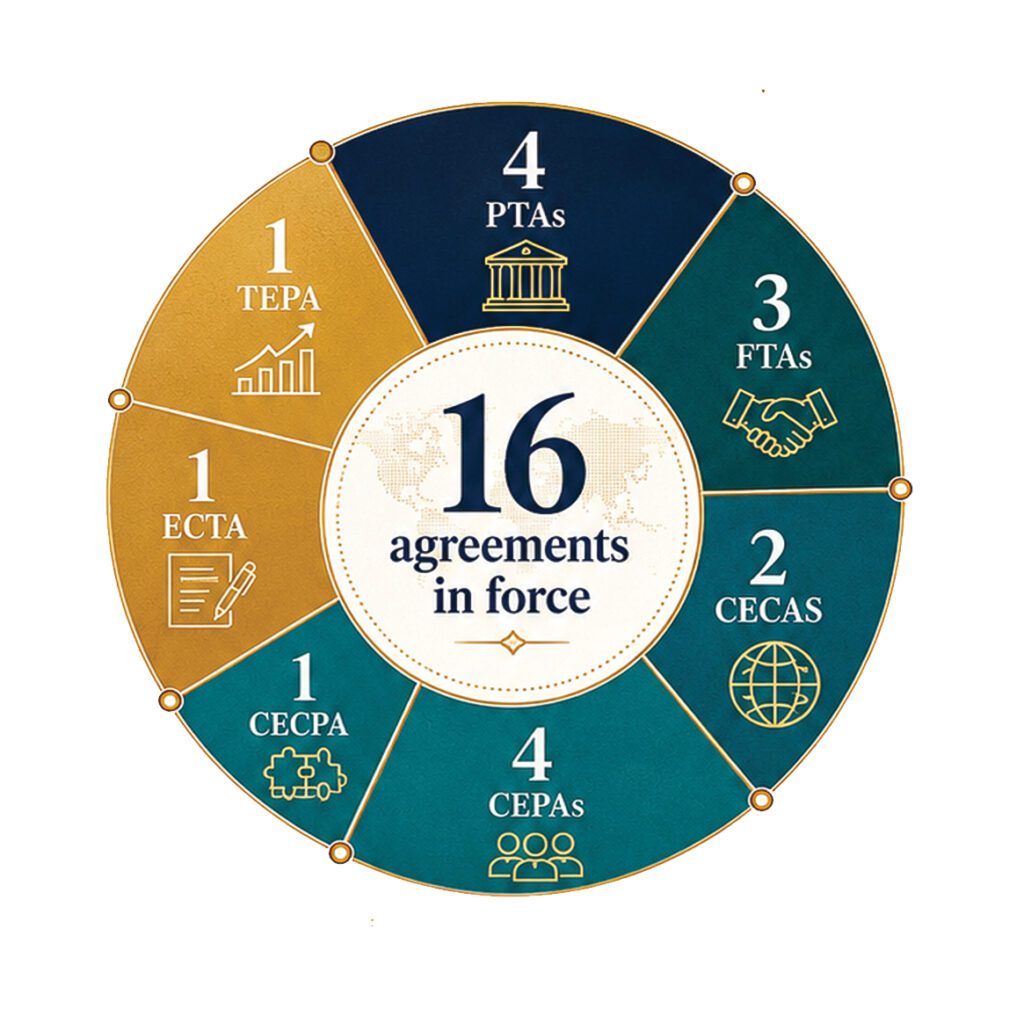
India’s Trade Agreements at a Glance (as of August 2026)
- Preferential Trade Agreements (PTAs): 4 (APTA, GSTP, Chile, MERCOSUR)
- Free Trade Agreements (FTAs): 3 (Sri Lanka, SAFTA, ASEAN)
- Comprehensive Economic Cooperation Agreements (CECAs): 2 (Singapore, Malaysia)
- Comprehensive Economic Partnership Agreements (CEPAs): 4 (Japan, South Korea, UAE, Oman)
- Comprehensive Economic Cooperation and Partnership Agreement (CECPA): 1 (Mauritius)
- Economic Cooperation and Trade Agreement (ECTA): 1 (Australia)
- Trade and Economic Partnership Agreement (TEPA): 1 (EFTA)
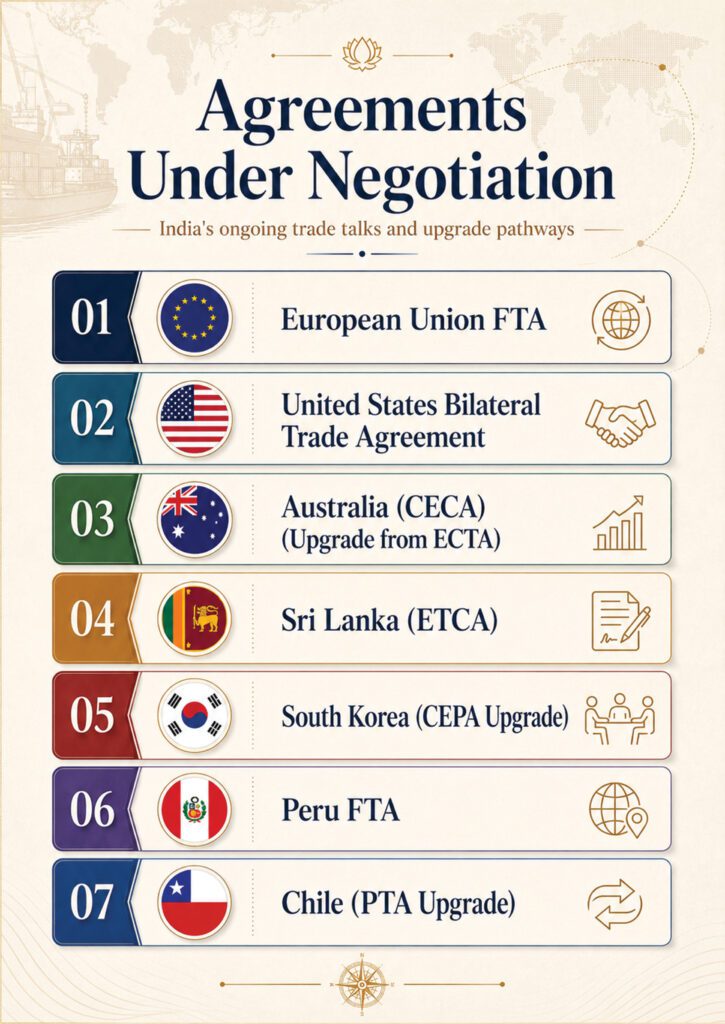
Agreements Under Negotiation
- European Union FTA
- United States Bilateral Trade Agreement
- Australia (CECA) (Upgrade from ECTA)
- Sri Lanka (ETCA)
- South Korea (CEPA Upgrade)
- Peru FTA
- Chile (PTA Upgrade)