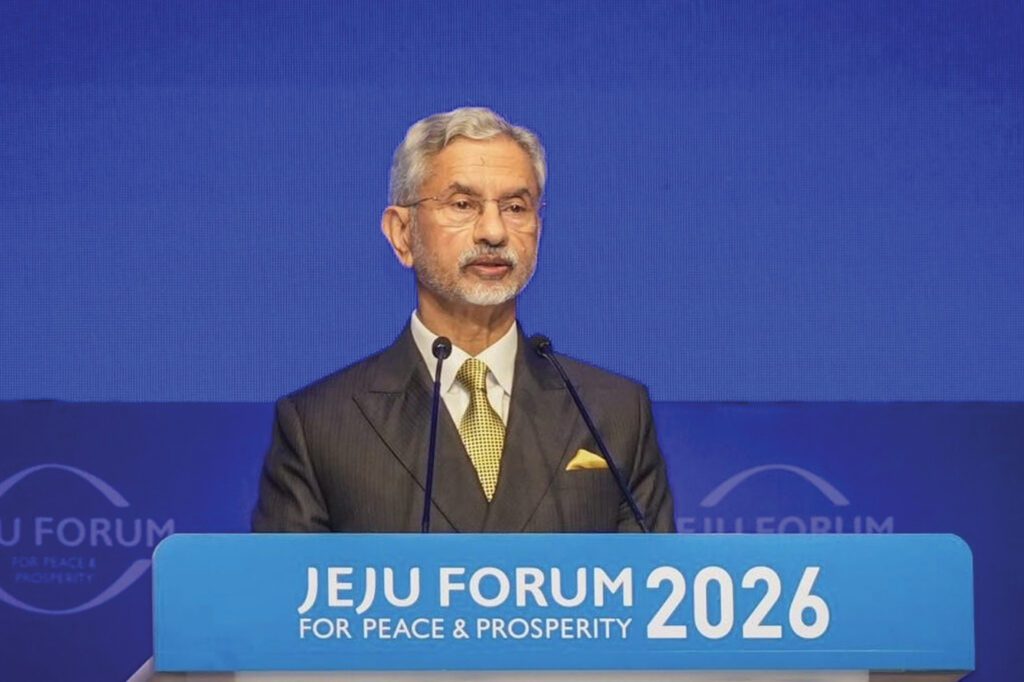
Jaishankar’s Five-Point Global Agenda
Speaking at the Jeju Forum for Peace and Prosperity in South Korea on 25 June 2026, External Affairs Minister S. Jaishankar argued that fragmentation of the international order is a structural reality rather than a passing phase. He outlined five priorities for navigating it. India should de-risk the global economy, diversify supply chains to reduce vulnerability to economic coercion, pursue issue-based cooperation among influential states, uphold international regimes such as UNCLOS, and strengthen Global South capacity. Each priority answers a constraint India already faces, from energy disruptions caused by the West Asia conflict and restricted access to critical minerals to violations of international law by permanent members of the UN Security Council.
Army Expands Dedicated Drone Units
Chief of Army Staff General Upendra Dwivedi announced on 29 June 2026 that the Army will raise Baaz Battalions by expanding existing Remotely Piloted Aircraft Flights into specialist units operating unmanned systems for intelligence, surveillance, and reconnaissance. The Army’s drone inventory has grown from a few hundred platforms two years ago to more than 50,000, and is expected to roughly double over the next two to three years. Referring to Pakistan’s parallel investments from multiple suppliers, he argued that operational advantage will depend less on platform numbers than on the ability to detect, track, and neutralise hostile drones.
Statutory Port Security Bureau Created
The government notified the Bureau of Port Security (BoPS) in late June 2026 as a statutory body under the Merchant Shipping Act, 2025. Modelled on the Bureau of Civil Aviation Security, it will regulate the security of ships and port facilities and includes a dedicated cyber security division. A senior Indian Police Service officer at Pay Level 15 will head it. During a one-year transition, Director General of Shipping Shyam Jagannathan will serve as Director General, while the Directorate General of Shipping has been redesignated the Directorate General of Maritime Administration. The Central Industrial Security Force will conduct security assessments and train licensed private security agencies. Home Minister Amit Shah directed that measures be calibrated according to vulnerability, trade significance and location.
Military Leadership Reshuffle
A wider round of senior appointments took effect on 1 July 2026. Air Marshal Ashutosh Dixit, an experimental test pilot and advocate of the Tejas and Advanced Medium Combat Aircraft programmes, moved from Chief of Integrated Defence Staff to Vice Chief of the Air Staff, succeeding Air Marshal Nagesh Kapoor, who became Director General of the Centre for Air Power Studies. Air Marshal Tejinder Singh assumed charge as Chief of Integrated Defence Staff, while Lieutenant General Sandeep Jain became Vice Chief of the Army Staff. Lieutenant General Mohit Malhotra took command of South Western Command, and Lieutenant General Rajesh Pushkar assumed command of Southern Command after leading 2 Corps during Operation Sindoor.
DRDO Gets Greater Financial Flexibility
Defence Minister Rajnath Singh released the Delegation of Financial Powers to DRDO (DFP-2026) on 29 June 2026. The framework introduces dedicated provisions for trial campaigns, testing and evaluation, authorises pre-project research, and separates grants-in-aid powers for extramural research, Defence Innovation Accelerator Centres of Excellence, and Technology Development Fund projects. Former Ministry of Defence Financial Adviser (Acquisition) Amit Cowshish told Business Standard that the changes cover smaller projects funded through the services’ revenue budgets and remain subject to fund availability and existing financial rules. The reforms are unlikely to alter the trajectory of India’s major strategic research programmes.
DAC Prioritises Air and Drone Defence
The Defence Acquisition Council, chaired by Defence Minister Rajnath Singh, approved capital acquisition proposals worth about ₹52,000 crore on 2 July 2026. For the Army, the package includes the Akash Tarang anti-drone electronic warfare system, man-portable anti-tank guided missiles, medium-range surface-to-air missiles, very short-range air defence systems with multi-spectral sensing, active protection systems for tanks, and jet-powered loitering munitions. The Navy secured multi-influence ground mines, shipborne unmanned aerial systems, and a land-based facility to test electric propulsion motors. The Air Force received fixed-wing high-altitude pseudo satellites to support persistent surveillance and remote sensing. The package prioritises countering aerial and unmanned threats rather than expanding conventional combat platforms.
Modi Tour Strengthens Indo-Pacific Ties
Prime Minister Narendra Modi’s visits to Indonesia, Australia and New Zealand produced agreements spanning defence, energy, and critical minerals, including the sale of BrahMos supersonic cruise missiles to Indonesia and renewed cooperation on civil nuclear fuel supplies with Australia. The tour unfolded amid heightened regional tensions, with China testing a nuclear-capable ballistic missile in the Pacific a day before Modi arrived in Indonesia. Foreign Secretary Vikram Misri confirmed the launch featured in discussions with Australian Prime Minister Anthony Albanese on 9 July 2026. The broader trend is towards closer regional security cooperation, illustrated by the Australia–Fiji defence pact, which New Zealand also plans to join. India’s continued dependence on Chinese machinery and rare earths constrains the extent of its strategic diversification.
Private Sector Opens Missile Production
The Ministry of Defence will issue a request for proposal inviting private firms, including ICOMM, Adani, Bharat Forge, the Tata Group and the Mahindra Group, to manufacture the Astra Mk 2 beyond visual range air-to-air missile for the Tejas Mk 1A, MiG-29, Su-30 MKI and Rafale Marine. The move reflects Bharat Dynamics Limited’s inability to meet both domestic demand and export commitments, with Indonesia seeking Astra missiles alongside BrahMos. The 500 km range Pralay tactical ballistic missile is expected to be the next programme opened to private industry. Astra Mk 2 was developed to counter the PL-15E supplied by China to Pakistan before Operation Sindoor, linking export demand and domestic procurement to the same strategic imperative.
Morgan Stanley Sees Manufacturing Boom
A Morgan Stanley report projects India’s manufacturing output will expand 2.8-fold to $1.5 trillion by 2035, increasing the sector’s share of GDP from 15% to nearly 20% and adding about $930 billion in output. Manufacturing GDP is projected to grow at around 9% annually, compared with 6.5% over the previous five years. Three factors carry the outlook. Targeted industrial incentives and higher public capital expenditure have been in place since 2019; India is integrating more deeply into global supply chains, and multinational firms are diversifying production away from China. Weaker domestic demand, slower reform implementation, and subdued global demand are identified as the principal downside risks. The projection aligns with the government’s National Manufacturing Mission and its $1.3 trillion export target for 2035.
India Launches SHANTI UNSC Campaign
External Affairs Minister S. Jaishankar launched India’s campaign for a non-permanent seat on the United Nations Security Council for 2028-29 at UN Headquarters in New York on 13 July 2026, under the theme SHANTI (Securing Holistic Advancement through Norms, Trust and Integrity). India and Tajikistan will contest the sole Asia-Pacific Group seat in June 2027. Having previously served eight terms on the Council, India has identified maritime security as a central priority, emphasising adherence to UNCLOS, unimpeded commercial shipping, counter-piracy cooperation, and the safety of seafarers. These reflect disruptions from the West Asia conflict and the Strait of Hormuz blockade, in which at least 13 Indians, most of them seafarers, have been killed since fighting began on 28 February. Countering terror financing, advancing climate action, and strengthening the voice of the Global South complete India’s platform.