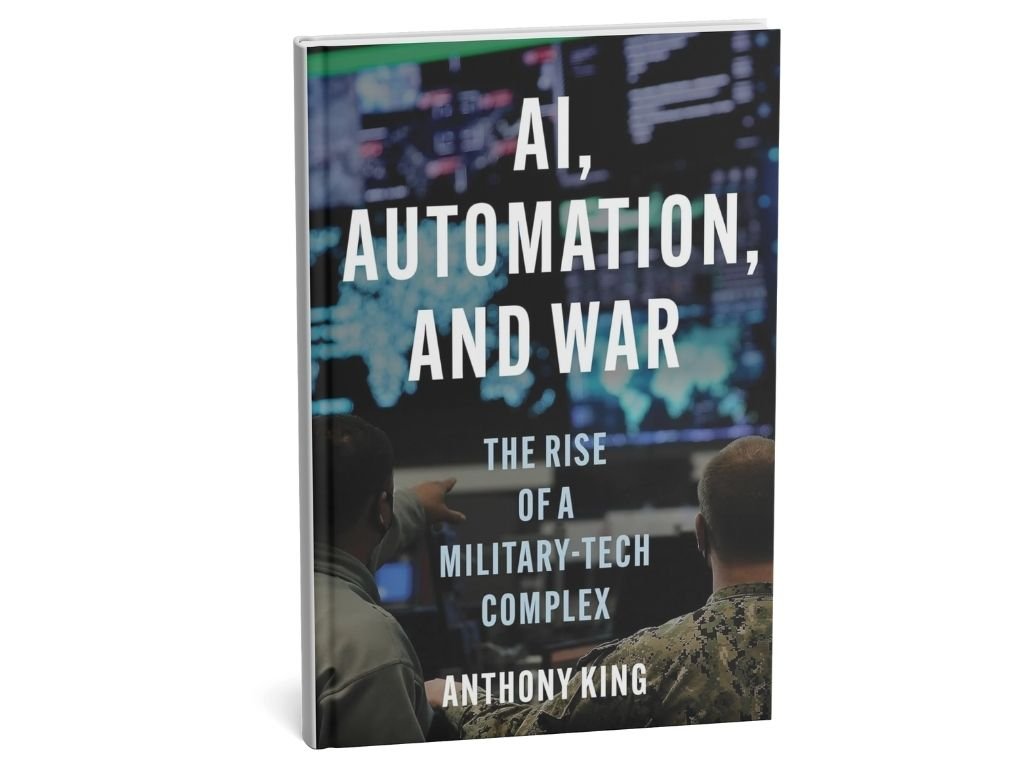
Professor Anthony King, author of Urban Warfare in the Twenty-First Century, delivers a modern classic in AI, Automation and War: The Rise of a Military-Tech Complex. The book revolves around concerns about autonomous weapons and the rise of increasingly intelligent systems; drones and robots controlled by algorithms—through which King presents a nuanced and richly detailed account of what military artificial intelligence might look like. Drawing on case studies and field interviews with 126 officers from armed forces, defence ministries, think tanks, and tech companies across the US, UK, he produces a detailed yet lucid analysis.
King begins by tracing the evolution of modern AI, from Charles Babbage and Alan Turing to the Dartmouth Conference and contemporary commercial applications of AI, such as Amazon’s recommendation engines and Tesla’s autopilots. He illustrates how AI advancement places us on the edge of the Fourth Industrial Revolution. This historical and commercial lens supports his core claim: second-generation, data-driven AI excels at pattern recognition but is narrow and specific, unable to interpret or redefine situations, especially ambiguous ones. In warfare, where conditions are uncertain and adversaries actively manipulate data, these limitations can be significant. Yet despite these constraints, AI’s ability to handle vast amounts of data makes it an indispensable tool for modern militaries, akin to the transformative effects of gunpowder, airpower, and tanks.
King also examines the fear surrounding AI as an ‘existential threat,’ highlighting campaigns like Stop Killer Robots and warning about lethal autonomous weapons, cyber escalation, and machines controlling strategic decisions and war. He notes China’s “New General AI Plan” and the US unveiling its “Third Offset Strategy” as signs of an emerging ‘AI arms race’. Yet, by analysing the record of second-generation AI in commercial contexts, he concludes that augmentation rather than full automation is more likely: advanced militaries are unlikely to hand over strategic decision-making to machines. Drawing on ongoing Russo-Ukraine and Israeli operations, King underscores that algorithms now assist intelligence gathering, operation planning, and targeting, but human personnel retain final authority.
One of the most compelling chapters in the book examines the new “military-tech complex,” an heir to the military-industrial complex. Describing it as a digital triangle linking tech agencies, armed forces, and defence ministries, King shows the quasi-privatisation of war, where firms such as Microsoft, SpaceX, Palantir, and Anduril supply software and data while operating closely with defence operational headquarters—discreetly, often covertly, and sometimes classified. He raises deep strategic and political questions, exemplified by Elon Musk’s control over Starlink in Ukraine.
The book is a fascinating, thought-provoking study, moving beyond dystopian visions of robot armies and AI takeovers to offer a more nuanced vision of human and machine coevolution: an unsettled, morally contentious terrain where data, corporations, and military personnel all contend for primacy.