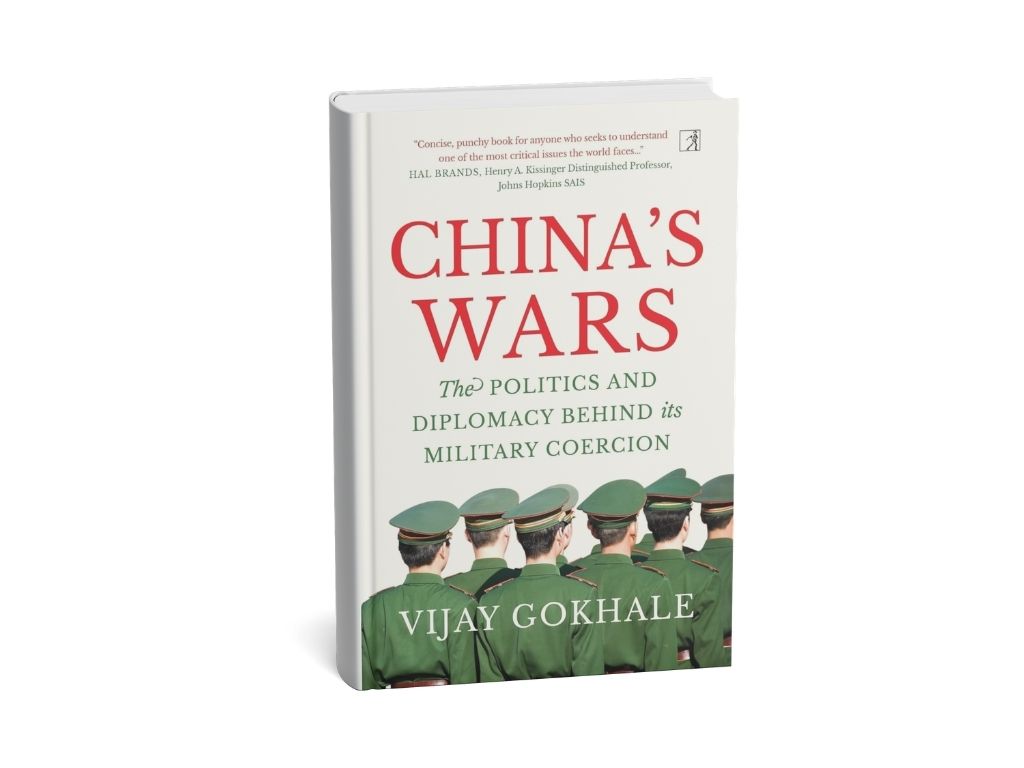
The People’s Republic of China’s coercive episodes blend the use of force, diplomacy, and narrative management to produce intended political outcomes. Existing scholarship tracing this pattern often reproduces a bias sympathetic to the PRC’s victimhood narrative, as it relies disproportionately on non-Chinese archival sources due to limited access to Chinese primary sources. Against this background, Vijay Keshav Gokhale’s China’s Wars: The Politics and Diplomacy Behind Its Military Coercion re-examines China’s military coercion beyond Beijing’s official narratives. By unravelling the strategic anatomy of Beijing’s coercive statecraft, it traces how force becomes politically meaningful before, during, and after conflict.
Gokhale’s core argument is that Beijing’s military coercion is neither purely tactical nor impulsive. Rather, it serves as a calibrated political instrument aimed at generating political-psychological shock, compellence, and preventing adverse shifts in the status quo. Even when China initiates force, the political grammar of “counterattack in self-defence” legitimises such actions by translating offensive strikes into defensive necessity.
The author goes beyond treating the PRC’s conflicts as isolated bilateral episodes and identifies recurring patterns. From the 1958 Taiwan Strait crisis to the 1979 Vietnam war, and the post-Cold War grey-zone coercion, the PRC’s resort to force was shaped by a combination of factors: regime security, strategic anxieties, territorial consolidation, and great-power triangularity among China, the United States, and the Soviet Union. Within this template, Gokhale re-examines the 1962 Sino-Indian conflict beyond what appeared prima facie as a frontier conflict.
In the author’s reading, the war’s most durable effect lies in inflicting political-psychological shock and altering India’s risk calculus. Ultimately, the PRC used coercion as a means to stabilise a disputed frontier without settling the dispute and kept India in prolonged armed coexistence.
The book’s strength lies in moving beyond war chronology towards a strategic synthesis of China’s coercive past. By drawing connections between diplomacy, force, narrative management, and geopolitical timing, the book reveals how coercive statecraft unfolds in time and space. Its limitation lies in its relatively thin theoretical engagement with coercion, deterrence, compellence, and grey-zone conflict. It also pays less attention to weaponised interdependence and economic coercion, tools increasingly central to the contemporary PRC’s statecraft. Yet these limits do not diminish its value; they clarify the book’s nature as a strategic diagnosis rather than a theoretical treatise.
Modern-day conflicts increasingly unfold across multiple domains, obscuring the distinction between war and peace. For Gokhale, this logic is not new to Beijing; it has roots in Chinese strategic culture, and the PRC’s early leadership, and now finds wider expression. The book’s larger warning is therefore clear: India must learn to read Beijing’s coercive playbook before the first shot is fired.