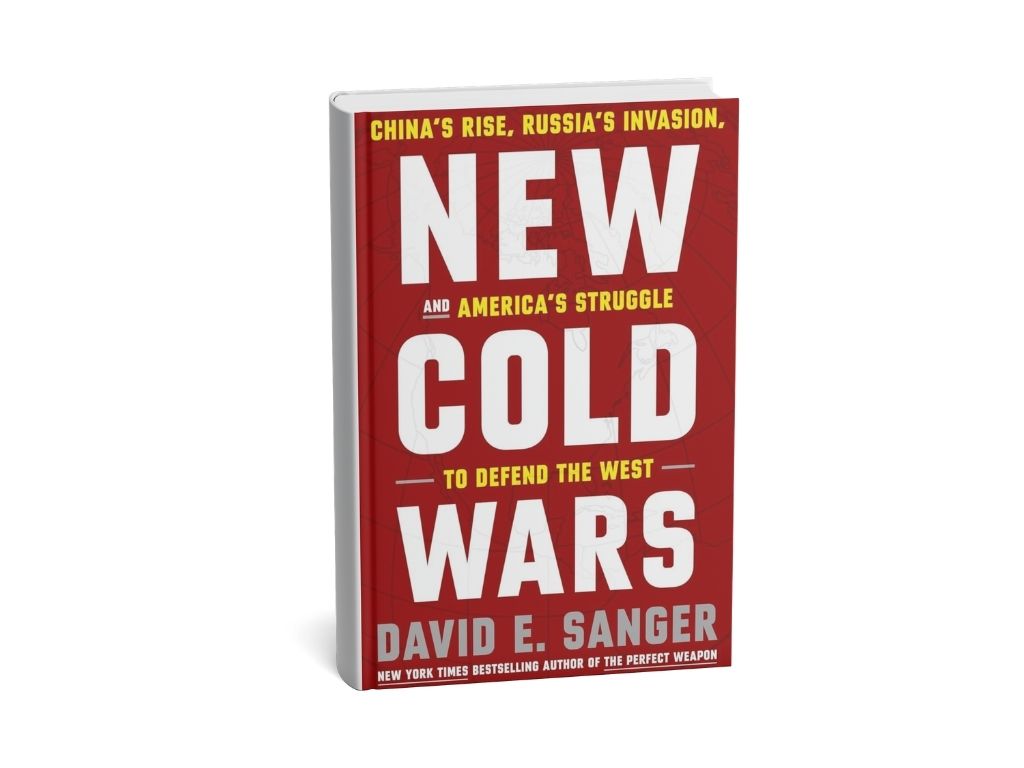
It was the moment of unipolarity. Having won the Cold War, Washington believed that economic prosperity would ultimately trump nationalism and territorial ambition. China would focus on skyrocketing domestic growth, Putin would prioritise oil and gas revenue over territorial ambitions, and eventually, China and Russia would integrate with the West in their own ways. David E Sanger writes, “This has come to be regarded as a fantasy era.”
Underlying these strategic miscalculations, Sanger argues, were Washington’s wishful thinking and faulty assumptions. One strategist describes this tendency as “strategic narcissism”, placing America at the centre of every foreign policy problem. In this book, Sanger is aware of the hubris of the American liberal international order. Having acknowledged these failures, he turns to the larger question: can American strategy adapt?
As the title suggests, he’s not shying away from calling it a “New Cold War” with China and Russia, and potentially a Sino-Russian partnership. He goes on at length, describing how the US found itself in another Cold War. By the time a realisation of the need for course correction occurred, three great powers with vast nuclear arsenals were already locked into a competition for military, economic and technological superiority. This book impressively covers a range of topics, from “chip war” in Taiwan to the battlefield reality of the Russia-Ukraine conflicts. Sanger’s elite-level reach as the correspondent for The New York Times gave him access to policymakers and strategists in Washington, making his writing a part of policy history. His diagnosis of the “fantasy era” and choices made under the assumption of “liberal triumphalism” are to tell US allies: to keep faith in American liberals.
However, Sanger’s overreliance on the Cold War analogy oversimplifies the current state of affairs. In essence, his analysis is close to committing the same mistakes he documents in the book. Although Washington, Moscow, and Beijing are the major centres of power, the global order is not bi- or tri-polar. Instead, the international system is increasingly multipolar, in which the middle powers of the Global South have a significant say in how the norms and rules of the current order should be formulated.
Providing a geopolitical account of a world in transition is akin to taking a shot at moving the target. The book’s strength lies in covering the US, China and Russia in such detail from broad theory to objective analysis. He warns of the coming of great wars, with technology at the forefront.
Whether one accepts Sanger’s Cold War framework or not, New Cold Wars offers a compelling account of how American strategic assumptions unravelled and why the next era of great-power competition may prove even more dangerous than the last.