The May 2026 BRICS Foreign Ministers’ meeting ended without a joint declaration. India, as chair, issued a Chair’s Statement instead. The reasons sit at the centre of the bloc’s enlargement.
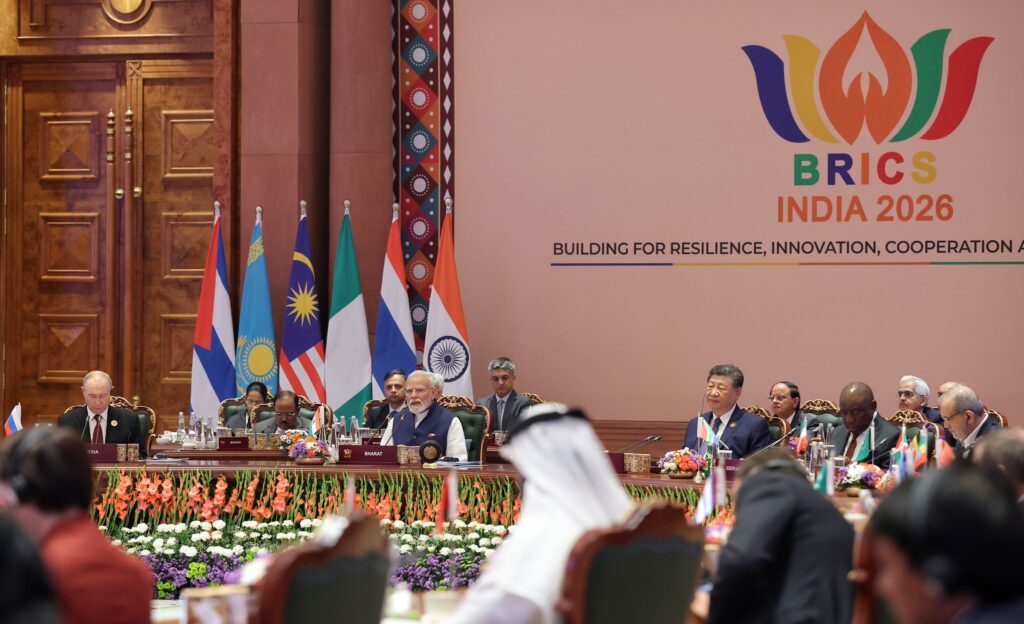
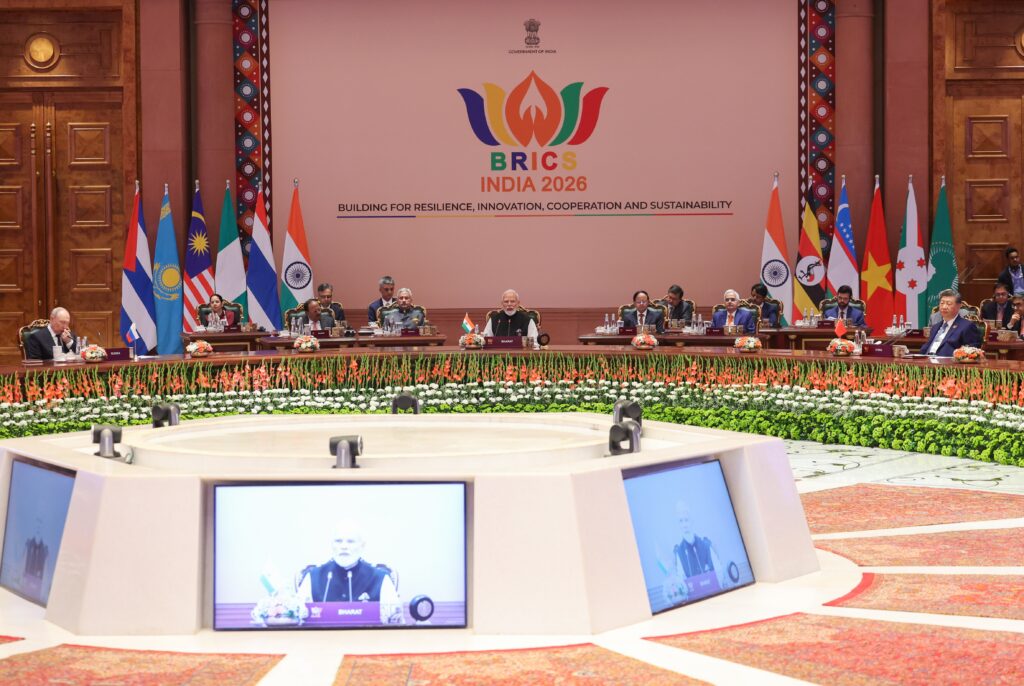
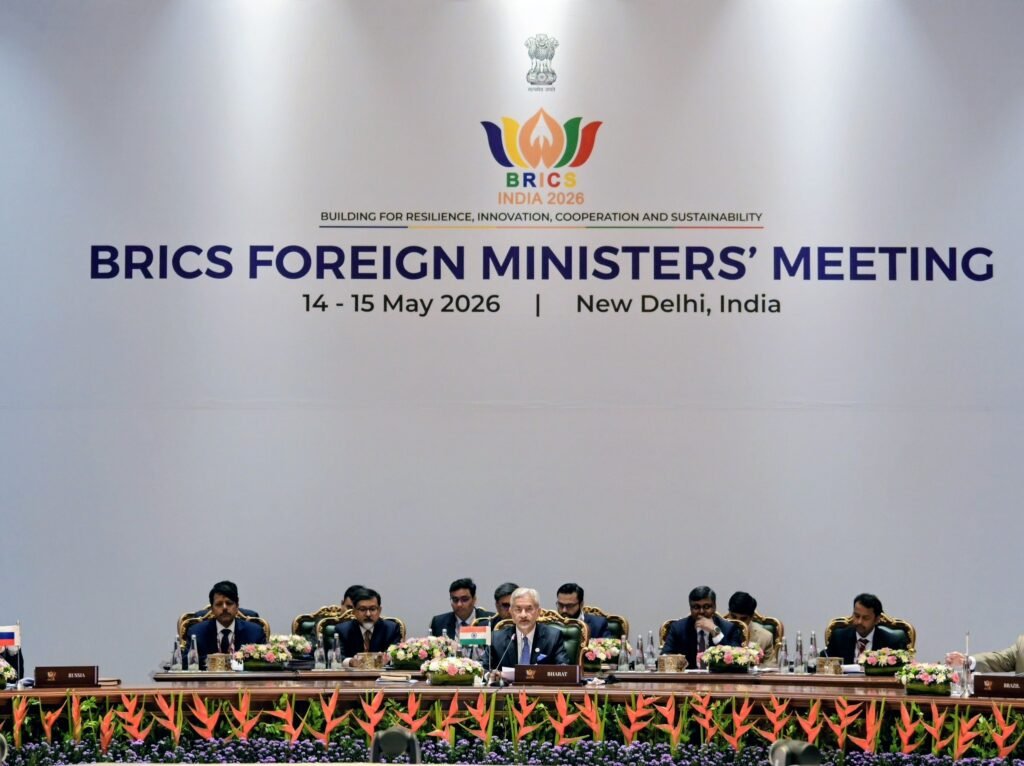
India closed the BRICS Foreign Ministers’ meeting in New Delhi on 15 May 2026 without the outcome that chairs usually aim for. The eleven member states could not agree on a joint declaration. India released a Chair’s Statement and Outcome Document instead. The text ran to 63 paragraphs, but two of them carried footnoted reservations, and one openly acknowledged differing views on West Asia. The wording is unusual for BRICS and points to a wider problem: the bloc has expanded, and consensus has become harder to arrive at.
The meeting, held on 14 and 15 May at Bharat Mandapam under India’s 2026 chairship, took place against the backdrop of the US-Israel war on Iran, blockade-related disruption at the Strait of Hormuz, and continuing instability in Gaza, Lebanon, Sudan, Syria, and Yemen. It followed a preparatory ministerial held on 26 September 2025 on the sidelines of UNGA 80, where India, as the incoming chair, had set out its agenda. In Delhi, the divergences that the September meeting had managed to paper over became formal record.
India’s Chairship: Theme, Priorities and Strategic Messaging
India’s chairship theme, Building for Resilience, Innovation, Cooperation and Sustainability, framed the meeting. Ministers reaffirmed BRICS’s three pillars: political and security cooperation, economic and financial cooperation, and people-to-people exchanges. They repeated the bloc’s commitment to openness, equality, and consensus.
The Chair’s Statement gave most space to reform of global institutions: the United Nations and its Security Council, the IMF, the World Bank, and the WTO. Members argued that present structures do not reflect contemporary realities and favour developed Western powers. The statement reiterated support for a multipolar order and for greater representation of Africa, Asia, and Latin America in global decision-making.
On economic matters, the ministers called for resilient supply chains, fair trade, reform of the global financial architecture, expansion of local-currency trade, and stronger South-South cooperation. The bloc opposed unilateral sanctions, protectionism, and trade barriers, and backed a rules-based multilateral trading system centred on the WTO.
The document also covered cooperation on artificial intelligence, digital infrastructure, cybersecurity, climate change, energy transition, health security, food security, and innovation-led growth. Initiatives endorsed included the BRICS Grain Exchange, cross-border payment systems, and a stronger role for the New Development Bank and the Contingent Reserve Arrangement.
On geopolitics, the ministers discussed West Asia, Gaza, Lebanon, Sudan, Syria, and Yemen, but could not agree on language for the Iran war. The text instead set out general principles: diplomacy, humanitarian access, ceasefires, protection of civilians, and respect for international law. The ministers strongly condemned terrorism, including the Pahalgam attack of 22 April 2025, and called for closer counter-terrorism cooperation.
The wider agenda touched people-to-people exchanges, cultural cooperation, women’s participation in peacebuilding, disaster resilience, outer-space governance, and the protection of cultural heritage. India used the chairship to push the bloc away from divisive disputes and towards development cooperation, institutional reform, and Global South priorities. The framing was that of a practical, inclusive platform rather than an anti-Western bloc.
West Asia complicated that framing. The Chair’s Statement acknowledged “differing views” on the Middle East crisis. Two paragraphs, including those on Gaza and the West Bank, carried footnotes recording that a member had reservations. The depoliticisation strategy ran into the politics it was designed to avoid.
An Enlarged BRICS Meets a West Asian Crisis
The expanded BRICS now has eleven members: Brazil, China, Egypt, Ethiopia, India, Indonesia, Iran, Russia, Saudi Arabia, South Africa, and the United Arab Emirates. The eleven account for roughly 45% of the world’s population, around 40% of global GDP measured at purchasing power parity, and an expanded share of global trade.
The arithmetic strengthens the bloc on paper. The politics complicate it. Adding major West Asian states brought regional rivalries directly into BRICS, and that became visible in Delhi. Iran’s foreign minister, Abbas Araghchi, urged members to condemn US and Israeli strikes on Iran as violations of international law. He accused the UAE, also a BRICS member, of “direct involvement in the aggression” against Iran. The UAE’s representative rejected the charge and accused Iran of attempting to justify “terrorist attacks” against Gulf states. No common language survived that exchange. The Chair’s Statement replaced the negotiated declaration that had been the planned outcome.
For India, the crisis had immediate economic implications. Instability in West Asia raised energy import costs, fed inflation, disrupted trade routes, and put pressure on foreign-exchange reserves and supply chains. The Strait of Hormuz, through which India sources around two-fifths of its crude in peacetime, remains under blockade. These exposures explain India’s preference to keep BRICS focused on development, connectivity, and economic governance rather than on security confrontations.
Enlargement has improved the bloc’s representational legitimacy and amplified Global South voices in international forums. Enlargement has also imported competing regional agendas, and that makes consensus on geopolitical crises harder to obtain.
The Costs of Consensus
The Delhi meeting illustrates a structural problem. Consensus across eleven members with rival regional alignments is not a procedural detail. It is the binding constraint on BRICS’s ability to speak as a single voice on hard cases. Divergences were visible on Gaza, on the Iran war, on maritime security around the Strait of Hormuz, and on the scope of escalation in West Asia.
The Chair’s Statement made these tensions explicit through references to “differing views” and through footnoted reservations on specific paragraphs. Press briefings pressed Indian officials on the absence of stronger unified language on Gaza and on the war. The bloc’s internal divisions were not concealed by the final document; they were recorded in it.
BRICS still operates as a flexible platform on which states pursue parallel national interests under a shared Global South narrative. Unlike NATO, the European Union, or the G7, BRICS has no formal mechanisms for crisis management, dispute resolution, or collective strategic coordination. That limits its effectiveness in major geopolitical crises and pushes day-to-day cooperation back onto the economic and technical tracks where consensus is easier to hold.
For India, the situation is a diplomatic balancing act in plain view. New Delhi must hold relationships with Iran, the UAE, Saudi Arabia, Israel, Russia, and the United States at the same time, and protect energy security, trade routes, and regional positioning as West Asia continues to deteriorate. The preference for an economic-governance agenda inside BRICS follows from that calculus, not from a doctrinal aversion to security questions. The Delhi meeting widens the bloc’s relevance and exposes the limits of its method at the same time. The two facts do not cancel each other out, but they do constrain what BRICS can be expected to deliver. Its credibility as a coherent and effective voice for the Global South now depends on whether members can build mechanisms that survive the rivalries enlargement has brought in. The 18th BRICS Leaders’ Summit, scheduled for New Delhi on 12 and 13 September 2026, will be the first test of whether heads of state can hold a line that their foreign ministers could not.
Note: This article has been researched, edited, and fact-checked by India’s World staff and prepared with AI assistance.