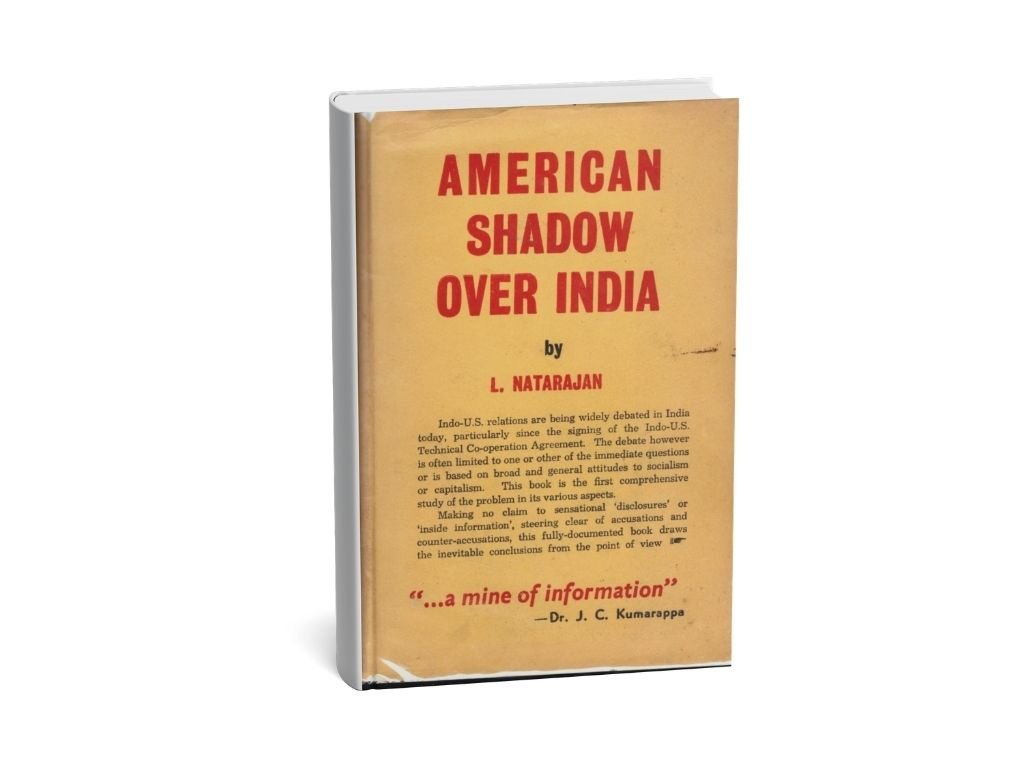
L. Natarajan’s American Shadow Over India, published in 1952, examines the rise of US influence in India after independence. The book was published during a period of the Cold War when many nascent nations were grappling with how to respond to the pressures from the United States and the Soviet Union. The focus of Natarajan is that the United States, despite its claims of friendship, was attempting to exert its economic and political influence over India. This book is a historical and economic commentary on “financial imperialism”—how American power was replacing British colonialism.
The book is well-organised, with chapters covering the history of Indian American relations before World War II and the post-war era. In the initial chapters, Natarajan examines the presence of American companies like Ford, General Motors, and Standard-Vacuum Oil, in India. He then describes how America’s presence expanded during the war, including the American espionage agencies and propaganda. The latter part of the book deals with the post-war years, particularly President Truman’s Point Four programme, which Natarajan claims was not about helping the Indian economy but about making it easier for American private companies to invest in India. He also notes that, at the US behest, Nehru’s government abandoned plans to nationalise certain industries.
Natarajan provides a valuable discussion of the flow of American capital to India. He documents how American private investment in India, Pakistan and Ceylon increased from $3 million in 1949 to $13 million in 1950. He suggests this was not an act of generosity, but a result of American businesses waiting until conditions were right to invest. He also highlights how India, facing recession, yielded to policies benefiting American business. This claim—that American aid was not free—is central to the book.
The book has some weaknesses. Natarajan writes from an obvious left-wing perspective, which often makes American policy sound more coherent than it really was. In fact, the American government held many different views on India. It is also not very generous to the Indian government in crediting its decisions. Nehru and other Indian politicians made choices for their own reasons and were not just being driven by the Americans. A more accurate account would have given more credit to India as an active participant.
American Shadow Over India is an important book for those interested in the origins of Indian foreign policy and the Cold War in South Asia. It raises pertinent questions about the nature of American aid to India, and about whether India was at all free from external domination after independence. These are questions that are still pertinent today.