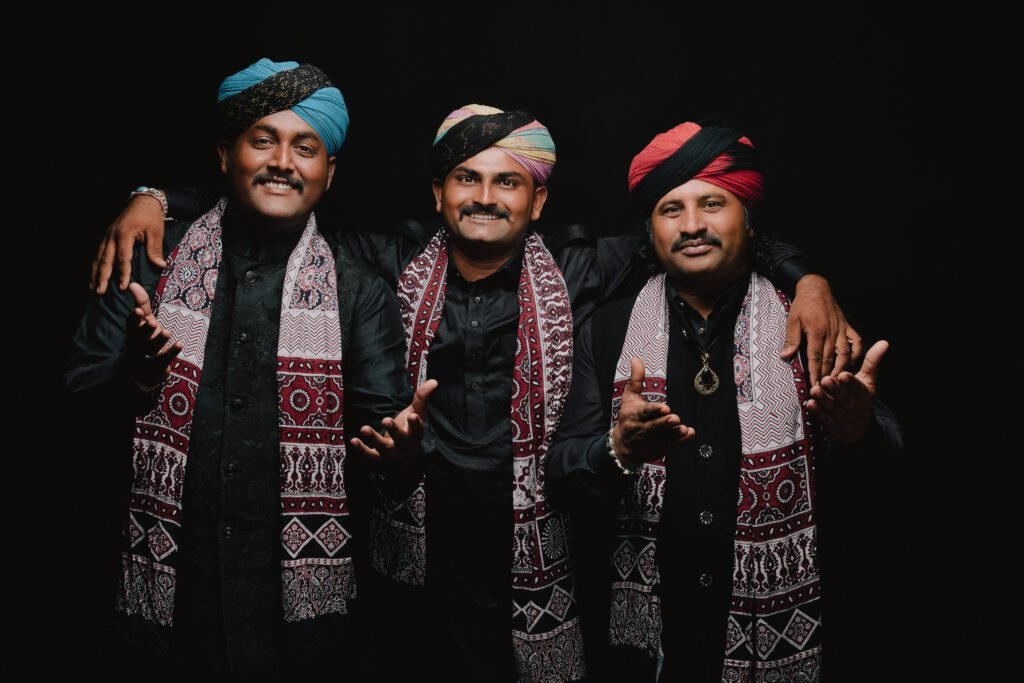
As contemporary societies turn difference into division, the Barmer Boys offer an alternative cultural logic. Rooted in the Manganiyar tradition of Rajasthan, their music moves seamlessly from Sufi kalaam to Krishna bhajans and songs of Shiva, dissolving boundaries of faith and history, and reminding listeners that plurality has long been a lived, shared inheritance. In doing so, they reveal a cultural grammar that quietly resists the fractures of the present.
Everything quiets down, and a single voice rises into the air, carrying a devotional melody through a silent room. What begins as an anticipation of a spectacle—colourful, fast and celebratory, a familiar exuberance associated with Rajasthan—slowly gives way to something far quieter and deeper. The voice carries a Sufi kalaam that transcends language, drawing tears from people’s eyes. At WOMAD in 2022, that quiet transformation was unforgettable: an audience that arrived for spectacle found itself suspended in stillness. “I did not understand a single word,” one listener said, “but I felt everything.”
And just as that stillness settles in, the morchang, an instrument that looks almost like nothing, reverberates a tranquilising effect with a sound as if it comes from somewhere very ancient, deep inside the earth. Then Sawai’s beatboxing cuts underneath this centuries-old melody, and the whole room shifts, rupturing the stillness. What unfolds is a seamless convergence of the old and the contemporary, something that defines the Barmer Boys: “Rajasthan’s folk legacy of the Manganiyars, reimagined for the 21st century.”