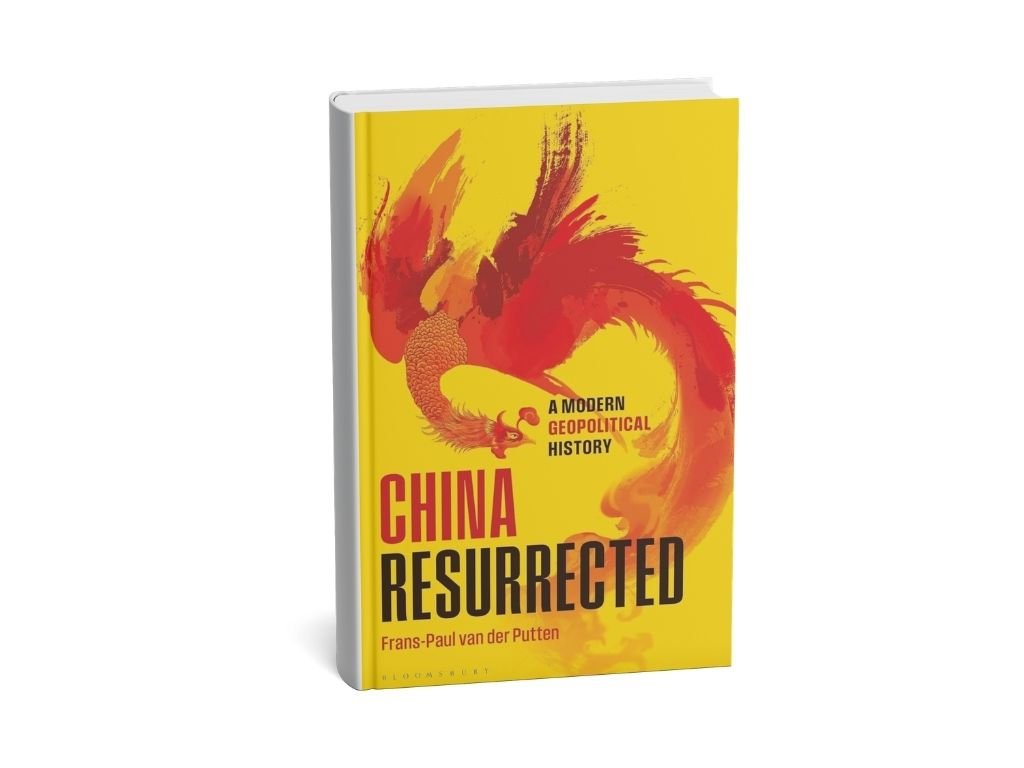
Few works on China have managed to balance historical depth with present-day relevance as effectively as Frans-Paul van der Putten in China Resurrected: A Modern Geopolitical History. Much of the existing literature on China’s rise rests on two dominant interpretive frameworks: first, expectations that China’s economic and social developments will ultimately lead it to converge with the existing international order; and second, the view that China’s rise will inevitably culminate in great-power conflict, likely tense but ultimately containable. Van der Putten departs from both approaches. Rather than portraying China as either a disruptive revisionist power or a state moving along a linear path of accommodation, he presents contemporary China as the outcome of a long historical process shaped by structural subordination, adaptation, and strategic recalibration.
The book’s central argument is that China is not a new entrant to global politics but a historically significant actor re-engaging with a system that once excluded and humiliated it. From the Opium Wars onward, China encountered modern geopolitics not as theory but as coercion: military defeats, unequal treaties, and territorial losses. Van der Putten treats this experience as formative, arguing that China learned, slowly and painfully, that survival depended on adapting to a world where power, not virtue, set the rules.
What makes the argument persuasive is its emphasis on continuity across periods. Despite regime transformations—from imperial reformers and nationalist leaders to Maoist revolutionaries and post-1978 reformers—the underlying dilemma persisted: how to modernise while preserving autonomy within a system dominated by more powerful states. The solutions differed, from revolution, isolation, to selective openness, but the strategic logic remained consistent. China’s behaviour appears erratic only when ideological coherence is treated as more important than geopolitical constraints.
As the book turns to developments after 2008, its analytical framework remains highly relevant for understanding China’s more recent behaviour. The intensification of US-China rivalry, increased pressure on Taiwan, and Beijing’s push for technological self-reliance can be read as extensions of the same historical logic of vulnerability reduction. The global financial crisis and the subsequent US pivot to Asia reinforced Chinese perceptions that the international order was both fragile and selectively restrictive. Taiwan emerges here not merely as a nationalist concern but as a strategic symbol of China’s unfinished subordination.
Viewed through Van der Putten’s framework, China’s interactions with the US, Russia, the United Kingdom, and other established powers underscore the book’s central insight: China does not seek fixed alliances but situational leverage within an order it neither fully rejects nor fully trusts. If the book has a limitation, it is its limited interrogation of how this behaviour generates reciprocal insecurity among other states. Even so, by grounding present tensions in a long history of unequal adaptation, Van der Putten demonstrates why China’s rise produces not merely strategic competition, but enduring uncertainty about the trajectory of the global order.