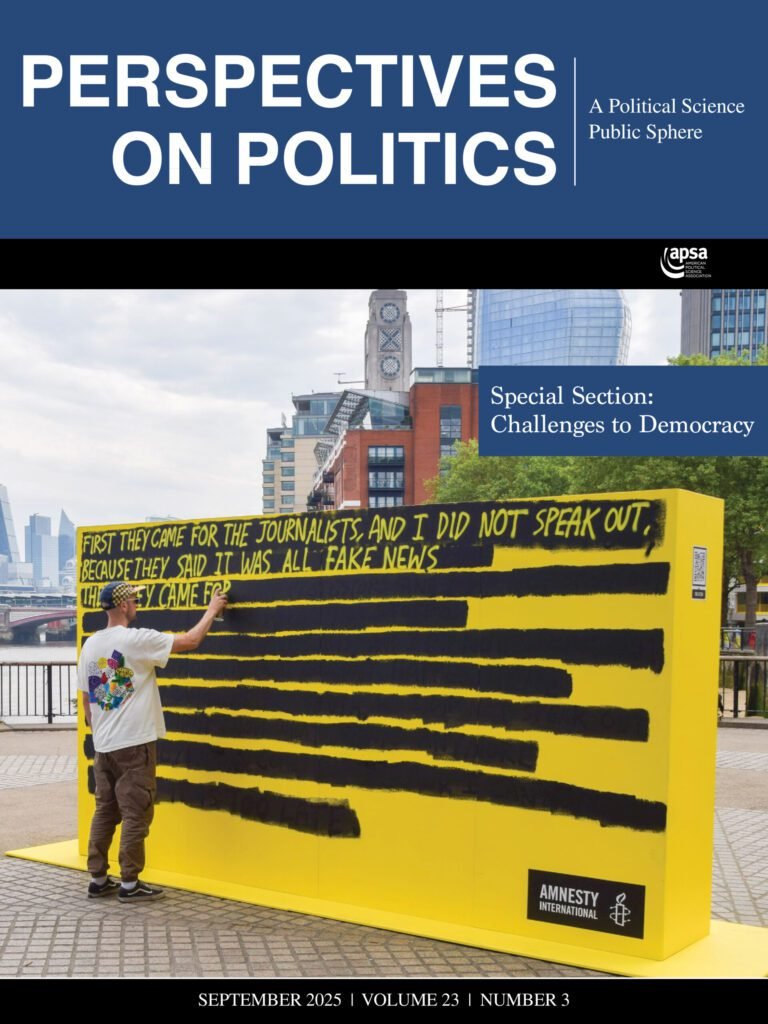
In The Politics of Alliance Cohesion: Experimental Evidence on American Attitudes toward Corrective Measures in Security Partnerships (Perspectives on Politics, Volume 23, Issue 3, Sept 2025), Osman Sabri Kiratli assesses American public attitudes toward corrective measures against uncooperative security allies. This study reveals that there is strong public support for corrective measures. However, the public response is moderated based on the nature of misalignment and the characteristics of the uncooperative ally.
Alliance discord also triggers demands for reduced American contributions to the alliance. The contextual variables introduced by the author in the study are the uncooperative partner’s regime type, military power, and whether it has a formal alliance treaty with the U.S. The author highlights the need for a comprehensive analysis of public attitudes with regard to foreign policy and alliance scholarship, especially in the context of Trump’s second presidency and growing views on declining U.S. contributions to international alliances. Kiratli carries out this study based on a preregistered survey experiment on a nationally representative sample of over 1,502 voting-eligible American citizens.
Within corrective measures, two distinctions can be made. First, their visibility to external actors. If corrective measures are private, reputational costs are minimised for both the sender and target, and it reduces risks of revealing alliance vulnerabilities to adversaries. However, public corrective measures “serve a dual functionality: they not only pressure the target but also signal resolve to domestic audiences and other alliance members about the potential consequences of alliance misalignment.” The second distinction with corrective measures is their intensity. At lower intensity, these measures include rhetorical strategies like naming and shaming. However, the author points out that the lack of material threats in rhetorical action reduces the cost of resistance for target actors, which might render this corrective measure ineffective. At higher intensity, corrective measures may include implementing or threatening economic measures or military aid suspensions.
In addition, the author also formulates the argument that leaders adopt corrective measures not only because of their effectiveness but to capitalise on domestic electoral advantages. This argument is based on the assumption that voters “expect decisive leadership responses when informed about an international dispute” and the literature on sanctions shows that U.S. presidents experience a boost in domestic approval rates when they impose economic sanctions on their adversaries, which gives credence to Kiratli’s argument on domestic electoral advantages.
Kiratli’s findings indicate that American citizens broadly endorse the use of corrective actions when allied nations act in ways that undermine U.S. interests. Among the range of strategies, the public shows a marked preference for coercive approaches, such as economic sanctions or reductions in military assistance, over symbolic or rhetorical ones. Yet, there is a clear reluctance to support the complete termination of alliances, which Americans perceive as a drastic and counterproductive step that could weaken U.S. strategic influence.
Furthermore, Kiratli observes that support for corrective measures is shaped by specific contextual factors. The regime type of the allied country is the most significant moderator; Americans are notably less inclined to endorse punitive actions against democratic allies than against authoritarian partners. This tendency reflects both a belief in the reliability of democracies as enduring partners and a sense of shared political and moral values. In contrast, variations in an ally’s military capability or the presence of a formal alliance treaty have little impact on public opinion, indicating that Americans evaluate allies primarily on the basis of behaviour and alignment with U.S. interests rather than on legal obligations or power disparities.
The key findings from Kiratli’s study have important policy implications, and the author emphasises that corrective measures against uncooperative allies carry strategic risks. They may not only provoke resentment or defiance among allies and erode trust in the alliance, but they can also have unintended long-term consequences. Policymakers, thus, must balance domestic demands for toughness with the broader goal of sustaining alliance cohesion.