The Partition of India remains one of the most defining moments in South Asian history, leading to the creation of India and Pakistan and the displacement of millions. The film opens with an archival montage-style sequence, using grainy historical footage to situate the narrative in the blood-soaked lanes of Bengal in 1947. This “bloodiness” was not incidental but structural. Partition triggered one of the largest forced migrations in history, as a collapsing colonial administration, weak institutional control, and communal identities led to widespread riots, massacres, and retaliatory violence.
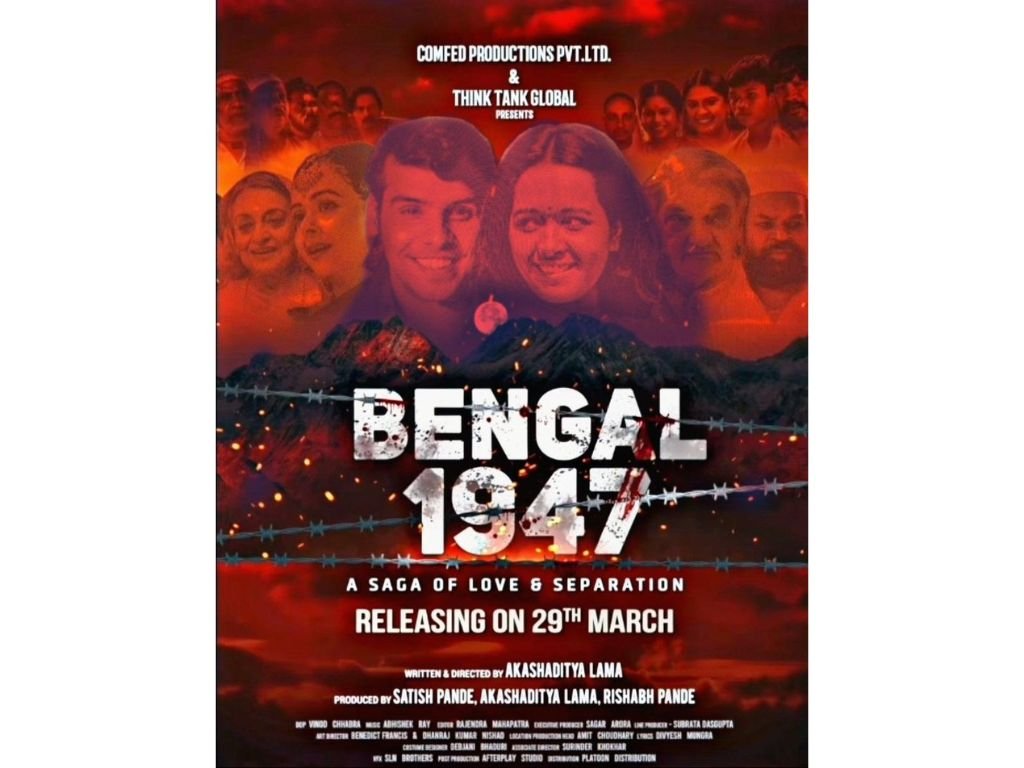
Bengal 1947, directed by Akashaditya Lama, brings this history to life through an ensemble narrative that interweaves personal stories set against the backdrop of Partition-era Bengal. Based on Lama’s play Shabri ka Mohan, the film unfolds as a historical fiction drama centred on a love story shaped by these upheavals. It follows Mohan, a London-educated man from a Zamindar lineage who returns to India, only to find himself, through a case of mistaken identity, immersed in a marginalised, lower-caste community where he begins teaching children. There, he meets Shabri, and their relationship develops under the dual pressures of caste hierarchy and the broader communal unrest of Partition. The narrative juxtaposes their romance with escalating Hindu–Muslim tensions, illustrating how both class and religion fracture social cohesion during moments of political crisis.
While a historical drama, Bengal 1947 has received recognition for its storytelling, winning Best Film at the Bioscope Global Film Festival, where Surbhi Srivastava also earned Best Actress. The film’s strength lies in its accessible, emotionally driven narrative, making a complex historical event. It is worth watching for its attempt to bridge history and human experience, offering a reminder of Partition’s enduring impact through stories that emphasise empathy and shared humanity.