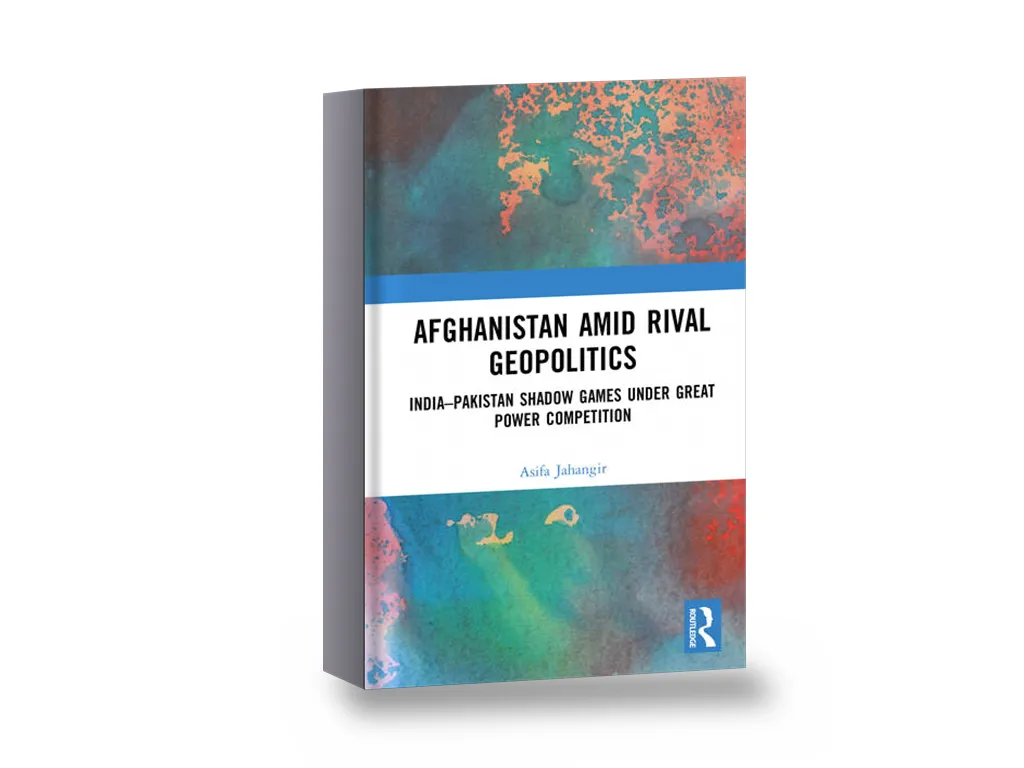
Much of the existing literature on Afghanistan’s geopolitics has been shaped by Western perspectives. In Afghanistan amid Rival Geopolitics: India–Pakistan Shadow Games under Great Power Competition, South Asian geopolitical analyst Asifa Jahangir offers a non-Western perspective on the Afghan conflict, examining the regional strategic rivalry between India and Pakistan. She rightly indicates that the strategic manoeuvres of great powers, coupled with the rivalry between India and Pakistan, are causing vulnerable security dynamics in South Asia.
The book unfolds the great power politics surrounding Afghanistan that shaped its history and politics as well as its international image worldwide. Asifa portrays the trilateral dynamic of India, Pakistan, and Afghanistan as a foundation of her theoretical perspective. She argues that the nature of the foreign policies of India and Pakistan towards Afghanistan is often categorised by their animosity towards each other. Asifa argues that such strategic behaviours have an impact on South Asian geopolitics. The deeply researched aspect of the book is that it not only helps to comprehend the “shadow game” between the secret services of these two countries but also helps to understand its consequences for their respective relationships with Afghanistan.
The author argues that the US-led War on Terror has welcomed a new model of balance of power, achievable through proxy war in the region. Both Pakistan and India tried utilising the security dilemma surrounding Afghanistan to enhance their influence in the region. Asifa argues that the US presence gave diplomatic leverage to India in pursuing its foreign policy objectives in Afghanistan. However, the author’s assessment of the benefits of the US presence on Afghan soil for India seems somewhat oversimplified, as even after the final withdrawal of the US forces from Afghanistan, India has continued and expanded its presence in the country. The author also describes the “non-kinetic” role of India in portraying soft power projection. She argues that effective infrastructure development helped India build people-to-people ties at the grassroots level. The author explains the growing Indian influence in Afghanistan as a main motive behind Pakistan’s pursuit of a “two-front war” strategy. Although she acknowledges the geopolitical fear and motive of Pakistan, she is critical of the “proxy war” methods used by both countries, which destabilise the regional security scenario.
In this backdrop, Asifa rightly calls for a strategic reorientation of Pakistan’s policy to maintain long-term geopolitical and geoeconomic leverage in the region. However, the author does not suggest any strategic realignment regarding India’s approach to maintaining stability in the same region. This reflects the author’s asymmetric attribution of responsibility to Pakistan while giving less analytical significance to India’s role in maintaining security dynamics. This can be either a deliberate academic omission or an underestimation of the credibility of India as a regional security provider. Additionally, the book would have presented a more complete picture if it had focused on the internal complexities of power distribution in Afghanistan. The book extensively discusses the impact of the shadow game of India and Pakistan on Afghan geopolitics. However, a more holistic approach would have included the domestic power dynamics among state and non-state actors as well, which are likely to have strategic implications beyond Afghanistan’s borders.
Overall, the book is an important read for scholars of international studies who want to understand the dynamics of South Asian geopolitics. It will help readers understand the war-torn country through a different geopolitical lens.