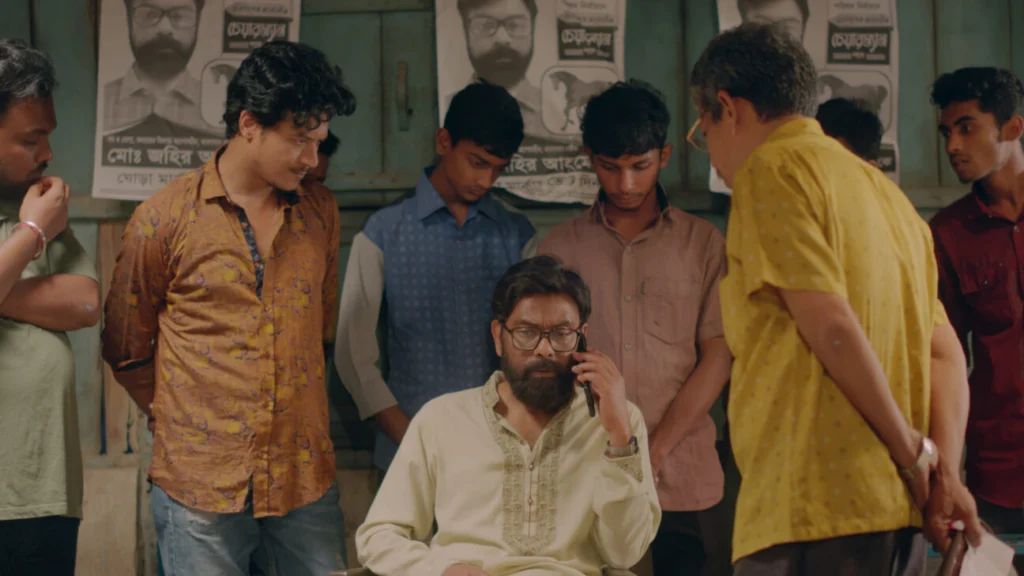
Bangladesh’s political landscape has been shaped by longstanding questions of democratic accountability, patronage, and the relationship between political authority and public interests. The July 2024 uprising, which culminated in the resignation of Prime Minister Sheikh Hasina after 15 years in power, brought these questions into sharp focus. Against this backdrop, Master, directed by Rezwan Shahriar Sumit, examines how political idealism can give way to corruption and authoritarianism. The film follows Jahir, a respected history teacher in a small town who enters electoral politics with a commitment to social change. Advocating progressive causes, including women’s rights and improved education, he wins a mayoral election. His subsequent involvement in a proposal for a luxury hotel that would displace local residents, however, draws him into a network of political influence that gradually undermines his original commitments.
As ambition overtakes social conscience, Jahir’s transformation reveals the tensions between electoral legitimacy and the exercise of power. Sumit presents corruption not simply as an individual moral failing, but as a process sustained by patronage, financial interests, and networks of political influence. Nasir Uddin Khan’s performance as Jahir anchors this moral transformation, while Azmeri Haque Badhon adds depth to the film’s portrayal of the people caught within its political conflicts. The carefully framed visuals and bright colour palette contrast with the increasingly sinister undercurrents of the narrative. The film’s gradual shift from idealism towards moral compromise gives its political critique a personal dimension, showing how the pursuit of power can reshape both an individual and the community around him.
Winner of the Big Screen Award at the 2026 International Film Festival Rotterdam, Master uses a local political story to examine a broader dilemma: how institutions and influential networks can erode the ideals that political movements initially promise to uphold. Its relevance extends beyond Bangladesh, offering a perspective on accountability, leadership, and the difficulties of sustaining democratic aspirations amid entrenched interests. At a time when questions about political legitimacy and public trust remain central to debates across South Asia, the film provides an engaging exploration of the personal and institutional costs of power.