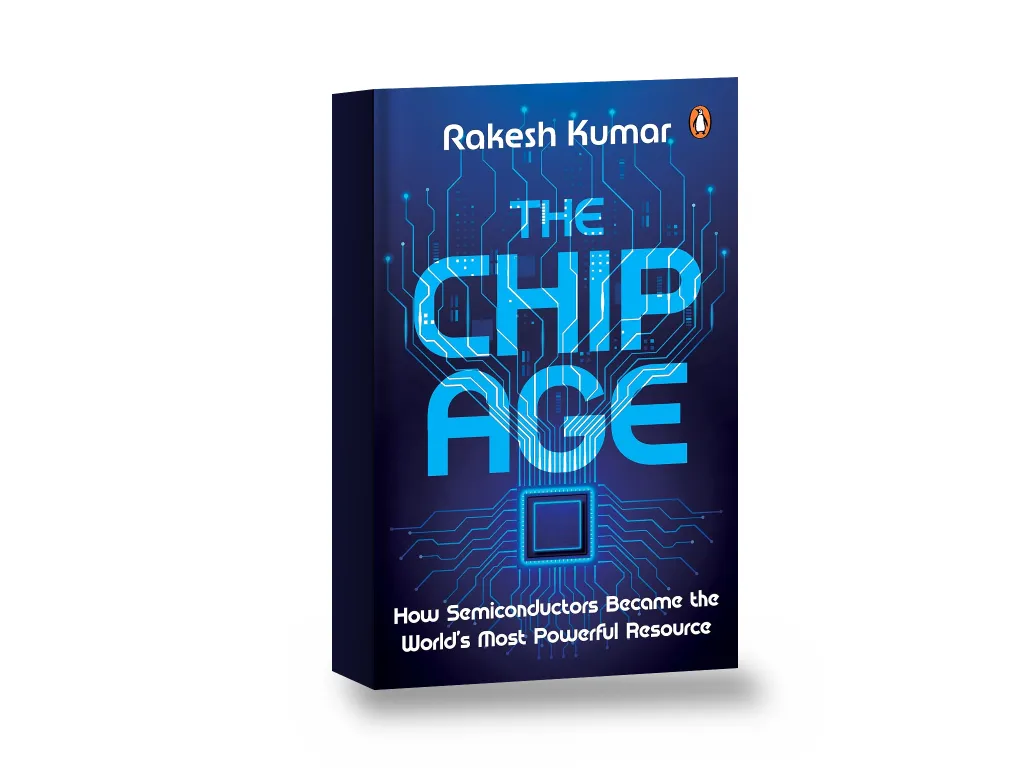
Today, technological prowess is an important element of national capability. In this direction, Rakesh Kumar’s latest book, The Chip Age, is a timely contribution that provides a technologically informed account of the growing geopolitical significance of semiconductors. The reason is that semiconductors not only serve as the backbone of the current-age economy but are also a means of achieving geopolitical supremacy. Kumar, a professor of Engineering at the University of Illinois Urbana-Champaign with a strong understanding of geopolitics, provides a holistic picture of the semiconductor industry.
The most important contribution of the book lies in its exploration of the growing significance of semiconductors across fields, geopolitical competition for commanding control over supply chains, and the often-overlooked social and environmental costs. The book also sheds light on how control over the entire semiconductor supply chain remained concentrated in a handful of countries, benefiting them while leaving many others exposed to technological vulnerability. The author then connects such unequal distribution and supply chain vulnerabilities to the rationale behind countries pursuing “chip sovereignty.” This also explains why countries such as India participate in initiatives like Pax Silica, which emphasises resilience in the semiconductor supply chain.
However, Kumar warns against the idea of self-sufficiency in semiconductors, noting that these are highly capital-intensive and geographically interdependent, making the entire supply chain difficult to replicate within the borders of a single country. He offers a pragmatic message in this regard: “Selective interdependence, not isolation, will solve chip problems.”
The other most notable contribution of the book is extending the debate beyond the US–China rivalry to examine instability associated with coltan mining in Africa, forced and child labour, human rights violations, and environmental challenges. Kumar has interestingly challenged the popular narrative of semiconductors as enablers of renewable energy and efficiency by bringing the impacts on the environment and communities into the limelight as the hidden cost. Thus, such a multidimensional analysis is highly relevant to debates about the future course of industrial policies, sustainability, and inequality.
However, at times, the technical details take over to the point that it becomes hard for non-technical readers to remain engaged, and, similarly, the breadth of issues covered by the author sometimes leaves very little space for comparative analysis of the variables themselves. Nonetheless, such technical explanations also help in understanding an otherwise opaque industry without leaving out the social and geopolitical aspects. Towards the end, the book offers useful advice on building a more resilient future: “well-calibrated pragmatism will be needed going forward.”
Overall, the book can be a helpful guide for students of international relations and technology, offering valuable insights into the opportunities and challenges associated with the growing significance of semiconductors across almost all fields.