Shobhankita Reddy
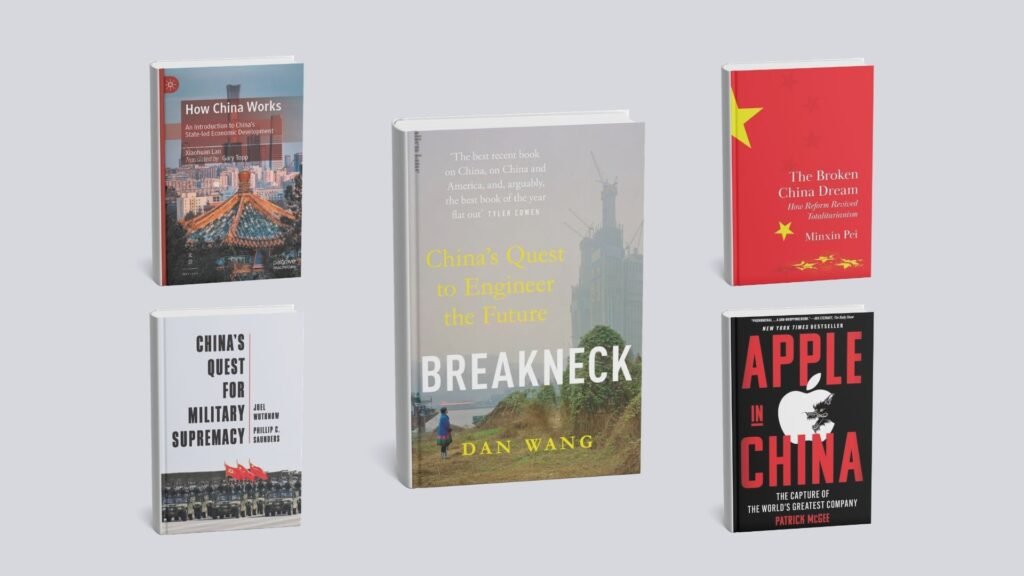
Breakneck: China’s Quest to Engineer the Future (2025) by Dan Wang
Lately, US politics has seen renewed calls to reshore manufacturing, driven by fears that decades of outsourcing has hollowed out America’s industrial base while enabling the rise of a technological adversary in China. Dan Wang’s Breakneck contributes to this discourse and makes the case for American society to look inward. He points to the US’s inability to produce at scale, evidenced, for instance, in an undersupply of public housing, delayed infrastructure projects, and outdated power grids. And yet, he asserts that “no two peoples are more alike than Americans and Chinese”. So, what explains their differing abilities to deliver on outcomes?
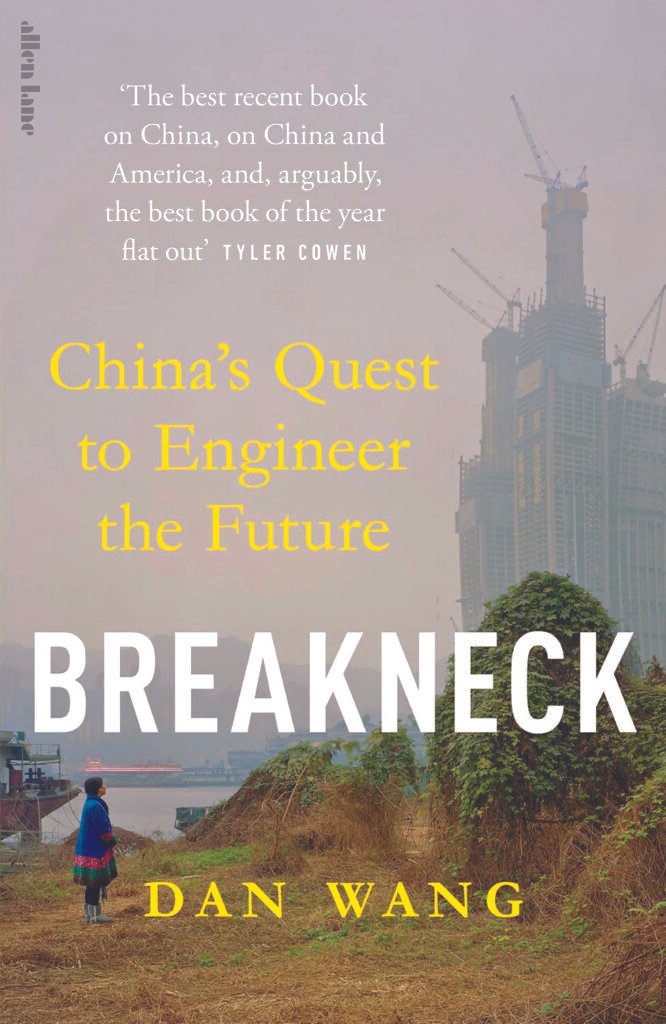
The big idea in Breakneck is that America is a “lawyerly society” as compared to China’s “engineering state”. American elites are lawyers as opposed to China’s technocratic leadership, and American society is focused on exquisite processes that obstruct progress, while China builds big and prioritises outcomes. However, Wang does not push and test the limits of these labels sufficiently in the book. In fact, the definitions of what constitutes “lawyerly” and “engineering” are not adequately established. Beyond the broad strokes, the book does not examine the American economic developmental path or the multiple causes of its purported deficiencies. It also offers no policy recommendations to course-correct, providing only a jibe at lawyers to get out of the way.
Ultimately, Breakneck’s success is in Wang’s lucid, lived-in experience of China. His characterisation of China as an engineering state is not only because of its propensity for megaprojects or the number of engineers in its highest leadership echelons. It is because of the Party-state’s assumed role of a grand master capable of executing a constructed plan, in which predictable outcomes can be delivered by changing a few input variables, and objectives achieved through top-down policy, a vast bureaucracy, and little regard for individual rights—consider its one-child policy or zero-Covid policy, for example. Wang does not paint a rosy picture of the costs incurred on account of the Chinese state’s blunt instruments but offers a compelling perspective on the strengths, limitations, and quirks of the Chinese model.
Yet, important questions remain on whether this characterisation best explains China’s success or if the economic progress inherent to it can be sustained in a changing geopolitical environment. Also, if the same values—pluralism, a system of checks and balances—that Wang so admires in America also lead to slower decision-making while averting the blunders of the Chinese state, has American society really failed?
Shobhankita Reddy is a researcher in technology geopolitics at the Institution.
Bhumika Sevkani
Apple in China: The Capture of the World’s Greatest Company (2025) by Patrick McGee
Patrick McGee’s Apple in China details how Apple, a consumer favourite for innovation in electronics, gradually developed and integrated its production processes in a country that has risen to rival the US. He portrays Apple as the company that is largely responsible for the development of China’s electronics industry. With the current geopolitical turn following the ascent of Xi Jinping in China and of Donald Trump in the US, the company now finds itself in a difficult situation where staying in China is proving to be increasingly difficult, but decoupling seems impossible.
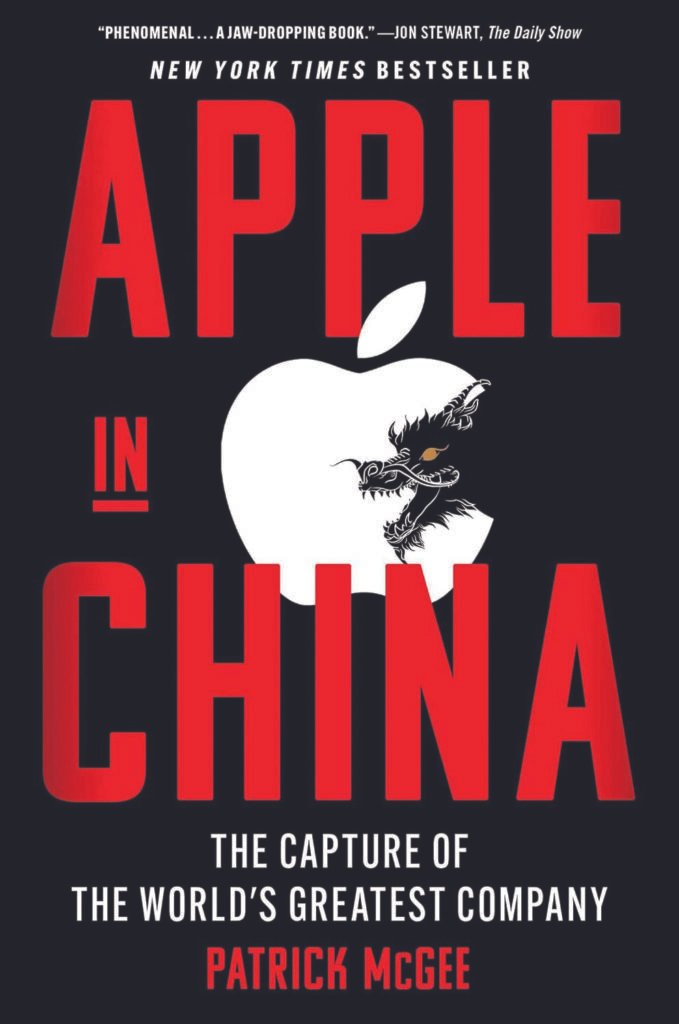
The book is structured in six sections, with the first three explaining Apple’s gradual integration into the Middle Kingdom as its executives solved one manufacturing problem at a time. The following sections talk about how the company navigated political and cultural issues specific to the country. From opening a store to negotiating with local officials for incentives, the company grew more politically savvy and sensitive to Chinese culture and the demands of the Communist Party of China. For instance, despite Apple TV+ not being available in China, Apple instructed its content partners to “avoid portraying China in a poor light”, effectively engaging in self-censorship. Parts Five and Six analyse Apple’s growing susceptibility to Chinese control—consider the shutdown of iTunes and iBooks and demands for a joint venture to maintain services in 2016—and elaborate on the weaknesses in Apple’s supply chain.
The book offers comprehensive details to understand the local environment for conducting business in China and provides insights beyond just that of cheap labour as an incentive for MNCs investing in the country. It also includes vivid accounts of how individuals shaped and contributed to the company’s current standing, perhaps going into excessive and some unnecessary detours into the background of individuals.
Finally, Apple in China fuses an understanding of the economics of innovation with the increasing relevance of grasping both local and global politics before committing to potentially irreversible decisions.
Bhumika Sevkani’s research focuses on China’s new energy sector.
Amit Kumar
How China Works: An Introduction to China’s State-led Economic Development (2024) by Xiaohuan Lan
The global trading order is in a state of flux, with trade agreements being abandoned and renegotiated by countries. While the crisis may have been triggered by US President Donald Trump, its stressors lie elsewhere. The global trade imbalances fuelled by decades of China’s massive trade surpluses had already ruptured the trading order. The fact that China today accounts for over 16% of the global GDP and powers more than 26% of global economic growth means that nothing that happens within the confines of its territorial bounds is limited to its economy alone.
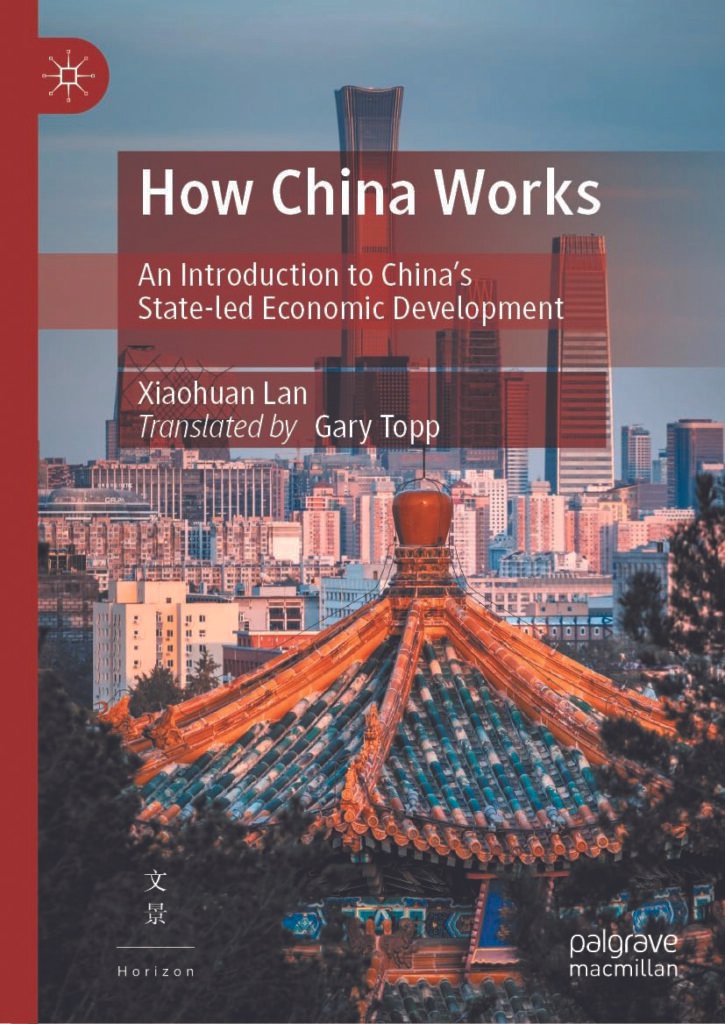
It is in this context that Xiaohuan Lan’s How China Works emerges as a must-read book on China’s economy. Lan identifies the Chinese state and its policies as the “main protagonists” in China’s growth story. The central theme to emerge from the book is how a tax reform, initiated in 1994, to address the central government’s declining revenue share, inadvertently set off a major behavioural shift among the local governments, which in turn defined China’s economic model for decades. Having lost a huge chunk of revenue to the central government due to the changed tax structure, local governments now incentivised pro-enterprise policies and heavy investments, which not only drove the economy for decades but also made China into a global manufacturing behemoth.
The downside, however, as Lan notes, was the long-term internal imbalances that simultaneously took hold, such as high household savings and suppressed consumption, often reinforced by a deliberate state policy of financial repression. China’s industrial overcapacity and huge trade surpluses emerged as the natural byproduct of this internal imbalance.
As states across the globe intensify negotiations to rewrite the new trading order amidst growing calls for rebalancing China’s economy, from both within and without, it is worth revisiting China’s economic journey of the past forty years, for here lies the genesis of today’s grievances. And Xiaohuan Lan’s How China Works is just the book to help us in this task.
Amit Kumar is with the China desk and studies issues at the intersection of economy, politics, security and technology.
Anushka Saxena
China’s Quest for Military Supremacy (2025) by Joel Wuthnow and Phillip C. Saunders
In China’s Quest for Military Supremacy, Joel Wuthnow and Phillip C. Saunders offer a corrective to the alarmism often surrounding the capabilities of China’s People’s Liberation Army (PLA). Rather than depicting an unstoppable “world-class fighting force,” they question if the successes achieved, in say, massive defence industrial entrepreneurship and a forward posture in missiles, shipbuilding and drones, has necessary translated to or been enabled by agility and prowess in intangible domains such as jointness or say, trust and coordination between the grassroots and a stable leadership.
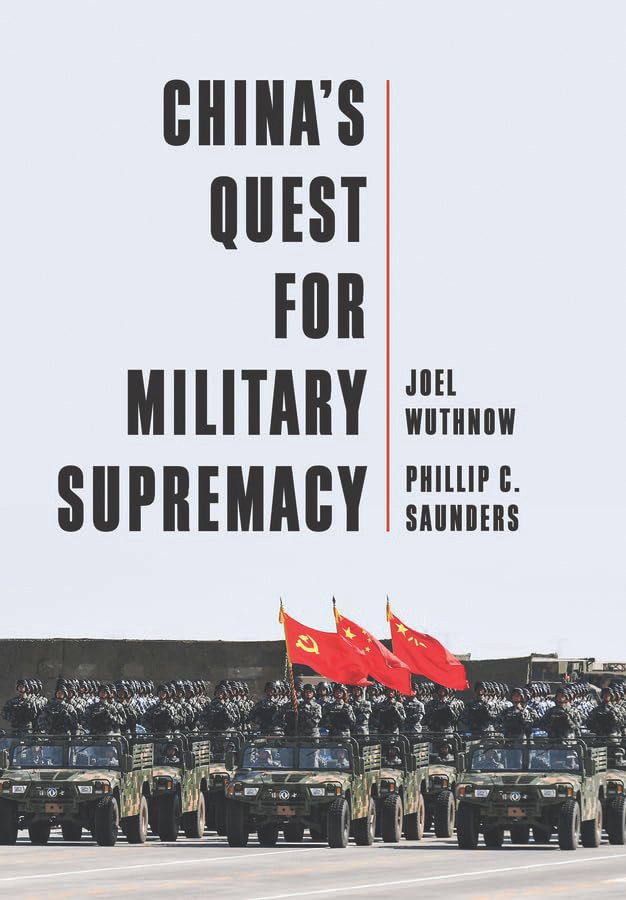
Wuthnow and Saunders argue that Beijing’s modernisation is not exactly a hurried scramble, but a decades-long strategy specifically targeted at deterring US intervention in the Indo-Pacific. They document how the PLA has closed the technological gap, fielding hypersonic missiles and stealth fighters that structurally alter and make for volatile regional security dynamics. However, they contend that the PLA’s organisation is diseased, with a lack of combat experience and a rigid, top-down command structure exacerbated by CPC General Secretary and Central Military Commission Chairman Xi Jinping’s centralisation of power.
A key insight in the book is the tension between political control and operational efficiency. The volume suggests that while Xi’s anti-corruption purges have ensured the irrevocability of military loyalty to the Party, they have also stifled the decentralised decision-making required for modern, high-intensity warfare.
Ultimately, China’s Quest characterises the PLA as a formidable regional heavyweight rather than as a global superpower. While capable of devastating coercion against Taiwan or rivals in the South China Sea, it lacks the global logistics and command infrastructure to sustain operations far from its shores. The book is a vital, sober assessment, which speaks to the fundamental organisational challenges of a force like the PLA. At the same time, the PLA is dangerous not because it has achieved all its objectives, but because it is now “good enough” to challenge the American-backed security order in the Indo-Pacific.
Anushka Saxena studies the Chinese military and regional security.
Manoj Kewalramani
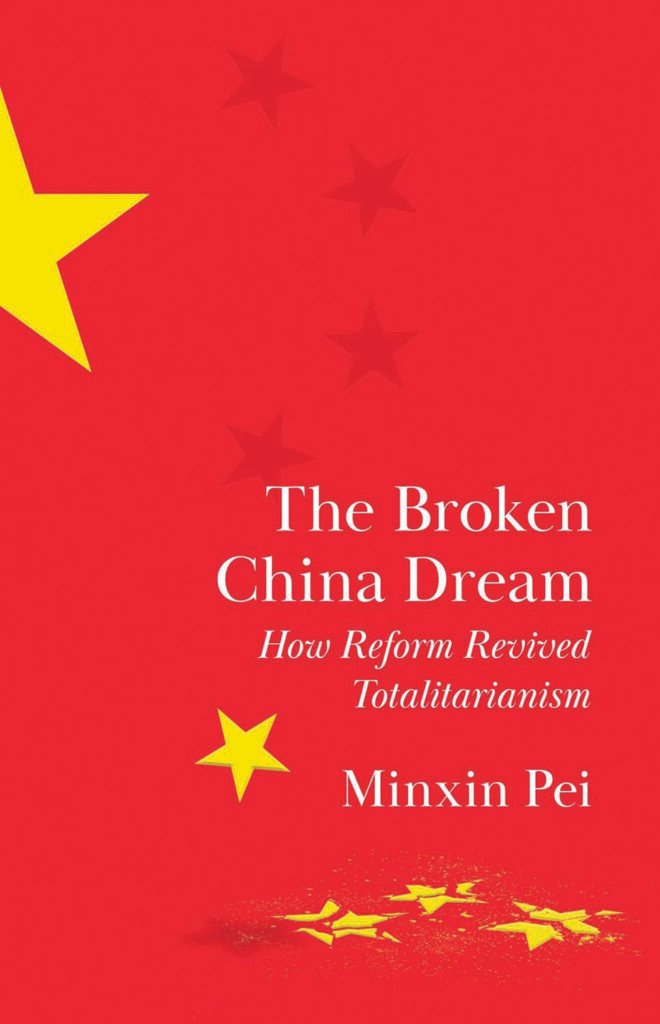
The Broken China Dream: How Reform Revived Totalitarianism by Minxin Pei
Over the past decade, there has been a persistent debate about the factors that have returned China to an era of strongman rule. Since the fall of the Soviet Union, conventional wisdom has held that as China grew economically prosperous and integrated into the global economy, this would be accompanied by political opening and potentially political pluralism, if not a turn toward multi-party democracy. But this has not happened. Instead, Chinese politics today appears to be returning to the ailments of the Maoist era—characterised by tight controls and a cult of personality.
Is this simply the product of the cut-throat nature of Chinese politics? Or a reaction to growing disillusionment with the West and the rise of populism there, which itself appears to be jettisoning democratic norms? In other words, is it driven by China’s disillusionment with the West and the West’s own weaknesses? Or is it the product of an inevitable design flaw in the Leninist party-state system?
In The Broken China Dream, Minxin Pei argues that the seeds of China’s return to totalitarianism under Xi Jinping were embedded in the post-Tiananmen order established under the leadership of Deng Xiaoping. Pei’s core argument is that China’s post-Mao era can be divided into three periods: the reform era of the 1980s; neo-authoritarian developmentalism beginning in 1992; and a “neo-Stalinist” era under Xi. What connects these three periods is path dependence, i.e., the leadership’s strategic choices in one era narrowed the range of options and potential paths available in subsequent eras, increasing the likelihood of certain outcomes.
Within this framework, Pei contends that the emergence of totalitarianism in China is the product of the pathologies inherent in Deng’s neo-authoritarian bargain. In this sense, he argues, the present outcome is inevitable, because there is a fundamental dissonance at the heart of a policy that seeks to pursue economic growth while maintaining one-party control. The system will eventually collapse in on itself. Does this necessarily mean the demise of the CPC-led system in China? Not really. But it does mean that there are limits to what neo-authoritarian developmentalism can achieve economically. And while appreciating these advances, one must not ignore the socio-political costs of such systems.
The book is a compelling account of China’s political and economic evolution in the post-Mao era.
Manoj Kewalramani chairs the Indo-Pacific Studies Programme at the Takshashila Institution.