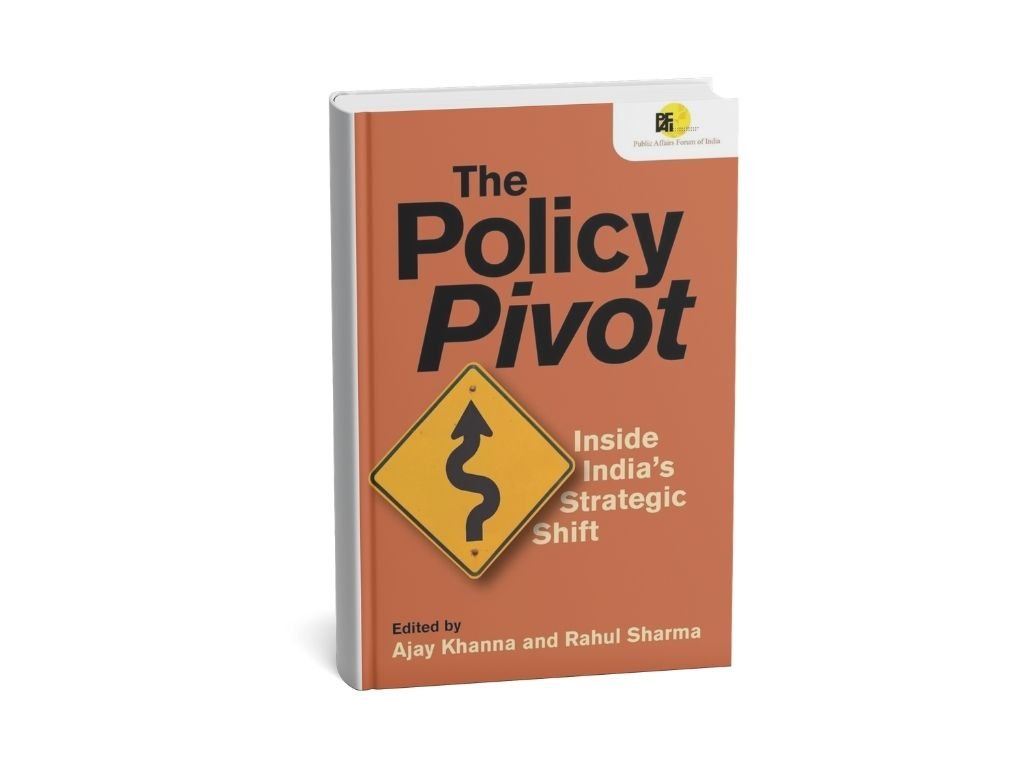
The Policy Pivot: Inside India’s Strategic Shift, an edited volume by Ajay Khanna and Rahul Sharma, is a compilation of essays on public policy spanning society, the economy, and diplomacy within India’s evolving governance architecture. The volume situates these essays within India’s developmental vision for 2047, linking them to both domestic and global determinants of policymaking.
It places the erosion of the post-war economic order and the embrace of protectionism within a broader critique of Nehruvian socialism, highlighting its contribution to India’s economic stagnation at a time when several East Asian economies experienced astonishing growth. Describing this phase as one of policy paralysis, the volume reflects on Modi’s unique mandate to end it and argues for policy reversals and corrections.
The section on social policy argues for equal emphasis on the “social” and the “policy”. It identifies education, women’s workforce participation, and broader social sectors as questions of community, information, and externalities. Schemes like Kudumbashree represent limited but important efforts to include women in the workforce. Though investments in multi-purpose cultural infrastructure are a strength in a diverse and populous country like India, assigning education to increased philanthropic investment does not fully make the policy ‘social’. Digital India policies offer a more justified approach to social inclusion.
On economic policies, the volume engages the paradox of an interconnected trade environment marked by a surge in protectionist measures and the “China plus one” strategy. Though the essays on economic policies rightly identify the integration of India’s small businesses into global supply chains, the strength of the economic theme is two significant ‘insights’ cum ‘policy gaps’ for India’s economic policies. The first is the push to accelerate trade processes. The Second is that manufacturing may not be as beneficial for India as it is for China or Korea, but investment in the service sectors may bring wonders to the Indian economy. In this context, T.K. Arun’s chapter, “The Role of Institutions in Promoting Economic Growth,” argues that economic growth is proportional to institutional quality, with a subtle emphasis on education.
Rooted in India’s “calm yogic approach,” the diplomatic section emerges as the book’s most refined and balanced theme. This strategy seeks to reconcile competing power centres while preserving strategic autonomy through multi-alignment and issue-based coalitions such as the Quad and I2U2. The Policy Pivot ultimately offers a textured map of India’s policy challenges and choices on the path to Viksit Bharat 2047. On a precise note, India’s policy strength lies in its preparedness for digital policies, such as Digital Public Infrastructure (DPI), Aadhaar, CoWIN, and KYC, but it misses India’s social and cultural aspects, such as inequality, weak property rights, overburdened courts, and caste hierarchies, as constraints on learning and innovation.