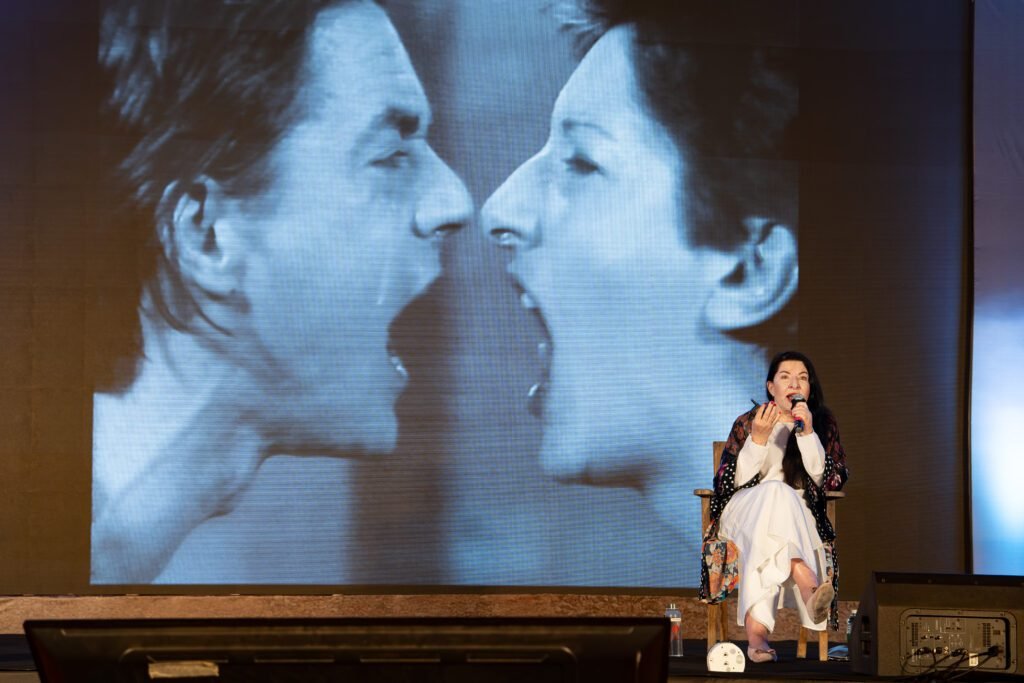
Once peripheral to the circuits of global contemporary art, Kochi now stands as one of its most compelling stages. The Kochi Muziris Biennale has transformed the coastal city into India’s most visible cultural interlocutor with the world. Marina Abramović’s presence in this edition of the Biennale underscores that transformation, marking Kochi’s transition from aspirant to authority in the global contemporary art world.
Marina Abramović in Kochi.
Twenty years ago, this would have sounded like a fairytale. Today, it not only sounds plausible, but it has already happened.
On February 10, 2026, at Willingdon Island, a venue of the sixth edition of Kochi Muziris Biennale, Abramović delivered a two-hour lecture performance. As a witness to contemporary Indian art for nearly two decades, I felt that being there to see the performance was a high point of my art life. I have been following the Biennale from its inception, as an art theorist and later as assistant curator of its fourth edition, and I believe Marina’s performance marked an inflection point in its brief history.