
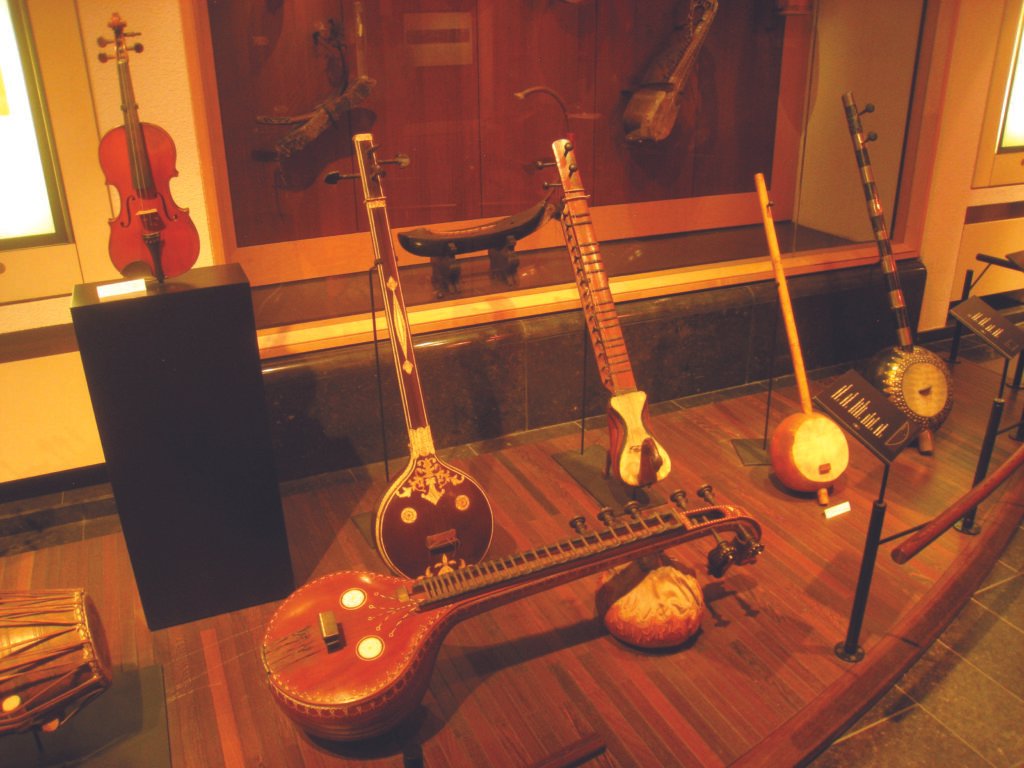
Long before cultural diplomacy became a formal term, music was already being used deliberately to shape perceptions. Indian instruments circulated through imperial exhibitions and European museums, arranged to project antiquity, coherence, and civilisational depth. Yet behind this carefully ordered display lay selective choices, hybrids, and silences. This raises a larger question: what kind of “Indian music” was being constructed for global audiences—and to what end?
In July 2025, a group of instrument-makers, musicians, curators, and academics gathered at the Royal College of Music in London to examine an unusual collection of musical instruments. In 1884, these instruments made their long and slow journey from Calcutta, then the capital of the British Raj, to London, the capital of the British Empire. They were intended to illustrate to Western publics the range of instruments used to perform Indian classical music, encompassing percussion, strings, and winds. However, in many ways, the collection represented an imagined musical tradition dreamed up by their donor, rather than the reality of a living performance culture.
The donor was Raja Sourindro Mohun Tagore (1840-1914), a wealthy Bengali aristocrat whose legacy is rather ambivalent, both in his contributions to the study of Indian classical music and in his politics. The latter balanced Tagore’s own exclusive brand of Indian nationalism, which positioned India as the cradle of civilisation, with his loyalty to the British Raj, his respect for European scholarship and institutions, and his coveting of Western distinctions.












1-1024x768.jpg)