
India is racing into the age of artificial intelligence with enormous ambition, but it is doing so on hardware largely controlled by others. Official estimates suggest AI could add $1.7 trillion to India’s GDP by 2035, and industry surveys show that around 87% of Indian enterprises already use some form of AI. Yet beneath this optimism lies a hard constraint: India does not manufacture cutting-edge AI chips. Its AI future, for now, depends almost entirely on global supply chains shaped by geopolitics, export controls, and corporate power.
At a time when computing power itself is becoming strategic infrastructure, the global politics of chips will play a decisive role in determining whether India becomes an AI leader—or remains primarily a consumer of technologies built elsewhere.
India’s AI Ambitions and the Limits of Its Computing Power
India’s AI push is real and accelerating. Under the IndiaAI Mission, government targets for public compute have already been exceeded: initial plans for 10,000 GPUs have expanded to around 38,000 GPUs deployed for researchers and startups by late 2025. This is a meaningful step for domestic innovation.
However, scale matters. In global terms, India’s compute capacity remains modest. The United States controls roughly 75% of the world’s AI compute, driven by the vast data-centre investments of companies like Google, Microsoft, and Amazon. In practice, a single U.S. cloud provider now operates more AI hardware than many countries combined.
This imbalance matters because AI leadership increasingly flows from those who control large-scale compute. Without comparable capacity, India risks shaping policy and ideas while adopting technical standards, platforms, and architectures set elsewhere. The danger is not exclusion from AI — but participation on unequal terms.
The Global Race for Advanced AI Chips
At the heart of this imbalance is an intense global competition for advanced AI hardware. NVIDIA’s new H200 GPU illustrates the stakes. Analysts report that the H200—an upgraded Hopper-generation accelerator—is around six times faster than the earlier H20 chip and offers roughly 50% more memory, making it especially valuable for training large AI models.
Demand has vastly outstripped supply. Chinese companies alone have ordered over 2 million H200 chips for delivery in 2026, while Nvidia’s available stock is estimated at around 700,000 units. This gap has triggered what analysts describe as a global scramble for high-end GPUs.
The bottlenecks extend beyond fabrication. Advanced AI chips depend on high-bandwidth memory (HBM), produced by only a handful of firms—Samsung, SK Hynix, and Micron—with lead times stretching six to twelve months. Integrating this memory requires sophisticated 2.5D and 3D packaging technologies, such as TSMC’s CoWoS process, where capacity shortages have emerged as a critical secondary constraint. Even countries capable of building fabs still rely on these tightly controlled upstream capabilities.
Geopolitics and Access to High-End Computing
As AI chips have grown more powerful, they have also become geopolitical assets. The United States now treats advanced GPUs much like strategic military hardware. Sales of Nvidia’s most powerful chips, such as the H100, are banned in China on national-security grounds. Even exports of the H200 have been allowed only under strict licensing regimes, including a 25% export fee introduced during the Trump administration.
China’s response has been twofold. On one hand, Chinese firms rushed to buy every available Western GPU—explaining the massive H200 orders. On the other hand, Beijing is pushing domestic substitution: new state-funded AI data centres are now required to use domestically produced chips wherever possible.
The result is a fragmented global chip order. Access to top-tier AI hardware is increasingly governed by alliances, trust, and policy alignment. Even countries considered friendly to the West may find their access constrained when supplies tighten. In this environment, compute is no longer just a market good—it is a tool of influence.
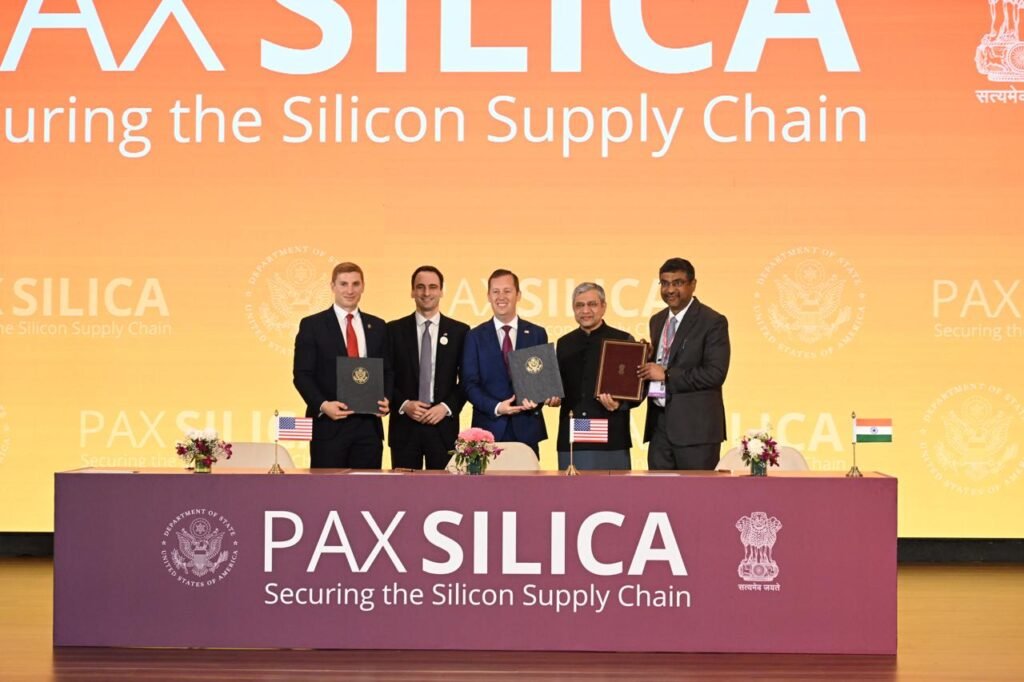
India has responded by strengthening strategic technology partnerships, particularly with the United States. In 2024, the two countries agreed to build a joint semiconductor fabrication facility in Jewar, Uttar Pradesh, focused on defence- and space-grade chips for applications such as night-vision systems, drones, and missile seekers. Linked to the U.S. CHIPS Act and broader Indo-Pacific economic initiatives, the project is explicitly about strategic trust.
U.S. firms such as General Atomics are collaborating with Indian partners like 3rdiTech, with plans to produce around 50,000 military-purpose chips annually. These deals illustrate how “silicon diplomacy” works: hardware partnerships that bind supply chains and geopolitical interests together. While such arrangements reduce India’s vulnerability, they do not eliminate dependence on global technology ecosystems.
What does the Global Chip Order mean for India?
India’s experience highlights a deeper reality: building fabs alone is not enough. Cutting-edge semiconductor manufacturing depends on imported equipment such as ASML’s EUV lithography machines, advanced materials, proprietary memory technologies, and complex packaging know-how. Even a world-class Indian fab would still rely heavily on external suppliers.
Recognising this, India’s semiconductor strategy has shifted. The India Semiconductor Mission now emphasises assembly, testing, and packaging (ATMP) and mature-node fabrication, where barriers to entry are lower. Of the $10 billion incentive package, roughly half supports a Tata–Powerchip joint foundry producing 28–110 nm chips, while the remainder largely backs packaging and testing projects. Micron’s Gujarat packaging plant and Tata’s Assam facility are concrete steps toward embedding India more deeply in the global value chain.
These investments matter — but they do not remove India’s dependence on imported GPUs, high-bandwidth memory, and advanced production tools. Compute power itself, therefore, must be treated as critical infrastructure.
This implies clear policy choices. India needs long-term GPU supply agreements, public-private compute pools for research, and explicit inclusion of AI hardware access in national security planning. Rather than attempting to replicate TSMC’s 3-nm leadership, India can focus on areas where it can realistically lead: advanced packaging, custom AI accelerators, power electronics, and domain-specific chip architectures. It can also build South–South partnerships by offering trusted, affordable AI cloud services to countries facing similar constraints.
The “Great H200 Scramble” ultimately reveals a new axis of power in the AI era. Countries that control advanced compute shape standards, norms, and trajectories; those without it adapt. For India, the question is no longer whether it will participate in the AI revolution, but how strategically it competes. In geopolitics as in computing, those who set the clock set the pace.