

As artificial intelligence reorders the architecture of power, productivity, and governance worldwide, India stands at a defining crossroads. How ready is the world’s largest democracy—technologically, economically, and politically—for this unprecedented techno-intelligence revolution? Can it craft a global model of AI development, adoption, and governance that speaks for the Global South? And can the benefits of AI be scaled to a billion people without eroding trust or human agency?
Global discourse on politics and economics is undergoing a dramatic transformation as artificial intelligence (AI) defines a new era of techno-intelligence. In this context, how India, as the world’s most populous country and largest democracy, thinks and acts in response to this techno-political transition, with its immense economic and social implications, is of particular significance.
Over the past few years, Prime Minister Narendra Modi has placed AI at the centre of India’s technological and developmental imagination. However, India’s institutional framework for managing AI-driven transformation, both to facilitate this techno-economic shift and regulate its consequences, remains limited and evolving. This gap between an ambitious political vision and the slower institutional efforts defines the current state of play in India’s approach to artificial intelligence.
India’s AI Discourse
India’s AI discourse largely revolves around three strands of thinking. First, there is a clear recognition that AI represents a transformative technological shift with profound implications for economic production, governance practices, and social life. Official statements and speeches by Prime Minister Modi indicate that India does not prefer to treat AI as a sector-specific tool or development, but as a general-purpose technology with wide-ranging consequences.
Second, India perceives the AI ecosystem as a potential accelerator of its developmental trajectory. It expects a major, perhaps multifold, economic boost through AI infrastructure and value chain activities such as semiconductor manufacturing, data centres, machine learning operations, and foundational model development. As a result, India is less concerned about the potential disruptions and job losses AI-backed automation may cause in different sectors.
Third, India views AI both as a domestic enabler of employment and as a strategic technology that necessitates greater global talent mobility. India’s official reports assert that AI could empower nearly 490 million informal workers in different sectors.
The discourse is closely embedded in the political vocabulary of “Made in India, Made for the World.” With this framing, the government expects Indian AI models to be ethical, unbiased, transparent, and rooted in data privacy principles. From a normative standpoint, India consistently projects AI as a global public good that should benefit humanity as a whole rather than a few powerful entities. India insists that, though AI must evolve as a technology that helps to expand human capabilities, the ultimate decision-making authority must remain with human agents.
India’s AI in Practice
India’s efforts to build AI capability need to be analysed through three interconnected components: initiatives for building foundational infrastructure, support for research and innovation, and skill development and labour force preparation.
Initiatives for Infrastructure
In 2021, the government of India approved the India Semiconductor Mission (ISM), with an outlay of ₹76,000 crore, to support the creation of a semiconductor and display ecosystem and to reduce import dependence. By 2025, with a cumulative approved investment of over ₹1.6 lakh crore, the initiative facilitated the establishment of 10 units spread across six states. Although not exclusive to the AI sector, the semiconductor initiative lies at the core of India’s AI ambitions, as advanced chip design and packaging technologies are essential for indigenous computing capacity.
| Initiative | Budget (₹ Crore) | Primary Goal / Current Status |
| R&D Innovation Fund | ₹ 100,000.00 | Supporting a private sector-driven research and development ecosystem. |
| India Semiconductor Mission | ₹ 76,000.00 | Reducing import dependence; 10 units are currently operational or under construction. |
| IndiaAI Mission | ₹ 10,000.00 | Democratizing access to computing power for startups and researchers. |
| Education CoEs | ₹ 500.00 | Specific Centre of Excellence for integrating AI into teaching and learning. |
Recognising the need for governmental support in building high-end computing infrastructure, India launched the IndiaAI Mission in March 2024, with a budget of ₹10,000 crore for five years. The mission aims to democratise access to AI compute, data, and platforms, particularly for startups, researchers, and public institutions. By the end of 2025, India had onboarded over 38,000 GPUs, making significant progress in expanding its high-end computing capacity under the mission. Providing subsidised access to GPUs, covering 40% to 100% of the cost, the initiative helps Indian startups to overcome a major entry barrier. To address supply chain vulnerabilities, the mission has empanelled 10 GPU suppliers and articulated plans to develop an indigenous GPU within three to five years.
The initiative has seven components, such as IndiaAI Compute Capacity, IndiaAI Innovation Centre, IndiaAI Datasets Platform, IndiaAI Application Development Initiative, IndiaAI Future Skills, IndiaAI Startup Financing, and Safe and Trusted AI, to ensure comprehensive support to India’s emerging AI ecosystem.
Research and Innovation
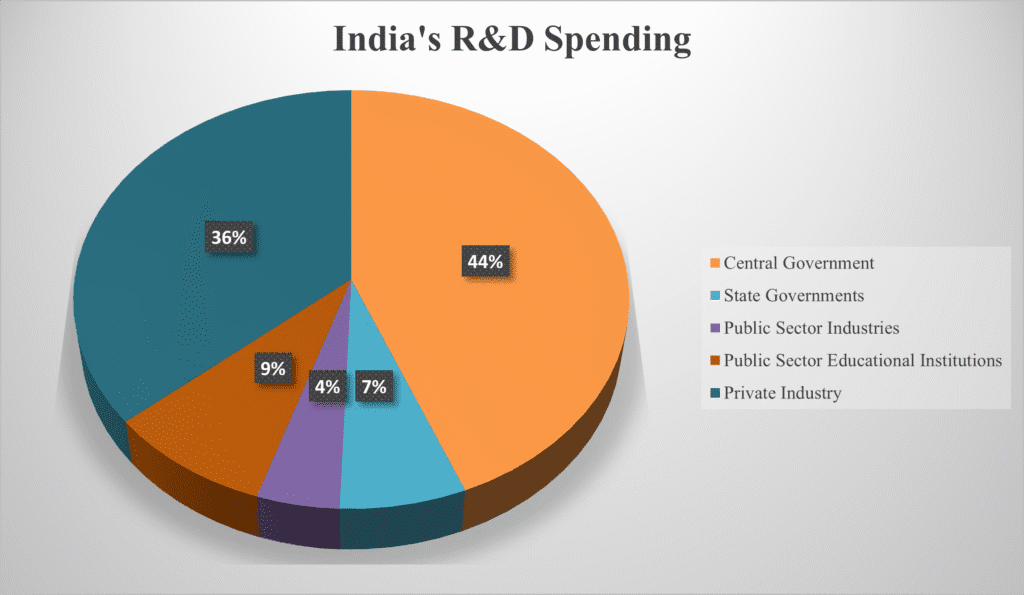
Over the past decade, India has more than doubled its R&D spending, rising from ₹60,196 crore in 2010-11 to ₹1.27 lakh crore in 2020-21. While the public sector, including Central Government (43.7%), state governments (6.7%), public sector industries (4.4%), and public sector educational institutions (8.8%), contributes 64% of this spending, only 36% comes from the private sector. Recently, Prime Minister Modi launched a ₹1 lakh crore Research Development and Innovation (RDI) Scheme Fund to support a private sector-driven research and development ecosystem in the country.
Sector-specific Centres of Excellence (CoE) are a major component of India’s AI-specific R&D efforts. The government announced its plan to establish three CoEs for AI in October 2024, focused on healthcare, agriculture, and sustainable cities, to encourage research-driven innovation within the country. An additional CoE for education was announced in 2025, with a budget of ₹500 crore to integrate AI into teaching and learning.
Moreover, the IndiaAI Dataset Platform of IndiaAI Mission hosts one of the world’s largest collections of anonymised datasets, helping AI research and innovation across sectors.
Training and Skill Development
Through the IndiaAI Future Skills programme, the government supports 500 PhD scholars, 5,000 postgraduates, and 8,000 undergraduates in AI-related fields. In parallel, Data and AI Labs are being established in tier 2 and tier 3 cities to decentralise AI research and innovation.
Semiconductor-focused skill development also forms a critical component of India’s AI-related manpower creation efforts. Under the Chips to Startup (C2S) programme, India is on track to train 85,000 engineers in semiconductor design and the use of advanced Electronic Design Automation (EDA) tools. Additionally, the Skilled Manpower Advanced Research and Training (SMART) Lab at NIELIT Calicut provides a specialised virtual prototyping facility, with the objective of training one lakh engineers.
Global Capability Centres (GCCs) operated by multinational companies—located in Indian cities such as Bengaluru, Hyderabad, NCR, Pune, Mumbai, and Chennai—employ a large number of Indian professionals in AI-related roles. India now hosts over 1,800 GCCs, employing approximately 2 million professionals, with nearly 70% of these centres focused on AI-related activities. Indian talent, therefore, plays a substantial role in the development, training, and maintenance of global AI models.
India’s AI Governance
Although India has yet to adopt a comprehensive and binding legal framework to govern its AI ecosystem, a techno-legal approach is gradually evolving to address initial challenges. While the Digital Personal Data Protection (DPDP) Act of 2023 regulates the collection, processing, and use of personal data, the Information Technology (IT) Act of 2000 and IT Rules of 2021 govern digital intermediaries and address concerns related to misinformation, deepfakes, and online harm.
The Data Empowerment and Protection Architecture (DEPA) also plays a limited role within India’s AI governance framework, as it defines how data can be accessed and shared for AI development, particularly in sectors such as finance and health.
A major step in articulating India’s AI governance approach was the release of India AI Governance Guidelines by the MeitY in November 2025. Although not an enforceable legal instrument, the Guidelines outlined a principle-based and risk-aware approach to the development and deployment of AI across sectors.
This trajectory was further advanced in January 2026 with the release of a White Paper titled Strengthening AI Governance Through a Techno-Legal Framework by the Office of the Principal Scientific Adviser. The document proposed addressing AI risks through a combination of baseline legal safeguards, sector-specific regulations, and technical controls embedded into AI system design.
Taken together, these developments point to an emerging but incomplete governance architecture. India still lacks a unified AI governance framework, a dedicated regulator, and clear rules on liability and accountability when AI systems cause harm, particularly in high-risk sectors such as healthcare, mobility, finance, and public service delivery.
India in Global AI Governance
India’s approach to global AI governance is shaped by three interlinked concerns: equitable access, population-scale skilling, and responsible deployment. Speaking at the AI Action Summit in Paris in February 2025, Prime Minister Modi emphasised the need for “collective global efforts to establish governance frameworks and standards that uphold our shared values, address risks, and build trust”.
A major concern that India shares is that rapid AI transition could deepen global inequalities. Therefore, it argues that there should be a collective effort to ensure that the Global South is not excluded from this technological transition.
During its G20 Presidency, India sought to build consensus around the principle of Harnessing AI Responsibly, for Good, and for All. Prime Minister Modi has called for a global compact on AI anchored in “effective human oversight, safety-by-design, transparency, and strict prohibitions on the use of AI for deepfakes, crime, and terrorist activities.” At the same time, India stresses that governance frameworks must balance risk management with innovation.
An AI Strategy in the Making
India’s approach to AI can be best described as a socio-economic strategy in formation. Viewing AI as a transformative force with significant economic potential, India treats it as central to its vision of Viksit Bharat by 2047. There are genuine efforts from the government to build strong AI capacity within the country, through substantial investments in computing infrastructure, semiconductor manufacturing, related skill development, and indigenous AI model development. It is expected that by creating a robust AI ecosystem domestically, India can emerge as a global AI powerhouse.
However, the institutional architecture required to govern AI at scale remains incomplete. It requires an effective legal framework that addresses AI-specific challenges without constraining possibilities for innovation and risk-taking. The absence of such a legal framework creates uncertainty around liability norms and is likely to limit the ability of AI startups to scale.
Ultimately, how successfully India can convert its political vision and evolving technological capacity into a productive, inclusive, and transparent socio-economic force will determine its role in the emerging global AI order.