

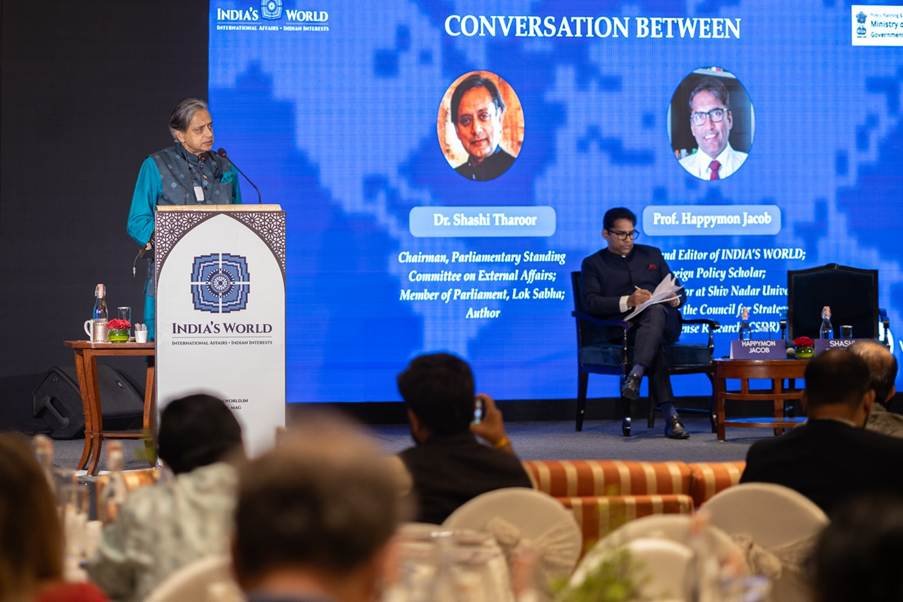
I’m very pleased to join this first edition of India’s World Annual Conclave, where we reflect on the forces shaping India’s engagement with our world. And when Happymon asked me for a speech, I said I’d much rather have a conversation with you, and we compromised on a short speech followed by a slightly longer conversation. So, this year’s theme, the mobility imperative, I think in many ways pushes us to think beyond physical movement and to consider how the flows of talent, capital, technology, and ideas are reshaping global alignments.
As India positions itself within this evolving landscape, mobility becomes more than a development priority. It becomes a lens through which we understand power, sovereignty, and choice. And it is in this context that the idea of strategic autonomy, which some wrongly consider a static notion, takes on renewed relevance.
In fact, in the shifting landscape of international relations, few ideas have evolved as dynamically as the concept we know as strategic autonomy. Once confined to academic debate, it now sits at the very heart of India’s foreign policy vocabulary. Strategic autonomy very simply refers to the ability of a nation to make sovereign decisions in foreign policy and defence without being limited by external pressures or alliance obligations.
It is not the same as isolationism, nor does it imply neutrality. Thank you. Rather, it speaks of flexibility and independence of the capacity to engage with multiple powers on our own terms.
Now, for India, this has always had very deep historical roots. It was shaped in many ways by the experience of colonial subjugation and the conviction that, particularly after 200 years of colonialism, that a free nation must never let others determine its place in the world. From Nehru’s non-alignment to the Modi government’s current approach of multi-alignment, and yes, Happymon is right, when I came up with that term a couple of decades ago, it sank without trace.
I had tried to use it at a conference of our ambassadors during my brief stint as a minister and was met by almost universal disapproval and condemnation of this solecism. But my argument was very simple. I had floated the idea earlier at the University of California in a lecture in which I argued that international relations had long since abandoned the Cold War binary of the earlier era, and that we were now in a world that resembled much more the Internet, the world of the World Wide Web, where we were connected to each other in a networked way, where I might be connected to him for some particular issues and purposes, he might be connected to him, but I may not be connected to him and he may see no particular merit in being connected to me.
Now, that sort of world is the world that I dubbed a world of multi-alignment. And I illustrated it in many ways. One simple example was in those days we used to have an annual meeting of the foreign ministers of Russia, India, and China in what was called RIC.
Then we would add the Brazilians and the South Africans and we’d get BRICS. Then we would subtract the Russians but not the Chinese, and we’d have BASIC for international environmental negotiations. And then we’d subtract the Chinese too and we’d have IPSA for South-South cooperation.
And India was the only country that belonged in all those configurations, not merely because its name began with that most indispensable element in any acronym, a vowel, but also because it had different things to gain out of each of these configurations and different things to contribute. And that was what I described as multi-alignment. Now, anyway, the fact is that successive governments have worked to preserve freedom of action while adapting to shifting geopolitical realities.
And that is essentially what one can call, as Happymon rightly said, either strategic autonomy, a phrase that goes right back to the late 40s, or multi-alignment, which is a more recent usage. But in either way, it offers a middle path between rigid block politics and passive disengagement. In practice, it demands deft diplomacy, resilient institutions, and a clear understanding of the national interest.
But, of course, the present international landscape brings its own mix of opportunities and challenges. The unipolar moment dominated by the United States has given way to a fractured and fluid order. China’s assertiveness, Russia’s revisionism, and divisions within the West, combined with Washington’s unpredictability, create a world that is increasingly difficult to navigate.
For India, this means constantly recalibrating relationships while safeguarding core interests, territorial integrity, economic advancement, technological progress, and regional stability. As global balances tilt, fracture, and reform, India finds itself walking a delicate tightrope among the United States, China, and Russia. In such a multipolar and volatile world, strategic autonomy is no longer an aspiration.
It is a daily diplomatic practice, complex, demanding, and consequential. We all know that India’s partnership with the U.S. has deepened significantly over the past two decades. Defence cooperation, intelligence sharing, joint military exercises, and technology transfers have all advanced.
The Quad, the Indo-Pacific Dialogues, the I2U2 grouping, and the India-Middle East Economic Corridor bear testimony to this maturing relationship, yet these are all enduring an inactive phase today. Shared concerns about China had also brought the two nations closer, yet the relationship has had increasing friction points. The Trump administration’s erratic trade policies, tariffs, and sanctions have strained economic ties.
Pressure from Washington to scale back energy and defence cooperation with Russia, or to fully align with Western positions, has tested India’s resolve. India’s response, I’d argue, has been measured and principled. It has continued to engage with the United States while maintaining independent positions on global conflicts.
It has insisted consistently on the primacy of national interest, and this, in many ways, is strategic autonomy in action. It is not an anti-American sentiment; it is simply a refusal to let another country’s priorities override our own. China, of course, presents an even more complex challenge.
The border clashes of 2020 shattered assumptions of benign coexistence, and tensions have remained high despite recent diplomatic progress. Yet China is also one of India’s largest trading partners and a significant regional actor. India has therefore pursued a policy of cautious engagement paired with firm deterrence.
It has strengthened border infrastructure, deepened its Indo-Pacific partnerships, and invested in indigenous defence capabilities. At the same time, India continues to participate in the BRICS and the Shanghai Cooperation Organization, where China has, of course, substantial influence. And talks on the border continue to make slow progress.
This careful balance is essential. And yet strategic autonomy here means avoiding the extremes of confrontation or capitulation. It means asserting sovereignty without becoming another country’s counterweight.
It means controlling China’s access to the Indian economy while keeping channels of communication open. Rivalry does not preclude diplomacy. Decoupling is not always feasible or desirable.
India’s relationship with Russia, which is all in the news these days with President Putin’s imminent arrival, is shaped by Cold War solidarity and longstanding defence cooperation. Despite Moscow’s growing proximity to Beijing and its global isolation after the Ukraine conflict, India has maintained its engagement. It continues to buy some oil, to import critical defence equipment, and to converse diplomatically.
This stance has invited criticism from the West, from both Washington and Europe. But India has remained firm. Its relationship with Russia is historical and multidimensional and is not subject to external veto.
Yes, India diversifies its defence imports and strengthens indigenous production. But it does so without abandoning old partners. Strategic autonomy here means refusing to choose sides in others’ binary contests.
During India’s G20 presidency in 2023, Prime Minister Narendra Modi also asserted that India had emerged as the voice of the global South. He described India’s democracy as a bouquet of hope, strengthened by its multicultural and multilingual character. External Affairs Minister Jayashankar has argued that partnerships must be based on interest rather than sentiment or inherited bias.
India’s is, I would argue, diplomacy with a spine. Assertive, pragmatic, and unapologetically Indian. It seeks to be non-West without being anti-West.
And it resonates across the global South, where rising and middle powers increasingly prioritize their own geopolitical and economic interests rather than be swept into great power rivalries. They seek agency, not alignment. Voice, not vassalage.
What emerges, therefore, from all of this is a vision of India as a sovereign pole in a rebalancing world. A nation that neither aligns blindly nor withdraws into isolation. Yet even as India pursues its strategic autonomy with principle, it faces significant headwinds.
The global economy is deeply interdependent. Technological systems are dominated by a few countries. Defence modernization requires partnerships.
Climate diplomacy demands coordination. Autonomy must therefore be understood not as isolation, but as resilience and adaptability. And indeed, as multi-alignment.
We must also recognize that domestic factors matter. This has been an increasing theme of my own articles on the subject. Political polarization, economic vulnerabilities, and institutional constraints can limit effective decision making and force us into defensive options rather than give us the kind of leverage we need at the negotiating table.
True strategic autonomy requires domestic economic strength, technological capability, and political coherence. We cannot be truly autonomous from a position of weakness. And in today’s world, shaped by cyber threats, artificial intelligence, warfare, space competition, the scope of autonomy must expand.
It must encompass data sovereignty, digital infrastructure, and secure supply chains. India’s recent efforts to build indigenous platforms secure critical minerals and assert its voice in global technology and in the governance thereof are meaningful steps forward. Strategic autonomy, if I may conclude, is not a slogan.
It is a strategy. It is the art of navigating a turbulent world without losing one’s bearings. As global power shifts accelerate, India must continue to walk the tightrope.
It must engage with the United States without becoming a vessel, deter China without provoking war, and partner with Russia without inheriting its problems and its isolation. It must invest in capabilities, cultivate partnerships, and assert its interests with clarity and confidence. For in doing so, India does not reject the world.
It reclaims its agency within it. Strategic autonomy is not about standing alone. It’s about standing straight and standing tall.
And yet it’s equally about ensuring that our internal strengths keep pace with our external ambitions. We must recognize that a confident India abroad is built upon a resilient and cohesive India at home. We must continue to expand our capacities, deepen our economic foundations, and strengthen the institutions that anchor our autonomy.
Only then can our choices be truly sovereign, and our voice carry the weight of a nation conscious of its destiny. As the French President likes to say to his Prime Ministers, I shall not keep you long, so I’m going to wrap up right there, and I shall turn over to Happymon to pursue the conversation. Thank you very much.