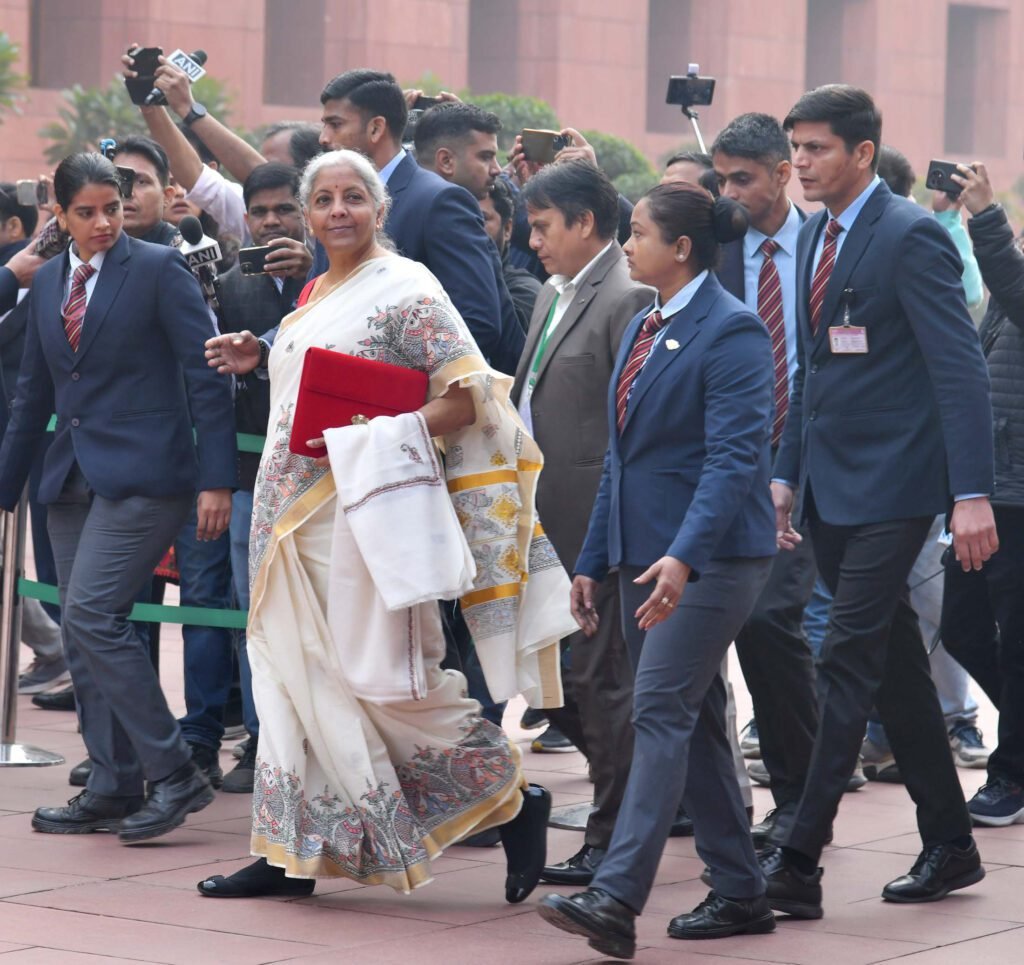
Artificial intelligence featured prominently in Finance Minister Nirmala Sitharaman’s 2026 budget speech. She described cutting-edge technologies, including AI, as “force multipliers for better governance.” Unlike previous years that focused on setting up new institutions, Budget 2026 signals a shift toward mainstreaming AI, with an expansion in compute capacity, embedding AI into education and public services, and using infrastructure and tax policy to crowd in private investment.
Notable AI-related initiatives in Budget 2026-2027
The following measures announced in the budget will help strengthen India’s AI ecosystem:
- ₹1,000 crore for the IndiaAI Mission (FY26–27) to continue support for domestic AI R&D and compute infrastructure. This is down from ₹2,000 crore in 2025, likely due to the underutilisation of previously allotted funds. Reports suggest only about ₹800 crore was actually spent from the earlier allocation.
- A High-Powered “Education to Employment and Enterprise” Committee, tasked with linking education, jobs, and new technologies. Its mandate explicitly includes embedding AI into school-level curricula, upgrading State Councils of Educational Research and Training for AI-oriented teacher training, and assessing how AI will reshape jobs and skills.
- Long-term tax incentives for data centres and cloud services. A tax holiday extending up to 2047 was announced for companies building data-centre infrastructure in India to serve global markets. The goal is to make digital and compute infrastructure—now deemed “strategic national infrastructure”—more attractive.
- Research, Development and Innovation (RDI) Fund. The new ₹1‑lakh‑crore RDI was outlined, with ₹20,000 crore allocated for FY26–27. It targets advanced technologies, including AI for agriculture, health, and education. This deep‑tech fund of funds aims to catalyse private R&D investment.
Together, these measures point to a clear intent: scaling AI by building foundational capacity, skilling future workers, and linking innovation to public-sector needs.
How does Budget 2026’s AI agenda differ from last year’s?
Many initiatives build directly on Budget 2025, but with shifts in emphasis. Last year, the government announced a ₹500 crore Centre of Excellence in AI for Education and five National Centres of Excellence for Skilling in AI, robotics, and cybersecurity. It also made an initial ₹2,000 cr allocation to the IndiaAI Mission.
By contrast, Budget 2026 focuses more on diffusion than on creating new institutions. The ₹500-crore AI‑CoE was not re-announced; instead, the new Education to Employment and Enterprise Committee was proposed to take the initiative forward. While Budget 2025 left the data-centre sector untouched, Budget 2026 introduced a long-term tax holiday for cloud and data-centre services, highlighting that AI compute capacity is now a strategic priority. Budget 2026 also raised the safe‑harbour threshold for IT services and doubled incentives for electronic component manufacturing—moves praised by industry as strengthening the broader AI computing ecosystem.
How will education and skilling adapt to AI?
For the first time, a Union budget explicitly mandates AI education from the school level onward. The proposed Education to Employment and Enterprise Committee is tasked with embedding AI into school curricula and upgrading teacher-training institutes nationwide. This builds on earlier initiatives such as the expansion of Atal Tinkering Labs, which were introduced in Budget 2025 to encourage technology exposure in schools.
Budget 2026 also emphasises skills for a tech economy. It affirms a target of 10% global services market share by 2047 through skilling and employment interventions. New fellowships, such as 10,000 technology fellowships at IITs, announced alongside expanded AVGC (animation, visual effects, gaming, and comics) labs, are intended to create sustained talent pipelines for an AI-driven economy.
Industry broadly welcomed this focus, arguing that AI-linked education and data-centre investments could have multiplier effects. However, the budget remains thin on implementation details. It does not outline curriculum requirements, timelines, or funding pathways beyond committee recommendations—leaving execution as the key uncertainty.
What research, infrastructure and industry incentives support AI?
Budget 2026 significantly strengthens the infrastructure underpinning AI. Beyond the RDI Fund, the government reaffirmed support for semiconductor, quantum technologies, and data‑centres as foundations of an “AI-led” economy. It announced an additional ₹40,000 crore for electronic components manufacturing and indicated that an Indian Semiconductor Mission 2.0 is forthcoming—critical for ensuring chip supply for future AI hardware.
In her budget speech, the finance minister explicitly linked several existing schemes to AI. She noted that the IndiaAI Mission, National Quantum Mission, Anusandhan NRF, and RDI Fund together bolster frontier technologies such as AI. In practice, the IndiaAI Mission’s earlier focus on subsidised compute and native AI model development is expected to continue, while tax incentives emerge as the primary lever to attract private infrastructure investment.
How will AI be used in government services and industry?
The budget frames AI as a form of public infrastructure. A flagship example is Bharat-VISTAAR, a proposed multilingual AI platform that integrates agricultural databases, including AgriStack and ICAR practices, to provide farmers with customised advice on crops, weather risks, and productivity.
AI deployment was also highlighted in social and logistical domains: from scaling assistive devices through ALIMCO to enabling non-intrusive security scanning at ports. These initiatives reflect a deliberate strategy to operationalise AI in sectors such as agri‑tech, healthcare, disability support, logistics, and welfare delivery.
Industry leaders welcomed these use cases. NASSCOM praised the focus on farm advisory AI, describing it as a push for “digital and AI-driven solutions to strengthen productivity.” Entrepreneurs also applauded creative-tech initiatives: for animation and gaming, the budget expanded AVGC labs to 15,000 schools and 500 colleges. Akshat Rathee of NODWIN Gaming called this a “strong step toward building India’s creative and digital talent pipeline”.
Will the AI startup ecosystem benefit?
The budget invited mixed reactions from the broader startup ecosystem. On the positive side, the push on AI infrastructure is expected to lower some entry barriers over time, as more data centres and higher compute capacity could reduce costs and speed up AI development.
However, many founders noted the absence of startup-specific interventions. Budget 2026 did not announce predictable government procurement pathways for AI startups, direct compute-grant schemes for early-stage R&D, or new venture-funding mechanisms tailored to AI entrepreneurs. Expectations around a ₹20,000-crore dedicated deep-tech venture fund were also left unmet.
From a startup perspective, the budget treats AI primarily as public infrastructure rather than as an entrepreneurial ecosystem. While this approach may accelerate adoption in governance and large industry, it makes little effort to address everyday challenges faced by AI builders, including affordable compute access in the short term, regulatory clarity, and early customer discovery.