
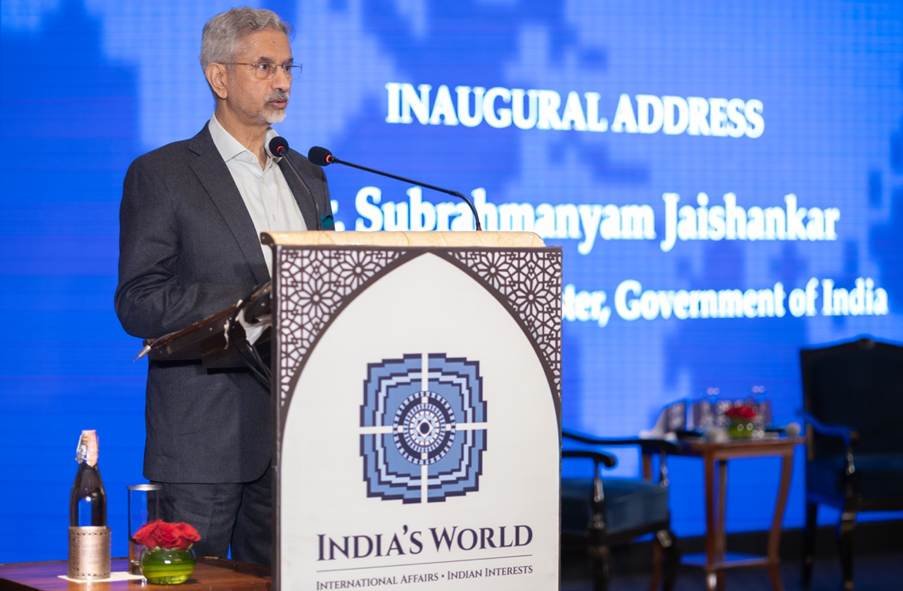
A very good morning to all of you. The last time I was here, whatever, 11 months and however many days ago, I said very nice things about the magazine which I had the occasion to preview. Today, let me begin by saying very nice things about the theme you have selected, and there’s a reason for it.
In a globalized world, I think we often, when we talk of our external engagement, especially our economic engagement, we tend to really focus on trade. Now, there’s nothing wrong with that. But we often neglect work and the mobility associated with work.
Just to give you a sense of what it is to which we don’t pay enough attention, last year, remittances to India were $135 billion. That’s about roughly twice our exports to the United States. Now, it’s just the remittances.
Because think of the people abroad, their own livelihood, the assets they have created there, the services which have been generated in India, the second, third order consequences of all this. And I leave it to you to imagine what is the size of this business which is called mobility. And I put it to you, you know, it is clearly multiple X times the remittance.
Now, that’s the positive side. There’s also, like in life, a downside to it. Because when mobility is legal, when mobility is formal, then it has a whole lot of beneficial impacts, which I will talk about.
But when it is not, then I think it is almost a magnet for every kind of bad business to be associated with it. So, if you look at trafficking per se, all the associated crimes, and often it leads people with agendas of various kinds, political agendas, separatist agendas, they all join up to the illegal mobility side of it. So, the very fact that you have today recognized the importance of mobility, for me, is a cause of satisfaction.
Now, obviously, there are two aspects to this mobility, or three aspects to this mobility. One is demography. I mean, there are places where there’s demand, but there aren’t enough people.
The demography and the demand are mismatched. The second, to some degree, is competitiveness and talent, that other people offer something which makes it worth, you know, the while of the hosting society to get them. And the third is actually social attitudes towards work, which is, in many cases, there may be people, but they don’t want to do that kind of work, or they don’t want to do it at that cost, in that number, under those conditions.
So, the fact is, today, mobility is an increasingly important factor of the international economy. Now, we know there is a market for mobility, but I think from the viewpoint of the government, there are three consequences which emerge from that. One, how can we be enablers of mobility? How can we improve the skill sets of people who are potentially mobile? How can we provide them with the facilities to make them mobile? The second, arrangements, arrangements, formal arrangements, sometimes between governments, between governments and companies, enterprises.
And the third, to the people who are mobile, who go out of the country, how do you equip them with the confidence and the assurance to operate in a global workplace? So, in a sense, it begins from creating a global workforce, preparing a global workforce at home, and then ensuring when the workforce is deployed in the workplace, that it is done so as efficiently and as securely as possible. So, I want to share with you today some of the things which have happened in the last ten years, because particularly to the Indians in the room, many of you would take it for granted, or many of you may not even be aware of it. But these are very deep changes which have been of great impact when it comes to mobility.
Ten years ago, if you wanted a passport, there were, I think, 77 places in India to which you could apply. Today, in the last ten years, we have added 468 more such places. So, pretty much any citizen of India is actually today able to apply for a passport by journeying at best a few hours, as compared to what it was ten years ago when actually you had to make a trip to, if not a metropolis, at least to a good-sized town, and probably spend a few days in order to just get a passport.
So, this expansion of a passport, because passport is where your mobility begins, international mobility begins. Moving on from that, you know, getting a passport used to be a very hard challenge in this country. I mean, I tell people when many of us, I see Vikas Sarup sitting here, when many of us joined the foreign service, people in your locality said, aha, we now know someone who will help us get a passport.
Okay. Today, I mean, nobody even talks about it. In fact, if somebody doesn’t get a passport within a week or ten days, you know, I get some angry social media comments.
So, the speed at which we do passports, the clarity of documentation, we’ve streamlined it, and, you know, when we speak today about digital governance, in fact, in many ways, it is our passport program which is a poster child of digital governance. Now, it isn’t just in India. We also used to have a situation where if you lost your passport, it was, you know, it was very difficult to get it replaced or renewed abroad.
And if you lived in one country, you couldn’t get it done in another country. Now, that’s gone. Just like in India.
You can today apply for a passport anywhere because we know people are also internally mobile. So, you don’t have to go to your home state or your district or your hometown to renew your passport or apply for your passport. You can do it from anywhere.
The fifth one is when people are abroad, they will have problems. There must be a channel to address those problems. And, you know, it cannot be episodic.
It cannot be I know somebody, so I complain and they look at me. There’s got to be a system to it. One of the big changes is a portal we started about a little more than 10 years ago called Madad, which means help.
It’s an acronym. And just to give you a sense of how much that portal is being used, I was clearing parliament questions for the week, tomorrow and the day after are my parliament days. In the last three years, only in the Gulf, we have addressed 138,000 grievances using the Madad portal.
So, that gives you the kind of scale of both the demand and the ability today to respond. Now, another, I would say, mechanism which we have expanded its usage is something called the Indian Community Welfare Fund. We collect a cess on passport and consular services and that is used to address the needs of people who are in distress.
And again, I’m just, you know, giving you a figure because I was looking at it early this morning for my parliament questions. In the last three years, 238,000 people have benefited from the use of this Community Welfare Fund. People for whom we may have bought tickets back home, who had legal cases abroad, in some cases they may have passed away, so their last rights were done.
So, I mean, there’d be a variety of stuff. So, the point I’m making is that when we speak about mobility, it isn’t a question of giving a speech and telling people, you know, it’s a great idea and, you know, we have comparative advantages and we should be going out. Unless you back it up with a whole lot of practical steps on the ground, unless you, as I say, prepare a workforce, equip a workforce, secure a workforce outside, you are not doing justice to the issue of mobility.
And sometimes it can be exhortative as well. You know, we often today make it almost an SOP to visit labour camps. I think even when the Prime Minister goes abroad, particularly to the Gulf countries, you would often see him making it a point to visit a camp where people are working on-site.
Often, it’s a construction site or a big service site. And, you know, when that starts from the very top, I think the rest of the system certainly gets the message. And this combination, you know, the combination of doing things physically, of using, you know, digital platforms.
I spoke about grievances. Even for consular services. You know, when you live abroad, you need attestations of various kinds, you need people to certify documents of various kinds.
Today we have a program called e-ceiba where people upload it online, they get their reply online. So, the embrace of digital mediums, the creation of a physical infrastructure, the improvement of services, the motivation that is given, all this today is preparing a global workforce. Now having said that, things do go wrong, you know.
And one of them, unfortunately, are conflicts. So, for a country today which has really millions of people working abroad, we cannot afford to be impassive or agnostic when there is a conflict. So, it has become, in a way, you know, for us, not, I won’t even say it’s a duty or obligation, we take it as a standard procedure that if there is a conflict, the moment we see that coming, our systems get ready to go to secure our people.
And again, you know, in the last three years, and I’m talking after Ukraine, you know, Ukraine, roughly we brought back 20,000 people. In the last three years, we’ve brought back 28,000 people from different conflict zones. So, this kind of gives you the kind of scale of the responsibility which happens, you know, when you have a mobile global economy and a mobile workforce which is operating in that economy.
Now, having said that, let me deal with other aspects of it, the diplomatic aspects of it. Clearly today, intergovernmental agreements dealing with mobility are a very important part of our diplomacy. We have 21 such agreements in addition to which we have mobility provisions in some of the free trade agreements that we have done.
And we certainly, in many relationships, see that as actually adding a new dimension to the relationship. I see the ambassador of Japan sitting in front of me. When Prime Minister Modi this year went for the annual summit, the understanding that we have for a greater flow of talent from India to Japan in various professions was very much a centrepiece of that visit.
Moving on from that, you know, all this would happen as I said, if we prepare a workforce, we better prepare a workforce. So, the emphasis that we have on skilling in India, you know, which is of course dealt with by a different ministry, but we are really part of a whole. We are the, you can say, the external face of the mobility.
But the back office of the mobility is the educational and the skilling system. And today the attention which is being given to improving skilling and customizing it where possible to the needs of a potential user is something which is important. Now recognizing all of this, of course, we are also in the process of rewriting our legislation which underpins mobility.
We have, the current legislation is more than 40 years old and it envisaged mobility, the very name was, it was an immigration act. Whereas today we see it much more as a mobility because we see it as a two-way process. The people who go out often do come back, sometimes for shorter durations, sometimes for longer ones.
So, we have an overseas mobility bill today which we have put out there for public comments. It is something when we are ready, we propose to bring in as a legislation. Now so far, I have spoken about the mobility of people.
But I also want to highlight that work can also be mobile. That, you know, if the talent doesn’t go out, the outcomes to the talent. And we have seen this growth in what are called global capability centres in the last few years.
I understand today that there are in this country about 1,700 global capability centres which are about half, they constitute about half the global capability centres in the world. And these are centres where global business has found it more effective, more efficient, really to send the business out and to utilise the talent in a different geography. And obviously given the availability of the talent and the efficiency of it in India, we are a strong attractor of that.
Again, there are estimates that about 2 million people are currently employed in global capability centres. And I think the rough revenue estimates which people put for global capability centres are between $65 to $75 billion currently a year. And looking ahead, I mean certainly as we are moving to an era of AI, of higher skills, of advanced manufacturing, and of, as I said, of social services of various kinds.
We do anticipate a world which will put a greater premium on mobility. And we see ourselves, you know, we are one-sixth of the world’s population. But I think if you look in terms of the younger working age population, we would be somewhere between one-sixth and one-fourth.
We’d be closer to one-fourth of the global workforce of a certain demography. So, our relevance to the global talent skill market is only going to grow with all of this. And having said all of that, I also recognize that, you know, mobility has its own politics.
It has its politics in the receiving society, in the hosting society as well. Managing that is also part of the diplomatic challenge, something that we are gearing up to do. So these were some of the thoughts I thought I would share with you today taking advantage of the team and the occasion.
Once again, thank you for inviting me to speak at the opening. And I look forward to the conversation with Professor Rajamohan.