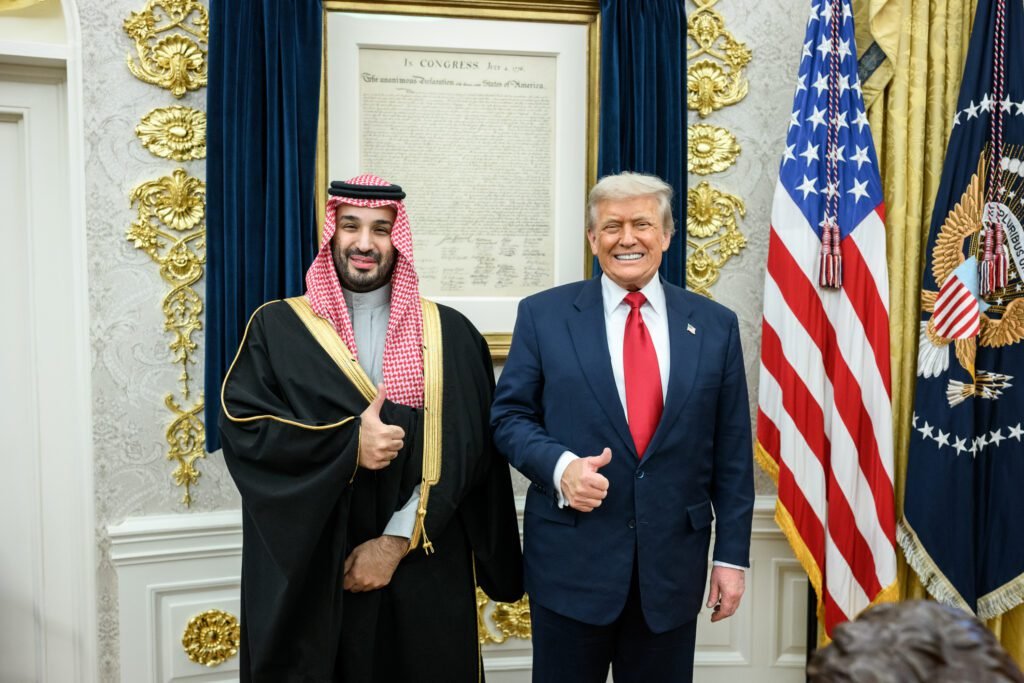
On 18 November 2025, Saudi Crown Prince Mohammed bin Salman (MBS) arrived in Washington for a meeting with President Donald Trump at the Oval Office. The visit marked a visible recalibration of American policy toward Saudi Arabia and underscored how far the relationship has shifted since 2021, when President Joe Biden referred to the Kingdom as a “pariah” in the context of journalist Jamal Khashoggi’s assassination. Although Biden sought to repair ties in 2022 through the Jeddah Communique amid oil market turbulence and the Ukraine war, mistrust lingered.
MBS’s visit combined high-level diplomacy, defence cooperation, and a series of large-scale economic deals, underscoring Riyadh’s ambition to be seen not merely as a regional actor but as an emerging power with global reach.
WHAT DOMINATED THE DISCUSSIONS?
The White House welcomed MBS with full ceremonial honours, featuring marching bands, flag-bearing horsemen, and a military flyover. The spectacle underlined the strategic importance Washington now attaches to Riyadh and signalled an interest in beginning a new phase in the relationship.
Trump and MBS discussed investment, defence, regional stability, AI and technological cooperation, and held a brief interaction with the press at the South Portico.
A major highlight was MBS’s signal of potential progress on joining the Abraham Accords, while reiterating that any breakthrough must reinforce a two-state solution for Palestinians. The positive tone of the meeting was reflected in Trump’s announcement that the US would recognise Riyadh as a “major non-NATO ally”, placing it alongside 19 other close American security partners such as Australia, South Korea, and Israel.
At the Saudi-US Investment Forum at the Kennedy Center, dozens of agreements were signed in the presence of both leaders. A Saudi government-backed AI firm, HUMAIN, finalised a landmark purchase of 600,000 Nvidia AI chips. Elon Musk agreed to build a 500-megawatt facility and data centre in the Kingdom, along with a rare-earth refinery. Oil giant Saudi Aramco signed 17 MoUs with major US companies, with deals valued at nearly $30 billion.
Trump also confirmed that the US would authorise the sale of 48 F-35 stealth fighter jets, making Saudi Arabia the first Arab nation to acquire the aircraft. However, analysts believe Washington will not grant Saudi Arabia the customisation rights that Israel currently enjoys. MBS also signalled plans for substantial long-term investment in the US economy, estimated at $600 billion and potentially rising toward $1 trillion. Negotiations on a civil-nuclear cooperation framework also advanced with the signing of a Joint Declaration.
How are US-Saudi Relations Being Reframed?
US-Saudi ties have been centred mostly on energy and geopolitical interests. However, the partnership has experienced a few moments of strain, such as the oil shock of 1973, post- 9/11 tensions, and the fallout over journalist Khashoggi’s killing in 2018.
Seven years have passed since the Khashoggi incident, and MBS is now positioning himself as broker of peace pacts; improving ties with Iran, pushing for a Gaza ceasefire, welcoming Syria back into the Arab League, and attempting to steer a more stable regional order.
For the Trump administration, the Middle East in 2025 is fraught with risk: an assertive Iran, the threat of Hezbollah in Lebanon, the Houthis in Yemen, and growing Chinese influence across the region. Washington, therefore, views Saudi Arabia as a crucial partner for stabilising a rapidly changing Middle East.
For Riyadh, the stakes are equally significant. The Kingdom, which is trying to diversify its economy away from oil under its Vision 2030, requires US capital and expertise in innovation and technology. Moreover, following the Iranian attack on Aramco facilities in 2019 and the Israeli strikes in Qatar in 2025, Riyadh recognises the need to prioritise its security cooperation with the US to secure its interests in the Gulf.
What are the Regional and Strategic Implications?
The visit occurred amid shifting power balances. China’s footprint in the Gulf has expanded through investments and high-level diplomacy. Russia remains influential through its central role in OPEC+ and as an arms exporter in the region.
Though US and European powers are trying to counter Chinese influence in the region through initiatives like India-Middle East-Europe Economic Corridor (IMEC), tangible results have yet to materialise.
Saudi Arabia recognises that regional stability is essential for attracting large-scale investment and positioning the Kingdom as a hub for inter- and intra-regional connectivity. However, recent shocks—such as the fall of the Assad regime in December 2024, the June 2025 Israeli attacks on Iran and Iran’s violation of Qatari airspace in June 2025—have reinforced Riyadh’s need for reliable security partnerships and credible deterrence. This urgency partly explains why Saudi Arabia signed a Strategic Mutual Defence Agreement with Pakistan in September 2025 and the significance of MBS’s current visit to Washington.
WHAT LIES AHEAD?
While differences remain over human rights and regional issues, the trip has created a platform for structured dialogue and collaboration in several domains. Moving forward, the relationship is likely to evolve along several lines—from security coordination regarding Iran, Yemen, and tensions in the Red Sea, to cooperation on energy security through nuclear energy projects and engagements on rare-earth minerals.
With renewed ties to Washington, Saudi Arabia is expected to play a more visible role in mediating regional conflicts while re-engaging with initiatives like the Abraham Accords.
Ultimately, the November 2025 visit was less about ceremonial optics and more about redefining the strategic alignment between Washington and Riyadh at a moment when both are recalibrating their roles in a transforming Middle East.