India’s relationship with foreign technology has ebbed and flowed over the years. India’s five-year plans marked a post-independence era of rebuilding with foreign assistance, transitioning to a period of self-reliance and self-sufficiency, opening up during the Green Revolution, liberalising in the 1990s and building new kinds of partnerships in the 2000s. This highlights the trajectory of India’s openness to foreign technology.
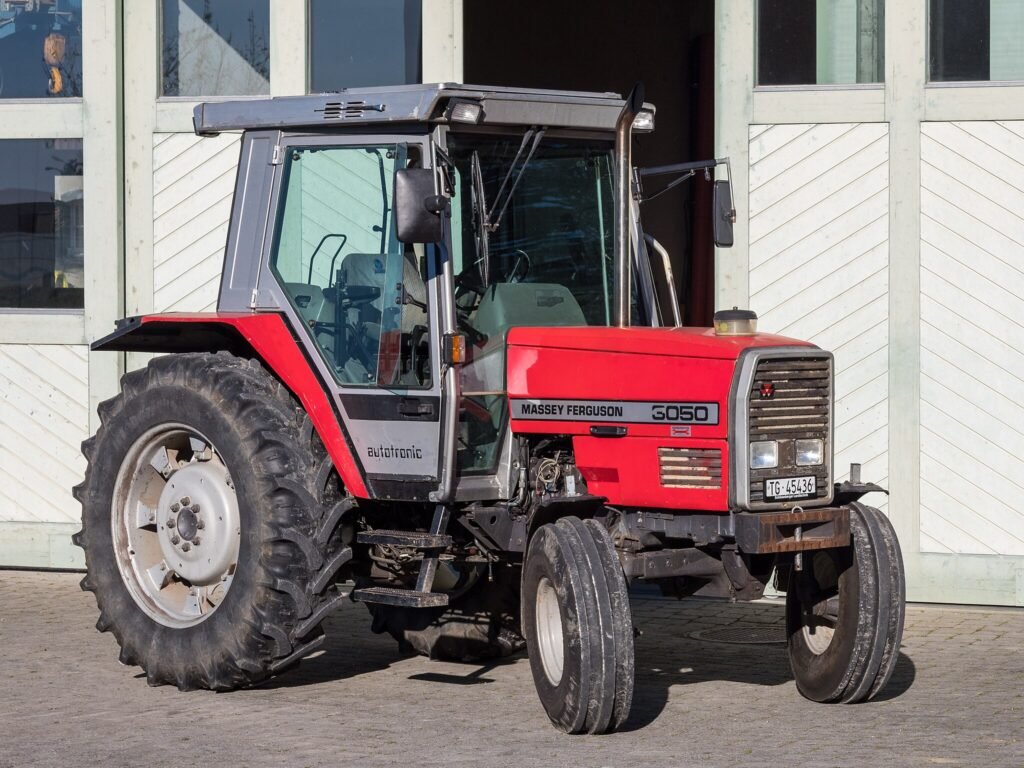
India’s acceptance of foreign innovation and eagerness to learn from it is perhaps best demonstrated by the modern-day tractor, which has steadily enabled mechanisation or automation in the agricultural sector. The tractor industry has been considered “a barometer for the state of the rural economy in India” and is reflective of whether agricultural livelihoods are thriving or barely surviving. Over the years, India has imported farm mechanisation tools such as tractors, power tillers, mechanical threshers, electric pumps, seed sowing machines and harvesters from its global trade partners to bridge the gap in agricultural productivity and exportable yield. But the evolution and rise of the tractor industry in India is especially noteworthy.
From British Surplus to Early Experiments
Looking at tractors in the southern state of Tamil Nadu specifically (and its early years as the broader Madras presidency), the adoption and evolution of foreign technology for domestic growth is clearly documented in the state administration reports. Tractors were first introduced into large farm estates in India by the British in the early 1900s. Tractors and threshers were believed to be powerful farm technologies that required low-skilled labour to operate. This enabled a swift shift from labour-intensive and time-consuming human or bullock-powered ploughing to a mechanised and productive agricultural tool. Soon after India’s independence, the Madras Administration Report of 1947 noted that “54 tractors, including 30 bulldozers, were acquired by the department from army surpluses and hired out for ploughing, bunding and levelling operations at concessional rates.” This period saw India benefit from surplus machinery and spare parts left behind after the British departure. The Madras Administration Report of 1948–49 highlighted the Grow More Food campaign, which saw the state agriculture department’s plan to increase rice production by 5.5 lakh tonnes by 1951–52. Mechanical ploughing and land reclamation were key initiatives of that year. The department thus imported 8,635 tonnes of iron and steel to sell as spare parts (e.g. cart tyres and axles) for agricultural implements. Within a year, the department amassed 152 tractors for cultivators to hire for “levelling, terracing and ploughing” their fields across the presidency. The utility of the tractors also improved as operators gained more experience. This effectively brought 35,569 acres under cultivation (compared to 4,360 acres in 1946–47), yielding 8,892 tonnes of produce. To maintain operational efficiency and service the tractors, the government established two regional tractor workshops at Coimbatore and Bapatla. These workshops were also set up to restore old units from the British era to working condition. These measures helped accelerate agricultural activities and quickly increased the yield of food crops while benefiting from leftover foreign technology.