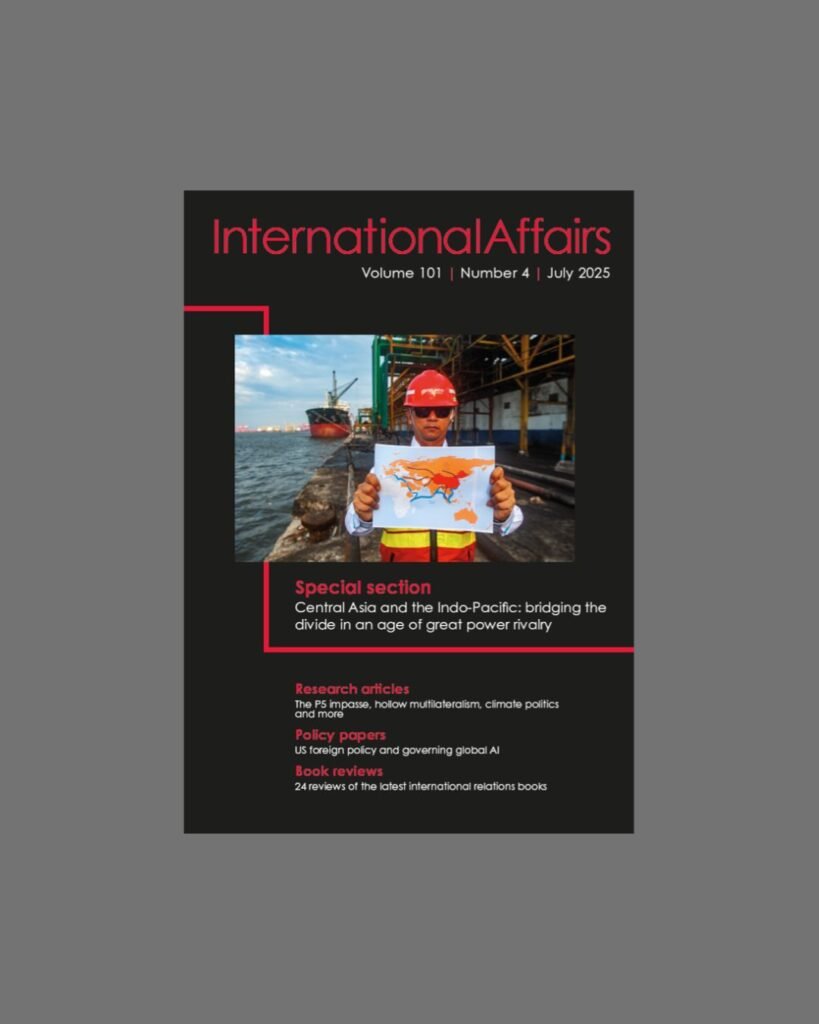
Andrew Gawthorpe and Catherine Wood, in their policy paper ‘Competing and Complementary Regions in US Foreign Policy’ published in International Affairs (Volume 101, Issue 4, July 2025), discuss the strengths and limitations of what they refer to as the ‘competing regions discourse’ in US foreign policy, making a case instead for recognising the complementarity of regions in order for the US to realise its foreign policy goals.
As the authors put it, the ‘competing regions discourse’ refers to the common assumption in US foreign policy discourse that there is a competition for American resources and attention between different regions of the world. This framework underpins arguments such as the need for the US to disengage from Europe and the Middle East in order to ‘pivot to Asia’ or that the failure of such pivots is a result of ongoing entanglements elsewhere. Viewed from this logic, US foreign policy goals always appear as a trade-off where prioritising one region necessarily entails neglecting another.
While not entirely dismissing the utility of the competing regions discourse, Gawthorpe and Wood highlight the limitations of such a foreign policy approach. First, they note that it has seen limited practical success, with continued crises in Europe and the Middle East making the goal of divesting resources away from these regions largely impossible. Second, it is based on and reinforces the view that regions exist in isolation, thus recognising neither the interconnectedness of the problems facing the US in these regions nor the potential for interregional cooperation. Finally, despite the emphasis on ‘regions’ in US foreign policymaking, this discourse has translated mainly into greater focus on Europe, the Middle East and the Indo-Pacific/Asia, to the neglect of Africa and Latin America.
Instead of this zero-sum mindset, the authors call for an interregional approach, arguing that simultaneous action in multiple parts of the world is required to tackle the challenges facing the US and its allies. Instead of viewing different regions as competing for American resources, what is required is concerted action across regions, much as the US’s adversaries are doing today. The authors argue that cooperation across regions can strengthen US influence and resilience.
The authors provide multiple examples to demonstrate the same. They point to the increased cooperation between Russia, China, North Korea, and Iran—countries spread across regions but coordinating closely in the wake of Russia’s war in Ukraine. Similarly, they argue that the challenge the US faces from a rising China cannot be boxed into an Asian or Indo-Pacific strategy but requires wider, interregional solutions. Thus, for instance, given how both the US and Europe have deindustrialised, pooling manufacturing capabilities is one way they can confront China’s military power.
After delineating their understanding of the competing regions discourse and presenting the idea of ‘complementary regions,’ the authors examine the foreign policy approaches of Presidents Biden and Trump. They highlight how the former aligned more with an interregional approach while the latter has so far shown little sign of continuing in that direction.